HMHS Britannic: Titanic's Lost Sister
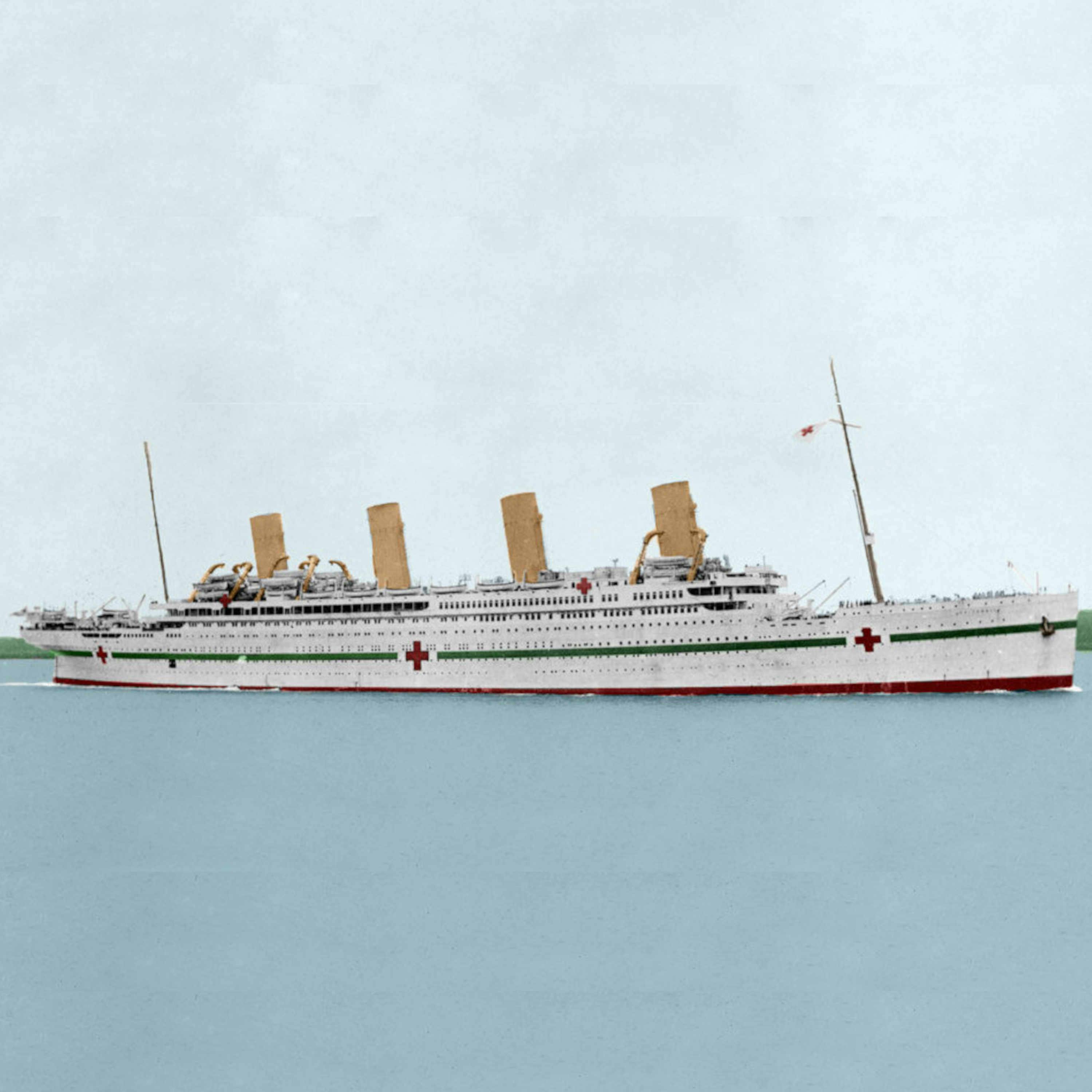
HMHS Britannic struck a German mine and sank on 21 November, 1916, during World War 1.


HMHS Britannic was built by Harland & Wolff for the White Star Line as an OIympic Class ocean liner. Her older sisters were RMS Olympic and RMS Titanic. Britannic never realized the glory of translatlantic passenger service, as she was requisitioned by the Admiralty as a hospital ship for service during World War I. On 21 November 1916, Britannic struck a German mine in the Aegean Sea sank. Thirty sailors and medical staff were lost, but 1,036 survived.
As noted in the episode, the following is a link to the article by Mark Churnside and Paul Lee regarding the "Gigantic" name controversy. https://www.paullee.com/titanic/gigantic.php
Written, edited, and produced by Rich Napolitano. All episodes, notes, and merchandise can be found at shipwrecksandseadogs.com.
Original theme music by Sean Sigfried, and you can find him at https://www.seansigfried.com.
**No AI was used in the production of this episode.
Shipwrecks and Sea Dogs is a maritime history podcast about shipwrecks, tragic loss, and incredible accomplishments on the world's oceans and waterways.
Follow Shipwrecks and Sea Dogs
- Subscribe on YouTube
- Follow on BlueSky
- Follow on Threads
- Follow on Instagram
- Follow on Facebook
Cold Open
It is 8:00 AM, 21st of November, 1916. His Majesty's Hospital Ship Britannic is steaming through the Aegean Sea, bound for the island of Lemnos to transport a load of sick and wounded soldiers back to England. The disastrous Gallipoli campaign is over, but still, desperate fighting rages in the Middle East.
On board, the morning is quiet and calm, as the orange-yellow glow of the sun reflects off the rippling waters to the east. Nurse and stewardess Violet Jessop is preparing breakfast for another nurse below deck, when her work is suddenly shattered by a violent explosion. The Britannic shudders with tremendous force; dishes and equipment crash to the floor around her.
Realizing immediately that something is wrong, she rushes up to the boat deck. There she sees that the ship is already beginning to list. Crew members hurry about preparing the lifeboats while the nurses gather together and wait calmly for instructions. Although there is no panic among them, the seriousness of the situation is clear. Water is already pouring into the ship through the lower compartments and through portholes that had been left open for ventilation.
As the crew organizes the evacuation, two lifeboats are lowered without authorization from the bridge. Because the ship’s engines are still churning, the vessel continues moving forward through the water. Jessop and others watch in horror as the two boats drift toward the stern, where the giant propellers are still spinning. The powerful current pulls the boats closer until they are smashed and drawn beneath the water.
Jessop is in another boat nearby when she realizes the danger. After just witnessing the horrific carnage from the suction of the propellers, she makes a split-second decision and jumps into the sea. The water is violently churned by the movement of the ship and the sinking hull. As she goes under, the powerful suction created by the ship pulls her beneath the surface.
While underwater, Jessop strikes her head against the ship’s keel as the enormous hull passes above her. The blow leaves her stunned, and for a moment she believes she may not survive. Somehow she manages to fight her way back to the surface. Gasping for breath, she swims away from the sinking vessel until she is eventually pulled into another lifeboat.
From the safety of that boat she watches as Britannic continues to sink rapidly. The bow dips deeper and deeper while the stern rises high above the water, exposing the massive propellers that moments earlier destroyed the drifting lifeboats. In less than an hour from the explosion, the great hospital ship disappears beneath the surface.
HMHS Britannic: Titanic’s Lost Sister - today on Shipwrecks and Sea Dogs.
Intro
Hello and welcome to Shipwrecks and Sea Dogs, tales of mishaps, misfortune, and misadventure. I’m your host, Rich Napolitano.
The Oceanic Steam Navigation Company, more commonly referred to as the White Star Line, had its share of maritime disasters throughout its history. Of course, the Titanic is the most famous of these, but many more met their end at the bottom of the deep blue sea. The Atlantic, Naronic, Republic, Oceanic, Laurentic, just to name a few. The Olympic class of ocean liners was hit particularly hard. RMS Olympic did not sink, but survived a serious collision in 1911, and made it through World Wars I and II, bruised, but still floating. You know what happened to the Titanic, but this is the story of her lesser known third sister; His Majesty’s Hospital Ship Britannic.
Main Body
In 1907, Director of the White Star Line, Joseph Bruce Ismay announced his plan to build three luxurious ocean liners of enormous size. This was in response to White Star’s biggest competitor, the Cunard Line, and its ships, Lusitania and Mauretania. Ismay was going to build the largest and most luxurious ocean liners on the water.
The ships would be built at Harland & Wolff of Belfast, Northern Ireland. The immense planned size of the ships caused Harland & Wolff to build a new 2-slip gantry, named the Arrol Gantry, in order to accommodate their enormity, and allow two ships to be constructed at the same time. Construction of the Olympic began in 1908, and Titanic in 1909; completed in 1911, and 1912, respectively. Britannic was laid down on November 30, 1911 at Yard number 433 at Harland & Wolff.
Design Changes
Construction on Britannic was only in its fifth month when the Titanic was lost on April 15th, 1912. White Star Line immediately halted construction of Britannic, pending investigation into the sinking. The American and British Board Inquiries recommended sweeping safety regulations requiring every ship was to carry enough lifeboats and life vests for everyone on board, 24 hour radio monitoring, mandatory response to red distress rockets, the creation and funding of an International Ice Patrol to monitor the Atlantic and Arctic Oceans; and the refitting of ships to include a double bottomed hull and an extension of bulkheads to make them higher and truly watertight.
These new safety regulations mandated changes to Britannic’s design. Its beam, or width, was increased to 94 feet, an inner, watertight skin was added to surround the boiler and engine room, and five of her 16 bulkheads were raised to the height of B deck to prevent water from flowing over top and flooding the next compartment. Her length of 882 feet 9 inches was not altered, making her the same length as Olympic and Titanic.
Despite the changes, Britannic was to be extremely similar to her sister ships in appearance and interior accommodations. One very noticeable difference were its 8 sets of gantry style davits meant to carry 48 extra large lifeboats in total. These are crane-like machines with electric motors, and each could handle up to six lifeboats. Because of her slightly increased tonnage, she received a larger 18,000-horsepower turbine engine, an increase from the 16,000 horsepower model of her earlier sisters, and built by Harland & Wolff instead of John Brown & Company. Britannic’s after shelter deck was covered, to provide third class passengers a covered, exterior, public space for lounging.
Launch
Britannic was launched on February 26, 1914. A rocket was fired to celebrate the launch, as the giant ship moved down the slipway. She was then moved to the Abercorn Basin to begin her fitting out. Hundreds of electricians, carpenters, plumbers, and other workers gave her the final touches. The press and the public were impressed by the ship, calling her “a twentieth century ship in every sense of the word” and “the highest achievement of her day in the practise of ship building and marine engineering.”
Britannic’s fate was again interrupted with the outbreak of World War I on July 28, 1914. Admiralty contracts were given higher priority to produce ships and materials for the war effort. Work on Britannic continued, but slowly.
By September of 1914, Britannic was put in drydock in order to install her propeller. RMS Olympic was recalled to Belfast in November of 1914, and her transatlantic service was paused. She was painted with a gray wartime livery for reduced visibility, and resumed limited commercial voyages.
Fitting out of Britannic as a commercial ocean liner continued into 1915. In May, she successfully completed mooring trials. On May 7, the Cunard liner RMS Lusitania was torpedoed and sunk by German submarine U-20. Commercial travel collapsed, and Olympic was brought back to Belfast until further notice.
The ongoing Gallipoli campaign in the Dardanelles in 1915 experienced terrible losses. Lacking sufficient troop transport ships, the Admiralty requisitioned RMS Aquitania and RMS Mauretania of the Cunard Line, and then RMS Olympic in September. In November, Britannic was also requisitioned, but with casualties mounting, she was designated as a hospital ship, and reclassified to His Majesty’s Hospital Ship Britannic.
Immediate work began to convert the passenger ship into a hospital ship. 3,309 hospital beds and public spaces on the upper decks were converted into rooms for the wounded to recover. Cabins on B Deck were used to house doctors. The first-class dining room and the first-class reception room on D Deck were transformed into operating rooms, and medical equipment and supplies were added. Her hull was repainted white with a longitudinal green stripe, and with three red crosses on each side, signifying it as a hospital ship. Britannic’s non-essential items such as fixtures, fittings, and decorations were put into storage.
Only five of the eight gantry style lifeboat davits had been installed by this time, so six additional Welin style davits were added, each carrying one open lifeboat, and one collapsible lifeboat.
1st Wartime Service
Britannic was declared ready for duty on the 12th of December, 1915 and given Transport Identification Number G608. She was staffed with 101 nurses, 336 non-commissioned officers, 52 commissioned officers, and a crew of 675. Captain Charles Alfred Bartlett was placed in command of HMHS Britannic. He was an experienced merchant seaman, member of the Royal Navy Reserve, and marine superintendent of the White Star Line.
On the 23rd of December, Britannic departed on her maiden voyage, leaving from Liverpool for the Greek port of Mudros on the island of Lemnos. She was joined by Mauretania, Aquitania, and Olympic. After a stop in Naples to replenish its coal, Britannic arrived at Mudros, loaded wounded and sick soldiers and returned them to England on January 9th, 1916. She then spent 4 weeks as a floating hospital off the Island of Wight.
Conditions of the Gallipoli campaign were horrific. Dysentery, typhoid, and diarrhea were rampant, with as many as 200,000 allied troops evacuated due to illness. The campaign was abandoned in January of 1916, and troops began evacuating from the Dardanelles. Britannic made additional voyages to the eastern Mediterranean in March and April of 1916 to evacuate the sick and wounded. Her military service came to an end in June, and she was returned to Belfast.
The British Admiralty paid the White Star Line 75,000 pounds in order for Britannic to be converted back into a transatlantic passenger liner. Work began at Harland & Wolff and continued for two months, until the Admiralty recalled her back into service on August 26, 1916. The work that had already been done had to be undone, and the ship was converted back into a hospital ship, and given a new transportation identification number, G618.
2nd Wartime Service
Britannic made two additional voyages to the eastern Mediterranean, as fighting in the middle eastern theatre continued. On November 12, 1916, at 2:23 PM, Britannic departed Southampton for Lemnos, on its final voyage. Captain Bartlett was in command, with Captain Harry William Dyke serving as his assistant.
Britannic arrived in Naples on November 17th for a load of coal, but bad weather delayed her departure for two days. On Sunday, November 19th, Captain Bartlett determined the weather was again suitable, and Britannic departed for Lemnos. On Tuesday, November 21, at 8:00 AM, Bartlett changed course for the Kea Channel which runs between the islands of Kea [KAY-uh) and Makronisos in the Aegean Sea. All was well, and Captain Bartlett left Chief Officer Robert Hume in command, with Fourth Officer Duncan McTavish also on the Bridge.
Explosion
Twelve minutes later, at 8:12 am, a loud explosion rocked the ship. The ship’s chaplain, Reverend John A. Fleming described the explosion as “if a score of plate glass windows had been smashed together.” The Britannic had struck a mine, laid by German submarine SM U-73 a month earlier. The mine struck Britannic on the starboard side between cargo holds numbers two and three. The blast damaged the bulkhead between Boiler Room 1 and the forepeak, and the bulkheads between compartments 2 and 3. The first four compartments were filling quickly with water, and Captain Bartlett, now on the bridge in his pajamas, ordered all watertight doors closed. In rapid fire, he also ordered a distress signal sent from the radio room, and for the crew to ready the lifeboats.
Unbeknownst to Bartlett, the explosion damaged a tunnel connecting the firemen's quarters in the bow with boiler room six. In addition, the watertight door between boiler rooms 5 and 6 failed to close properly, possibly due to the flexing of the ship’s hull in the blast. Water was flooding into boiler room 6, and through the door into boiler room 5.
The SOS signal sent from Britannic was received by other ships in the area, including HMS Scourge and HMS Heroic. But no reply was received. The blast forced the bow of the ship rocketing upwards, causing its hull to flex, and the foremast to jolt backwards, breaking the antenna wires used to receive radio messages. The ship could still send messages, but could not receive them, resulting in Bartlett having no idea if his SOS messages were ever received.
The internal telegraph from the bridge to the engine room was also knocked out, and orders had to be sent using the emergency telegraph.
Within minutes, Britannic was listing to starboard as water flooded the lower compartments. Captain Bartlett was well aware the ship was in trouble and sinking, and ordered a course straight for Kea Island, hoping to beach his ship. But the steering gear had been damaged, forcing Bartlett to use the port side engines to attempt to point the ship toward the island.
In the chaos, stokers from the boiler room abandoned their post and launched two of the lifeboats. A mix of crewmen, nurses, and staff boarded the lifeboats and hastily launched them. The ship’s port side propellers were partially up out of the water, and the small boats drifted into them, killing thirty of the occupants. A fortunate handful jumped clear before the boats were destroyed.
At 8:35 AM, with Britannic steadily sinking, Captain Bartlett gave the order to abandon ship, and for the engines to be stopped. On E deck, medical staff had left the portholes open. These were usually 25 feet above the waterline, but now water poured through them, flooding parts of the ship that were not damaged.
Doctors, nurses, and crew were mustered at lifeboat stations, carrying the possessions they could take with them. Lifeboats were readied, but Captain Bartlett did not yet give the order to lower them.
By 8:55 AM, Captain Bartlett observed that the sinking had slowed, and ordered the engines to be fired again. The Britannic had drifted too far too starboard and he attempted to steer the ship again toward Kea Island. But the ship was sinking too fast, and was not responding enough to reach the island. At 9:00 AM, he ordered the engines shut down again, and gave two blasts of the ship’s whistle.
Six of Britannic’s compartments were now flooded, and she was listing badly to starboard. As the water reached the bridge, Captain Bartlett and Assistant Captain Harry William Dyke walked off the starboard side ship and into the water. They boarded a collapsible lifeboat, from which they coordinated rescue efforts.
Britannic continued to sink, eventually capsizing on her starboard side; her funnels collapsing into the sea. Violet Jessop, whose survival story you heard at the top of the episode, described Britannic’s final moments:
"From the lifeboat we watched Britannic sink rapidly beneath the waves. The white pride of the ocean's medical world ... dipped her head a little, then a little lower and still lower. All the deck machinery fell into the sea like a child's toys. Then she took a fearful plunge, her stern rearing hundreds of feet into the air until with a final roar, she disappeared into the depths. It was all over in less than an hour.”
Thirty-five lifeboats were successfully launched, and fishermen from Kea [KAY-uh] arrived quickly to pull survivors out of the water. HMS Scourge arrived at 10:00 AM, and it picked up 339 survivors. HMS Heroic arrived shortly after and took on 494 more. 150 survivors had made it to Kea, where doctors and nurses tended to the injured in a makeshift operating room. HMS Foxhound, HMS Foresight, and the French tug Goliath arrived later that day, and provided medical assistance, and transportation of survivors to the Greek city of Piraeus.
Of the 1,066 people on board Britannic, 1,036 survived. Of those who perished, 21 were crew members, and 9 were officers of the Royal Army Medical Corps. Only five of the dead were buried. The remaining bodies were never recovered.
The sinking of the Britannic was the third maritime disaster survived by Violet Jessop. She was aboard RMS Olympic in 1911, when it collided with HMS Hawke. Neither ship sank, but each sustained significant damage. She also served as a stewardess on RMS Titanic. She evacuated on a lifeboat, and was handed a baby to care for as well. She was rescued the following day by RMS Carpathia. Stoker, Arthur John Priest, and sailor Archie Jewell also survived the sinkings of both the Titanic and Britannic. Priest also survived the sinkings of SS Alcantara and SS Donegal, earning him the nickname of “the unsinkable stoker.” Archie Jewell later perished in the loss of SS Donegal.
Violet Jessop returned to the White Star Line in 1920, and later worked for the Red Star Line and sailed twice around the world on the company’s flagship, Belgenland [BEL-gen-land]. She then joined the Royal Mail Line for a time, and retired to Great Ashfield, Suffolk in 1950. Years after her escape from the Britannic, doctors told her she had fractured her skull when she hit her head on the ship’s hull, likely explaining the severe headaches she experienced for the rest of her life. Violet Jessop died in 1971 at the age of 83.
The wreck of the Britannic was found by French oceanographer and explorer Jacques Cousteau in 1975, using side-scan sonar developed by Dr. Harold Edgerton. Using his famed research ship, Calypso, Cousteau found the ship lying on its starboard side, under 400 feet of water in the Kea channel, about two and a half nautical miles Northwest of the island of Kea.
The following year, Cousteau and his team entered the interior of the wreck, observing the large hole left in the ship’s hull by the mine.
In 1995, Dr. Robert Ballard, who found the Titanic in 1985, used remotely operated vehicles to take stunning photos of the wreck, and found it to be well preserved.
The title to the Britannic wreck was purchased from the British government in 1996 by Simon Mills, and he has spent many years researching and exploring the wreck. Mills has written four books about the ship.
In 2019, veteran American wreck divers Rick Simon and Joe Mazraani joined a dive expedition to Britannic, led by British diver, Dr. Scott Roberts. Simon and Mazraani discovered the much sought after bell of the Britannic, buried under decades of mud and silt. The bell, and other artifacts, were left in place, but a team of eleven divers, organized by Simon Mills, recovered the Britannic’s Bell and brought it to the surface. The Greek Ministry of Culture announced the recovery in September of 2025.
Until 2022, a special permit was required to dive the wreck, as it was protected by the Greek government as a historic site. In 2022, the Kea Underwater Historic Park was created, including the wreck of the Britannic, the ocean liner Burgidala, and the paddlewheel steamer, Patris. These wrecks are now accessible by divers guided by Greek dive centers that are officially licensed by the Greek Ministry of Maritime Affairs.
Gigantic Rumors
I want to address a hotly debated and somewhat controversial topic in the world of ocean liner and White Star Line enthusiasts. It has long been rumored, reported, and repeated that the original name of Britannic was the Gigantic. This has been improperly sourced over and over again for over a century, includes the myth that White Star President Bruce Ismay himself used the name “Gigantic” during hearings regarding the Titanic. The transcripts of the hearings clearly prove that he did not say this. However, unreliable press reports have continued this rumor for many years.
In fact, the ship’s name has always been the Britannic. At least, in an official sense. The October 1911 order book of Harland & Wolff includes the name “Britannic” written next to yard number 433. This was before construction of the ship began, and before the name had officially been announced. Even as far back as May, 1911, the name “Britannic” was being referenced. The transcripts from the Board of Trade’s Committee on Lifeboats between May 19th and May 26th, 1911 includes a question from Mr. Thomas Scanlan, to Mr. Alexander Carlisle. Scanlan asks, “Mr. Carlisle, I think, if you will look at the model you will see there would be room in the Olympic and the Britannic for three or four more sets of davits on each side?”
This very clearly suggests that the name of the yet to be constructed ship was to be Britannic starting at least in 1911. However, this is where things get a little murky.
There is indeed evidence of the ship being referred to as Gigantic during this same time. A 1911 entry in the Chain and Anchor Order Book was kept by N. Hingley & Sons Ltd. from August 1911 to June 1914. In the index of this order book, there is a list of vessels being constructed at Harland & Wolff, listed by yard number. The entry for #433 includes the name “Gigantic” in handwritten, red ink. This stands out, since the majority of other entries just list a yard number, and not the name of the ship. For one reason or another, Hingley & Sons believed the ship at Yard 433 would be named Gigantic.
The New York Times included references to White Star’s ship “Gigantic” on several occasions, including an announcement on November 25, 1911, and another on April 21, 1912.
Lastly, the name Gigantic was still being used in correspondence as late as November of 1913. A letter from London and Northwestern Railway to Hingley & Sons, confirming shipping rates of the anchor to Belfast, includes reference to “... the rate for
the large anchor for the S.S. Gigantic to Belfast…”.
It is likely that White Star informally had plans to name the ship Gigantic early on, and perhaps the name was leaked to the press, or used in internal communications with its vendors. From there, the name probably spread and became the source of the much repeated rumor. But as stated, Harland & Wolff recorded the name as Britannic in its records from the beginning. A headline in the May 31, 1912 New York Times read, 'New SHIP THE BRITANNIC - 'Name Selected for White Star Liner.” Britannic is the only name for the ship ever announced by White Star.
A very detailed explanation is provided in the article titled, “The Gigantic Question” in “The Titanic Commutator”, issue Number 180, written by Mark Chirnside and Paul Lee. A link to the article is included in this episode’s show notes, if you would like to go down that rabbit hole.
Britannic never had a chance to realize its glory as a luxurious ocean liner. After the loss of the Titanic, the White Star Line needed Britannic to be its shining star, and the jewel of the ocean. But it was not to be. Instead of glamorous ballrooms, exquisite dinners, and grand staircases, she served her country when it needed her most. To quote the movie Blade Runner, “The light that burns twice as bright burns half as long.”
That’s going to do it for HMHS Britannic: Titanic’s Lost Sister. Thank you to Patreon subscriber Gillian S. for suggesting this episode. It had been on my to-do list for a while, but Gillian nudged me into bumping it to the top. If you have episode suggestions, please submit them on shipwrecksandseadogs.com, or email them to me at rich@shipwrecksandseadogs.com.
I would like to take this opportunity to give my long overdue gratitude to those who have supported Shipwrecks and Sea Dogs on Buy Me a Coffee, Patreon, Apple Podcasts, and Into History. I don’t have everyone’s full name, so I will include first names and last initial, if I have it. Anyway, here goes…
Big thank yous go out to Kim N, Lisa J, Deb C (and thank you Deb for all your book recommendations), Stuart E, Tracy S (and thanks Tracy, for your very thoughtful message), Marwan S, Joe D, Nancy B., Dawn D., Matt G., Beth, Ryan O., Dawn N., Gillian S., Kylie A., Marial F., John S., Rob A, Lance M, Andre G, Tom T, Andy T, Yasmin L., Connie M, Alfred D, Michele T, Al T, Jon V, Emma D, Adam V, Shaun G, Roy W, Tavi G, Keira K, John, Julie R, Sergio S, Connie, Thomas, Nancy N., Erik C, Kevin U., Timothy J., Georgina O., Timothy K., Jonathan D., Brien D., Chris, Brenda C, Cheryl E., Bob. Colby E, Samuel N, Matthew F, Buck B, Steve W, Lawrence S, Stacy F, Paul F, Thomas J, David F, Shane K, Linda C, Cleon M, Timothy J, Cameron S, Matthew C, Arturo G, Andy M, James H, Michael D, and quite a few others who chose to stay anonymous. If I missed your name, I apologize, and please let me know.
For the many of you who subscribe through Apple Podcasts, I don’t have access to your names, but please know I see you, and I am grateful! And thanks to my one subscriber in Hong Kong!
Sources
https://www.liverpoolmuseums.org.uk/stories/remembering-britannic-titanics-sister-ship
https://www.britannica.com/topic/Britannic
https://www.pbs.org/lostliners/britannic.html
https://atlanticliners.com/white_star_home/britannic_home/
https://www.history.com/this-day-in-history/november-21/britannic-sinks-in-aegean-sea
https://www.titanicbelfast.com/history-of-titanic/ship-fact-files/britannic-ii-fact-file/
https://www.titanicconnections.com/the-wreck-of-the-britannic/
https://keadivers.com/kea-underwater-historic-site/30-wrecks/89-brittanic.html
https://dvtenacious.com/h-m-h-s-britannics-lost-bell/
https://www.paullee.com/titanic/The_Gigantic_Question_part1.pdf
https://www.paullee.com/titanic/The_Gigantic_Question_part2.pdf
https://www.paullee.com/titanic/gigantic.php



