The Open Boat: Facts into Fiction
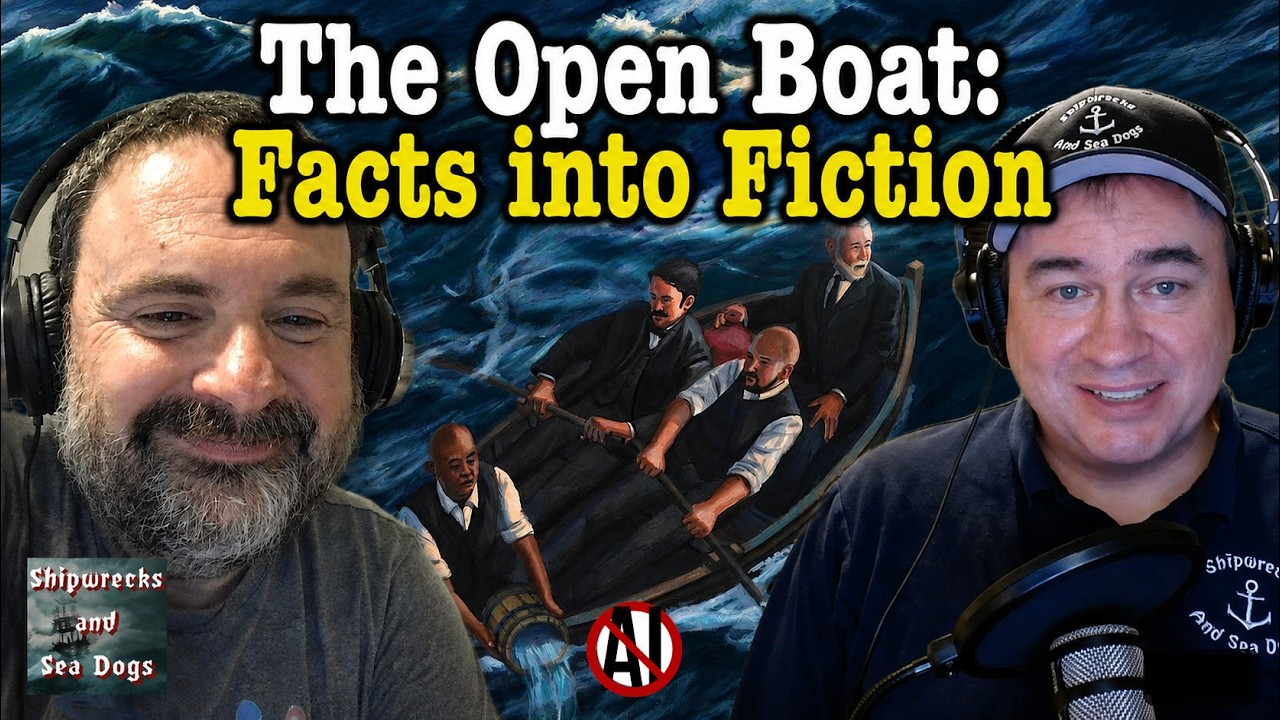
Author Stephen Crane survived the shipwreck of SS Commodore in 1897 and wrote "The Open Boat" based on his expierience.


In 1897, journalist and novelist Stephen Crane boarded the SS Commodore, a gunrunning ship bound for Cuba, and nearly didn't survive the trip. When the ship sank off the coast of Florida, Crane spent over 30 hours adrift in a small dinghy with three other men, an ordeal that became the basis for one of the greatest short stories in American literature: "The Open Boat."
In this episode, Rich speaks with Professor of American Studies Ben Railton to explore the true story behind Crane's fiction, from the real-life sinking of the Commodore and the harrowing survival at sea, to how Crane transformed his own near-death experience into a landmark work of literary naturalism.
📚 Ben Railton is a Professor of American Studies at Fitchburg State University. His work explores the intersections of history, literature, and American identity. Read more of Ben's work at https://www.blackwhiteandread.com.
You will hear:
⚓The real history of the SS Commodore shipwreck and Crane's role as a gunrunner-journalist
⚓What actually happened during those 30 hours in the open boat
⚓How "The Open Boat" reflects Crane's philosophy of nature's indifference to human suffering
⚓Why this story remains a cornerstone of American literary naturalism
⚓The blurry line between memoir and fiction in Crane's writing
* No compensation or remuneration was paid by or paid to Nautilus Media LLC, Shipwrecks and Sea Dogs, or Rich Napolitano in exchange for Mr. Railton's particpation in this episode.
** No AI was used to create this video.
**🎧 LISTEN AD-FREE + BONUS EPISODES**
👉Shipwrecks and Sea Dogs is part of the Into History podcast channel — subscribe here: https://www.intohistory.com/shipwreckspod
👉Get exclusive bonus episodes and merch on Patreon: https://www.shipwrecksandseadogs.com/patreon
👉Subscribe on Apple Podcasts: https://www.shipwrecksandseadogs.com/apple
👉Shipwrecks and Sea Dogs Merchandise is available! https://shop.shipwrecksandseadogs.com
👉You can support the podcast with a donation of any amount at: https://www.buymeacoffee.com/shipwreckspod
#shipwreck #history #maritimehistory #ships #podcast
Written, edited, and produced by Rich Napolitano. All episodes, images, and sources can be found at shipwrecksandseadogs.com.
Original theme music by Sean Sigfried. seansigfried.com
You can also listen to Shipwrecks and Sea Dogs podcast on Spotify, Apple Podcasts, or wherever you listen to podcasts. https://www.podfollow.com/shipwreckspod
Learn more about your ad choices. Visit megaphone.fm/adchoices
Rich (00:02.881)
Hello and welcome to Shipwrecks and Sea Dogs, Tales of Mishaps, Misfortune, and Misadventure. I'm your host, Rich Napolitano. Today I'm very happy to have with me Ben Raelton. He's an educator and author, and he's here to talk today about The Open Boat, a short story written by American author Stephen Crane. And we'll also talk about the shipwreck behind the story. Ben, thanks so much for joining me.
Ben Railton (00:27.426)
Thank you so much, Rich. It's really great to be here. As we were just talking about, I I've been a fan and supporter of this podcast for a long time. I think it's really unique angle, not just on the specific histories, but a lot of what I do in my career is the idea of American studies of kind of pulling together, you know, literature, culture, history, all the different layers of identity and community that are kind of part of our our story collectively. And and I'm I'm a really big fan of any kind of like lens that can open those things.
Rich (00:52.097)
Mm.
Ben Railton (00:57.46)
Up. So just thinking about, you know, episodes of this podcast, even from the last couple months, you know, it can go toward, you know, World War I, it can go toward, you know, the recovery process in the 21st century, toward Japanese American histories or Japan and American histories, like the conversation that you and Jenny Chan had a couple months ago. I think this is a great American studies lens, and that's a lot of what I try to do as well. Think about how we can open up these different questions through kind of
Rich (01:14.199)
Mm.
Ben Railton (01:27.28)
Interdisciplinary conversation. So I really love this this angle on that and really, really glad to be here to be part of that.
Rich (01:32.711)
Hmm. well, thank you. And you know, your your newsletter that you put out every Sunday, Scholarly Sunday, thank you so much for always talking about my latest episodes and that. But included in that are so many other things, like you said, just across a broad area, newsletters, books, TV, movies, all kinds of media that have to do with with these kinds of stories.
and I think that's what makes for me anyway, maritime history so interesting is that it's not just about a a boat or a ship that wrecked and what happened after. I like to weave in context from all over what's happening at the time. You know, there's always politics, there's geography, weather, you know, financial schemes or just negligence or hubris or all kinds of things that that go into these stories.
and putting them in context with the world at the time, I think lends lends itself to a much better understanding of of how and why these things happen.
Ben Railton (02:42.208)
And sometimes people write great works of literature about too, as as we're talking about here. So just or, you know, make films, songs, right? So many different kinds of cultural representations of these things, but in this case a really, really powerful work of of fiction inspired by those kind of things too. So Thank.
Rich (02:46.112)
Ha ha.
Rich (03:00.404)
Yeah, perfect segue. so we're talking about the open boat, a tale intended to be, after the fact, being the experience of four men from the sunk steamer Commodore. That's the official title by Stephen Crane. so w what inspired your interest in this story originally as it pertains to your work and what you do as an educator?
Ben Railton (03:26.476)
Yeah, so the first thing I'll say, Crane was one of my kind of gateway drugs to American studies. I think he's so talented and he's probably known best if he's if he's remembered these days collectively for the Red Badge of Courage, his historical novel about the Civil War, which still gets taught, I think, a decent amount. It's short and hard hitting. And even that just to say, it's based of course on very real events, but Crane is born in eighteen seventy one. So he didn't live through the Civil War in any way. He's just such a talented writer.
Rich (03:32.126)
Mm.
Ben Railton (03:56.393)
That he can imagine it in a way that hits us so hard. And that was kind of my starting point. But then the more I read of him, his fiction about New York City, like Maggie, A Girl of the Streets, which was his debut novel about a young woman growing up in deep poverty in New York, his poetry, which is if people haven't checked out his poetry, highly recommended, really unique, really interesting, just a talented, talented dude. And he he died at 29. He lived a very frustratingly, tragically brief life, but did so much in that span.
So I've always been a Crane fan since I kind of started thinking about these American studies questions. But then this story in particular teaches really, really well for folks who are educators and in multiple directions. So I use it consistently in the survey of American literature because it's a really good example of both realism and naturalism, things that we'll, I think, talk about as we go. Both kind of that observational realism, but also the heightened, kind of exaggerated tone and drama of naturalist writing that Crane.
Is often connected to. So it's a really good example of a couple of big things that are happening in American Lit around the turn of the 20th century. But also I teach it in a different context as part of a kind of deeper dive into Stephen Crane in a class that I teach on major American authors, because I think it's really interesting to put this one story in conversation with things like the Red Badge of Courage and think about things like bravery and heroism and the kind of darkness.
of the world and how this one experience of his he uses to open up to so many other things. So I think it's a great representative story, but it's also a great kind of Crane story and and it it teaches well in all those different contexts and I I I go back to it a lot. So I'm really glad to have the chance to talk about it in this setting as well.
Rich (05:32.406)
Hm.
Rich (05:45.237)
Yeah. wow, that's f fantastic. I agree with all of what you just said. I read the Red Badge of Courage in high school and I think most Americans do. but this was the only other work by Crane that I have read. and it it does such a great job of of pitting humans against nature, you know, kind of relevant to what is going on right now in pop culture with the Odyssey.
That's something that came to mind when I was reading it. so let's talk about the story, which it it the the work itself is fiction, but it's it it came from his own experience after he was shipwrecked on the SS Commodore. what can we what can you say about that as far as why he was on the Commodore to begin with?
Ben Railton (06:39.446)
Yeah, so Crane
His his day job, the way he made a living in that in that brief life, at least for the last decade or so of his brief life, was as a journalist. and in particular, what we would call these days kind of like a war correspondent. Like he traveled to some of the most dangerous places, at least in the Western Hemisphere specifically. That's what ended his life actually was he got malaria while covering a a Central American Revolution just a couple of years after this and passed away. But so he was I think he was drawn to these kinds of of settings.
Rich (06:43.646)
Mm.
Ben Railton (07:10.842)
Which is obviously ironic in this case, because he didn't know that it would lead to this shipwreck. But he was drawn to danger, he was drawn to kind of war. So he was traveling to Cuba on the Commodore, I believe, to cover the kind of impending revolution there that would end up being part of the Spanish American war a couple years later. and and he's on board this ship traveling to Cuba and it it goes down, losing almost everybody on board, as I know we'll talk a little more about, but leading to this harrowing kind of survival experience that.
That he has. And I think one of the things about Crane and kind of realism in that period is it's very often inspired by these very specific real situations and events in these kind of autobiographical or at least autobiographically adjacent kind of ways for authors. But then they can turn it into something so different. And I think when I teach the story, we talk a lot about how the correspondent in this, for example, I mean, that is what Crane's job was, that is who he was on that ship. But I also don't think it's
It's exactly Crane. I think it's a it's a fictional character within this group of fictional characters that are presented by this outside narrator who is also kind of Crane, he's the writer of the story. So I think he he turns it into something really different based on that real experience as well.
Rich (08:26.802)
Yeah, and the the ship itself, you know, for all you shipwreck fans out there, was as we said, the the SS Commodore. It was traveling from Jacksonville, Florida, with twenty-seven or twenty-eight men on board, headed for Cuba. And they didn't make it very far just after departing the St. John's River, about two two miles, about three kilometers out, hit a sandbar in the fog.
got towed off of the sandbar but then wound up getting beached again near Mayport, Florida. So again, they didn't make it very far. the ship began to leak. They had a hole in the hull somewhere, the boiler broke down, pumps failed, as is as is often the case in a shipwreck. And just off shore of what is now Ponce Ponce Inlet, or Mosquito Inlet as it was called at the time, which is near Daytona Beach.
is where the ship went down. And in the actual story, Crane was able to get off the ship with three other men on a lifeboat, and that is where the story of the open boat begins. the harrowing tale of their survival or attempt to survive offshore Florida in the dark, in this tiny dinghy it's called in the story, in r in rough weather. So we'll take it from there.
Ben, why don't you go ahead and introduce us to how the story sets out after the shipwreck in this tiny dinghy?
Ben Railton (10:01.272)
Sure, and and it's one of my favorite first lines in American literature. And and for folks who haven't read it, I hope a at least after this conversation that we're having, you'll check it out because we obviously can't do justice to to all the layers of it. But it's not spoiling much to say that the the first line is a standout, which is none of them knew the color of the sky. Just throwing us right away not only into into this this literally immersive moment, this moment where you are focused on what's ahead of you, what's in front of you, trying to
Survive these waves, this surf, these conditions, this moment. But also, I think immediately giving us this really interesting sense that we're looking at these men and we're looking kind of through their eyes at the same time. And the thing I really love about what Crane does with this story is that he does both. I think he really gives us their perspectives, each of these four men, the correspondent, the oiler, the cook, and the captain, these kind of type characters who have survived this shipwreck together or are trying to survive it.
As you said, we're seeing through their eyes in different ways in different moments, not only the correspondent, but really all four of them. But at the same time, we have this sense that we're looking down at them, even though they aren't looking up, right? They're they're so focused. But we at times anyway, have this kind of bird's eye view, literally and figuratively, of of this boat and of these men. And so we're we're moving back and forth. And as the story kind of deepens, that's the move we keep making. We get inside their different perspectives, inside their dynamics, their conversations, but that we keep
kind of also observing and watching what's happening to them. and and that back and forth I think really builds the different layers of the story, but also kind of the tension of the story in terms of that we're with them, but we also are seeing what's happening to them. And I think it makes for a really, really compelling short story.
Rich (11:50.111)
Yeah, and the characters from the start, Crane does a really good job trying to without without being so on the nose about it, developing the characters in a way that we understand their their their personality, maybe their constitution, and how they're doing physically. my take on it was that the captain was kind of a grizzled veteran of the C. I he was obviously injured.
maybe even a little bit despondent. Obviously his ship just sunk, so that's never that's never gonna put a captain in a good mood. and you know, and of course in the story, the only one of these four that is named is the oiler Billy. The other three are just called the correspondent the cook and the captain. So my take on it was the cook was probably a younger man with not very much experience.
They don't talk he doesn't really do much other than bail the ship with a with a bucket or not the ship, just the their little boat. And the and the oiler, who does quite a bit of work on the boat, as we'll we'll talk about, who maybe has a you know a brave heart and stout body, but he too is struggling to with all of the grueling work that has to be done. throughout the story
The there's a recurring theme of this battle between human endurance and will to survive and and nature. and and something that I h like to s like to say, how I describe the ocean is that it's it's beautiful and terrible and entirely unforgiving. it doesn't care that we're there, in other words.
and I think that comes through in the story. what's your what's your take on that?
Ben Railton (13:56.173)
Yeah, that's well said. And and the genre of naturalism that Crane has often seen as this really powerful example of.
Is this idea of of sort of locating human characters within bigger forces, things that are kind of bigger than any person or even maybe all people. Sometimes it's it's bigger kind of societal forces like money can be a really prominent thing in naturalist stories because it's bigger than any sort of one person. It's this set of four.
but as far as I know, and I haven't read all obviously all of any body of literature, but this is one of the only ones that really does that, at least an American lit, that really does that with the ocean.
Joseph Conrad, Heart of Darkness, that author, he was interested in it for sure. He's a an English author. Some of his stories are about people at sea in that naturalist way. But in American lit, Crane is the one who really is interested in it in a nautical way. After Melville, anyway, but that's long before naturalism. Moby Dick is a really different kind of book, even though it is about or inspired by a ship that eventually wrecked. So taking that idea of naturalism, but putting it in, I agree, maybe the most dramatic example of that, right? Anybody who has any experience, particularly with the deep
Deep water, even a couple miles offshore, as you noted, it's a different world. It's a completely different world from any human one that we might be familiar with, I think. And really leaning into what that means on the ground, right? To what that experience is like when you're looking at the next wave, when you're imagining kind of what that's going to do to your little world, to your little environment, and trying to fight it, trying to resist it. I think it's kind of a perfect embodiment of that naturalist idea, but it's also
Ben Railton (15:46.823)
really unique in American Lit and how it does that in this in this nautical setting. So yeah, I I think it's a it's a that's part of what makes it so teachable is that it's both representative of of a whole movement, but also really unique at the same time.
Rich (16:01.608)
Hm. And the imagery used is fantastic throughout this this story. And one of my I I jotted down a a few quotes from the book to illustrate this, but to this point of the naturalist or the naturalist movement of literature, he he writes that there was a terrible grace in the move of the waves, and they came in silence, save for the snarling of the crests.
I think that's just great. I that is such great writing because that is the ocean. It is endless, it is always coming, and it's unforgiving. It's it's just never gonna stop. So th they i i if you are out there like he was, and these characters are in the story, you have to keep going. Or I guess you don't have to, you could give up. But I mean that's that's I think the dichotomy of the story here is that that
challenge of human endurance versus nature.
Ben Railton (17:01.526)
And a quote like that I think also, to go back to something I had said
Rich (17:03.872)
Mm-hmm.
Ben Railton (17:05.962)
Part of that is the is the feel of it for the men, right? Is their like sensory experience, what they're hearing, what they're feeling. But I think that's also the narrator kind of describing it in a way that is outside of the men, as you're saying. That is really the reality of it. That is the the world of of that very inhuman, unforgiving. And I think it does both at the same time, very frequently, where we are in their perspective, we are hearing with them, feeling with them, but at the same time kind of looking
Looking at this thing that is outside of them. And his ability to move us back and forth between those is is just, I think, really unparalleled.
Rich (17:44.541)
Another thing that came up in the story and and I'm probably not the best person to try to figure out what it means, but I I'll ask you. he there's the example of a a bird, a gull of some kind that appears on the boat and actually sits on the captain's head at one point. And and also a shark that doesn't attack the boat or anything but is kind of following them around for a while.
Ben Railton (18:02.296)
Yeah.
Rich (18:10.708)
What is your opinion on on that symbolism that Crane used?
Ben Railton (18:15.458)
Yeah, it's a great question because particularly the bird, you know, there's this very famous example of the albatross in the Rime of the Ancient Mariner the Samuel Taylor Coleridge poem. and and or e even like the the raven in Nevermore, right? Birds as this c in in the raven by Edgar Allan Poe, the one who says Nevermore. birds being this kind of representation of of human emotions like loss or despair or
Rich (18:23.733)
Yeah.
Ben Railton (18:44.524)
you know, those kinds of darker emotions. I think there's a through line of that in in in a lot of romantic writing in particular and and Crane's poetry is very romantic. And so I think there's that, right? That the the bird and maybe the shark as well can can represent the emotions of the people in a symbolic way. That adds another layer. But again, because this is Crane and this is this naturalist story, I think it's also really telling that the bird compared to like the Raven in Nevermore, or the Elp in in the Raven, sorry.
Or the albatross, the bird doesn't really care at all, right? It has no real interest. It's there and then it's gone. It's doing its own thing. The men are insignificant to it, like they're insignificant to the world that they find themselves in. And so I think it's kind of like a riff on those earlier kinds of birds and on the idea of like a symbolic nature that can kind of reflect where the people are. But I think ultimately it's also just, as you've been saying about the ocean, a nature that it doesn't matter at all to the nature. There's an insignificant
Rich (19:43.126)
Mm.
Ben Railton (19:44.391)
Crane has that famous line in one of his poems that gets quoted a lot a man said to the universe, I exist, and the universe says, That does not inspire in me a sense of obligation. Like the universe doesn't really care if we exist or not. And I think this story reflects that too, right? To the universe that they find themselves in, it's going about its its processes, its world, whatever happens to them. They have to fight it, as you said, but it it just is doing what it does. And so I think the bird kind of echoes, but
Rich (19:55.742)
Mm.
Ben Railton (20:14.224)
But then also ultimately doesn't echo the people because that natural world is bigger than, is outside of, is is is really its own thing. I I think it does both of those things.
Rich (20:26.364)
And the at a few times during the story there's a reference to the seven mad gods who rule the sea. what do you think he's referring to there?
Ben Railton (20:39.104)
Yeah, you mentioned the Odyssey and I think there is again, Crane was really well read and he was really interested in being in conversation with other lit, whether it's Coleridge or Moby Dick or
The Odyssey. And I think this does feel like a very, you know, or there's a bunch of horse imagery in this as well, right? The bucking Bronco that the ship is like. I don't think that's unrelated to the the famous horse that is the starting point for, you know, the Odyssey's character, Odysseus, in his own way. So I do think the gods of the sea sort of put us in that kind of like mythological world, right? That this is part of larger myths of human versus nature, of trying to survive, of epic quests.
Rich (20:59.818)
Yeah.
Ben Railton (21:21.346)
Like Odysseus's. and I think the seven gods kind of conjure that up. But it's also the case that the the main perspective we're getting in this s story is that of a writer, right? Is that of someone who would want to give things a kind of epic feel, even if at times he sort of takes a step back and realizes this is just a really grounded, terrifying human experience, right? This is not Odysseus, this is not gods and monsters, this is just.
this tiny boat in this big ocean. So to me, like those mythological references are partly very legitimate kind of comparisons. This is an odyssey, but they're also partly sort of satire because you know there's no big myth here. This is just small people trying to survive in a giant ocean. And I think you kind of get both of those things a little bit.
Rich (22:11.838)
Another thing that struck me w quite a bit was that a lot is made during their their d journey in this lifeboat, or not even a lifeboat, just a tiny dinghy, was their struggle. They're they're the you know, it's uncomfortable, it's always wet, they have to take turns rowing and and steering and you know the captain's injured, so he can't do much, and the correspondent and the oiler wind up doing much of the rowing.
And so I was thinking about that in terms of just, you know, a almost in opposition of this struggle versus nature, they have this bonding of these four characters that really probably barely knew each other prior to this. the captain typically, especially back then, probably did not mingle much with the the hired work and the correspondent himself was was just a passenger.
So now they're stuck on this little dinghy and they are now bonded together in this like minded challenge to survive. So I thought you know how I thought in
Rich (23:29.662)
me gather my thoughts. I I'll edit this, obviously.
Ben Railton (23:34.19)
Okay.
Rich (23:37.504)
So in opposition of this of this struggle with nature, they have this bond with each other that keeps keeps them driving forward against their their common enemy.
Ben Railton (23:51.524)
Yeah, that's well said and I really appreciate
Us turning to that a little because a lot of what we've said so far makes it seem like it's a really pessimistic story in a lot of ways, or at least at least darkly realistic, darkly naturalistic. And it has those elements for sure, but I would actually say this is probably the most inspiring of of the things of Cranes that I've read. He often could be pretty fully dark and pessimistic. Red Badge ends on some pretty dark notes. His stories like Maggie about the cities are really bleak in a lot of ways.
Poetry can be very, very dark like the universe and and man one. And this story has a lot of that darkness in it, and it it ends with a death, and it ends with a sense of of loss for sure. But I do think it's ultimately deeply inspiring and optimistic about what is what humans can do when they're pushed and confronted by these things, particularly together, right? And I think that's really the point that you nicely were making, is that as much as they're individual types, I think this is a this is a a conjugal.
There's a camaraderie here that allows them, for example, to do things that they knit they would not have been able to do. There's a lot of kind of a reflection of how painful rowing is and how much I think any one of them probably would have given up on that process. But for each other, even more than kind of for themselves, they don't. They keep fighting, they keep trying. And and even though they partly fall into certain roles, like the captain being the captain still, and the there is this sense that they are pulling together literally and figuratively.
And I think it makes it a kind of beautifully optimistic story in the face of all these dark things. and and a representation of those things that is part of why I try to talk with students seeing that it isn't just what we might call naturalism, because naturalism really does see people as relatively powerless often. That's kind of the the vibe of a lot of naturalist writing. and I think in this story there is powerlessness and then there are other things that can be done and that especially can be done together. And so I think
Ben Railton (25:54.897)
think it has that other side or that other level of it for sure.
Rich (25:59.389)
And Crane uses some repetition too, as a literary element. one of the things that comes up multiple times is this trading off of rowing, where you know, the the correspondent will say, Billy, can you spell me a bit? And then they switch and the the oiler Billy comes up from the the, you know, waterlogg bottom of this tiny dinghy.
To row and then the correspondent goes down to try to cat catch a few winks, you know, but it's and then almost in the next sentence they'll he repeats it again. you know, can you spell me? And then they s they change again. what do you in terms of his intent, what do you think was the purpose of of repeating things like that? And there's a couple other things that he repeats a few times as well.
Ben Railton (26:56.483)
Yeah, there's a kind of rhythm that the story gets into. And I do think you said early on in this conversation, you know, the idea of the kind of the the constancy of this experience, right? Of the ocean, of the repetition, of the need to survive. I think he's really interested as a writer in using prose to kind of create
Rich (27:07.454)
Mm-hmm.
Ben Railton (27:16.535)
those kinds of effects, right? Create that feel. and I think the repetition really does that, right? It pulls us in, it immerses us in that experience, in that in that moment to moment
constant struggle that they're in. I think the repetition opens that up. But I also think that again, it it lends itself to that tone of of community as well, because it's not, for example, the I think most of the repetitions are not just external things. It's the things that they are doing. It's the it's the ways that they are kind of battling together. And I think it kind of it really drives home the building of that community, right? That even as the story goes along and things get more and more
bleak in some ways for them, right? There's no one in the rescue station. There's they can't turn into shore easily, right? They're all these things that feel like they are tragic. The story kind of resists that, I think, and the repetition sort of resists that, right? That they keep fighting, they keep pulling, they keep these processes going, even though those tragic notes are building. And and the end that I'm sure we'll get to, the end has both, right? It has, again, it has a loss, it has a death, but it also ends on a note of camaraderie and
community for this group. And so I think the repetition really kind of builds both the tragedies that are happening, but also that sense of resistance to it as well.
Rich (28:38.42)
A another thing that was repeated and I and I and it illustrates a few of the things we're talking about is as they were trying to get closer to shore, and obviously for anyone that's not familiar, as you get closer to shore the surf gets rougher. And it actually is very difficult to manage that, especially in a tiny boat. the what's repeated several times is this frustration. If I am going to be drowned
Why in the name of the seven mad gods who rule the sea was I allowed to come thus far and contemplate sand and trees? I think that was that's such a magnificent line for a lot of reasons.
Ben Railton (29:20.599)
Yeah, and naturalism
for example, is is often connected to the idea of ironies, right? Things that are not just tragic but ironic and frustrating. And that's a really, really powerful example of that. that it's not simply that you that there's a loss, but it it's a loss that contrasts with the possibility or the seeming possibility, right? Seeing this thing right there and not being able to get to it. long before like Kafka writes about something like that in the castle where you know you're trying to get somewhere and you can never
never get there no matter how much you try. I think this is a really beautiful kind of example of that irony as well. but but again as much as we're in their individual perspectives where they're sort of asking that, we then see that they keep fighting together, right? So there's these ironies and these tragedies, but they also don't allow that to sort of be the end of the story, right? They don't give into it. And I think all of those layers are present in moments like that.
Rich (30:20.778)
They're a as they're continuing to struggle and you know they their their first attempt to reach the shore is d it does not work because they can't they can't get through the surf. So they head back out to sea where it's a little calmer. and their frustration is growing. And this was there was one line and one line only in this that actually made me laugh. I thought maybe slightly you know, some sense of humor from Crane was when he said
Four scowling men sat in the dinghy and surpassed records in the invention of epithets. That's fa that is great. Such a good way of as you know, at the time, talking about all the curses they were probably using without actually saying them. Very eloquent.
Ben Railton (31:07.501)
I it is, and I do think another thing in this story that we haven't said explicitly so it's worth saying, is that, you know, Crane writes this incredibly fast. It's published four days after he's rescued, after they are so just incredible turnaround, even for a guy who was prolific and talented. And I think we can see at least part of this as a tribute. Right? He wants this story to be a sort of tip of the hat to these three other men that he was in this experience with, who, as the end of the story suggests, kind of now speak a language together.
that nobody else maybe can quite speak in the same way, right? There's something they've shared that connects them. And so I think I think the whole story is at least partly
among many other things that we've talked about, a kind of way to pay tribute to that experience and that group. Even even in in a line like that that is about sort of their worst, right? But it's about this thing that almost can't be spoken to anybody else, right? It's just sort of what they experienced and and said in response to it and did in response to it. And it's funny, but it's also I think really like we know, you know, the four of us know, and there's things we know that nobody else ever can in the same way.
Rich (32:03.168)
Mm.
Rich (32:15.54)
And I think that comes across in their frustration when they when they actually get close enough to shore and they see some men on shore, and they're just waving at them out there in the boat and and they're sitting there in the boat thinking, Why are they just waving at us? You know, I'm gonna if I could, I'd strangle that guy. Why is he what does he mean? Why is he just waving? Why don't they send a boat out for us? And so that's you know, maybe a little bit of a a
Ben Railton (32:25.165)
Ha ha.
Rich (32:43.088)
dig at human nature from Crane, perhaps. You know, again, I'm not the greatest at interpreting literature, but they were very frustrated at at the lack of assistance they were getting at that time. just demonstrating their overall frustration and desperation.
Ben Railton (33:00.365)
And Crane was really interested as a writer in the question of kind of empathy, whether people can
imagine themselves in other situations. When he wrote about poverty, he had a couple short stories actually about a wealthy young man who tries to have an experiment, for example, where he is homeless for a time, to see if he can kind of fully empathize with that experience, with that. And I think the end of Red Badger Courage is partly about that. Like, can anyone understand what the war was like if they weren't there? If they just talked to a veteran like Henry Fleming. And I think the story's at least partly about that too. Not only what links the four
men, but what separates them from everybody else, especially those people on the beach. even eventually when they're rescued, that idea that they speak a language that is just a different one, that is not that is not the same. And and that does lead to that sense of of separation and frustration with the kind of part of human nature that can't get it, that can't really kind of e get to that level of empathy with them.
Rich (34:00.171)
Yeah. you know, so as going toward the end of the story, they get to a point where they're they're exhausted and the captain says, you know, we better head in and just we're we'll get swamped and we are going to capsize, but if we don't go now, we're gonna be too exhausted to to make a swim for it. So they so they go ahead and try that. And it turns out that Billy, the oiler, is
the only one of the four that that dies. He he drowns in the surf. and and so for me I was thinking, you know, he seemed to be the strongest or most capable of surviving. he did the most on the boat, I think, maybe along with the correspondent. But he he drowns and the other three survive. So a little bit of irony there, I think.
Ben Railton (34:53.429)
And my understanding, is that that wasn't that's one detail that is not that is not accurate to the experience. I think the
the four men all survive that that Crane was part of on the boat. And so it's it's a striking choice. It's a really striking choice. I was talking about this with my wife and she said that that guy must have read the story like, what the heck, man? You know Yeah. and fair, but on the other hand it does sort of elevate him in a way, right? It makes him into a really tragic hero.
Rich (35:14.208)
Yeah.
Ben Railton (35:24.769)
I think at least in part, maybe the suggestion in the story, the fictional character, is that he perishes because he gave so much, right? Because he he he worked so hard and and sort of his strength, his heroic strength, which saved them, it seems, you know, gives out in the last. but it is also again, yeah, that level of like naturalist irony, and of
of the uncertainty of the universe, right? Another thing Crane was really interested in was the question of kind of fate and whether there's any way to kind of predict it or, you know, control it, understand it. And I think the end of the story suggests to a degree no. To a degree we are at the mercy of all the things that we are at the mercy of. But again,
Three of them survive in part because of the oiler and in part because of their whole community. And so as much as they are at that mercy, they also did something to kind of pull through. and I think we get all of that from the end of it for sure.
Rich (36:25.104)
And at the end, after the the the three survivors make it to the shore, I think Crane maybe gives a little bit of a little bit of credit to their fellow man because they are aided then by the people on shore. They bring them blankets and hot coffee and things and and take care of them, in contrast to earlier when no they were just waving and nobody was helping. So I think he he bails them out a little bit there.
Ben Railton (36:55.055)
Yeah, I was thinking this time reading it,
Rich (36:57.702)
Mm.
Ben Railton (36:58.605)
This will seem like a non sequitur, but I think there's a connection. I was thinking about the the Mr. Rogers quote, look for the helpers that is often quoted in the aftermath of different kinds of traumas and tragedies. For most of this story, the helpers are each other, right? The helpers are just like again, I think they survive in a way that no individual maybe would have because they're trying to save each other. I really think we get that feeling. And then yeah, as frustrated as they were with what they kind of saw on the beach, when they get there it is a different tone. It is a different
different idea of kind of how people can pull together after tragedies. And and I think that's that's a through line of a lot of of history is how these traumas can lead to some of the best responses, even while they also are some of the worst kinds of experiences that people can have. And and I think we do get both of those things for sure in this.
Rich (37:49.461)
I think there's a little bit of a connection to the the red badge of courage, as you were talking about earlier, because the final final line in the story says having heard the Great Sea's voice, they felt they could now be interpreters of it. So kinda like you said, they having gone through this together, they now understand it. And if you unless you have gone through it, you you can't possibly understand it. that's how I took it anyway.
Ben Railton (38:21.111)
Yeah, and and I think it's also a little sorry, did I freeze for a second there?
Rich (38:21.871)
Rich (38:26.728)
No yeah, you're good. Go ahead.
Ben Railton (38:29.325)
Okay. I think it's a little bit of a meta kind of moment about the author as well, right? About why Crane
writes this and writes it so fast. And it is, it's his most aut autobiographical piece of fiction. He wasn't alive during the Civil War. He didn't live in the abject poverty that characters like Maggie live in. So a lot of his fiction is about people he knew or things he was adjacent to. But this is the one story of his that is so explicitly autobiographically s oriented. And I do think that end is partly an expression of that, right? Like there is a language here, there is a voice here that he can now transform
to channel a little bit and turn into this story for his fellow survivors and kind of for the larger community who who can read this and maybe try for that empathy, try for that connection that we were talking about. And again, I think that makes it really unique in American Lit as an expression of those things, as a a piece of fiction about a shipwreck and its aftermath that has that autobiographical component, that realistic component, as well as all those layers of symbolism and naturalism.
Rich (39:42.869)
And like you said, I I think what's interesting here is that following his rescue on the shore, he did write this story four days later, but before he wrote it, he you know, he obviously gave his account just kind of a blow by blow of of what happened and you know, they were shipwrecked and here's what happened. so that was his first account and then based on that he wrote this narrative. you know
autobi autobiographal, autobiographical, historical fiction perhaps, you know, s but there's I'm sure a lot of truth in what he wrote and a lot of a lot of these things really did happen and the dialogue captured the realism that was happening at the time. So I you know, having it having it had happened so just recently, everything was fresh in his mind. So
I imagine a lot of it was accurate.
Ben Railton (40:44.343)
Yeah, that phrase in the full title that you quoted at the start of the conversation intended to be after the fact.
is a really, really interesting one, right? That th these are things that happen. There are facts here, there are realities here, but it's a piece of fiction, and he's acknowledging that. And so he can do things as an author, as a narrator, that are his own choices and inventions or et cetera, literary devices as we've talked about. But it it blurs those lines. And and his whole career did. Again, he was a journalist and an author of fiction. He was a correspondent and a narrator. He was these multiple things, and I think this story really does blur the.
Those boundaries in a way that's pretty ahead of its time, right? Like there's some famous examples of that much, much later in American Lit. Norman Mailer writes this book called The Armies of the Night about the anti-Vietnam War protests. The subtitle of that book is History as a Novel, the Novel as History. And so that's like 75 years later, you've got people like Mailer playing around with those categories in postmodern kind of ways. But Crane is doing that too, right? He's playing with what is fact, what is fiction, what is history, what is you know the story here. And I
Rich (41:38.518)
Mm.
Ben Railton (41:51.473)
I think this is a beautiful kind of like blurring of those lines a little bit.
Rich (41:56.995)
So just to to recap a little bit about the the true story of the SS Commodore, the the four men on the boat were Stephen Crane, Captain Edward Murphy, ship steward Charles Montgomery, and Oiler William Billy Higgins. And so those were the the actual people that the the story of the open boat was written about.
And like you said, it was it was published just shortly after. It was originally in the June nineteen or I'm sorry, originally in June eighteen ninety seven issue of Scribner's magazine. And became quite quite a popular story at the time. even the the shipwreck itself of the Commodore was was all over the news. So I guess he was you know, intentionally probably
Taking, you know, taking full advantage of of the popularity of the story, obviously. but what a just a fantastic work. And it's a short story, it's an easy read. Take you maybe an hour to read it. and actually as a follow up to this, I since it is in public domain, I'm going to do a a voiceover of the story and and and publish it on the feed in the podcast for everybody. So just as a little bonus.
Ben Railton (43:15.201)
It reads out loud really well. We always read little passages of it anyway when I teach it at least in person and it reads really well. And I just want to mention we haven't yet gotten my favorite quote in, which was the quote that I I suggested when I I nominated it as a as a possible episode for your podcast to talk about, which is shipwrecks are apropos of nothing. I think it's a really, really beautiful quote that suggests again the randomness, the haphazardness, the kind of like uncertain fate in the world.
But also reminds us of just how talented a prose stylist this guy is, as we've talked a lot about today, that that he could be both the experiencer here, part of this story, but also just turn it into this really beautiful piece of prose. And I think it it it's a great example of how it doesn't have to be either or. Things can be incredibly real and incredibly beautifully narrated and and written and and told at the same time.
Rich (44:10.736)
And one more quote from the story that I that I jotted down just because I find it beautiful, and matches everything we've talked about as far as the theme. She did not seem cruel to him then, nor beneficent, nor treacherous, nor wise, but she was indifferent, flatly indifferent.
mean, doesn't pretty obvious what he's talking about there. but just sums it up. The the ocean shipwrecks are you know, they're it's just unrelenting and unforgiving.
Ben Railton (44:49.419)
And and and can produce at the same time and it's maybe the biggest irony, but it's a more optimistic one, can produce these amazing human
responses, right? And I know they don't always, I'm sure plenty of the ones that you examine lead to more kind of dark human responses, but at their best can produce that kind of community and camaraderie that we see here. and so the sea fully indifferent, but obviously our our characters manage not to be, even at their worst. and I think the story kind of has both those tones as a result, really dark and really inspiring at the same time.
Rich (45:26.666)
Yeah. really fantastic, well written story. thank you very much for for bringing it up. and to wrap up, well just for again for all you shipwreck heads and wreck divers out there, the ship SS Commodore actually was found. in May of twenty twenty two. Kimberly Eslinger Falk was a graduate student at East Carolina University at the time.
And she and a group of technical divers from the Cambrian Foundation did the first archaeological study of it. And then in 2004, Lighthouse Archaeological Maritime Program at the St. Augustine Lighthouse and Museum, along with the Ponce de Leon Inlet Lighthouse Preservation Association, discovered evidence of this shipwreck or and they positively identified it by its engine. they
nailed it down to a shipyard and or a an engine company in Philadelphia from eighteen eighty two, and that proved beyond a doubt that it was the Commodore. So that's off the coast of Ponce Inlet in Florida.
Ben Railton (46:34.123)
And I'll just say one of my very favorite things about the angle on history that your podcast provides is that and and Crane would appreciate this, I think. It's both a l it's a literal thing, but it's also such a great metaphor for the idea of all the history that's down there, right? All the history that's kind of often out of sight, but is there to be kind of discovered, recovered, engaged with, if we're able to do that. And and I think that's a literal fact with shipwrecks, but it's also a really nice metaphor.
Rich (46:43.518)
Yeah.
Ben Railton (47:03.857)
metaphor for what we're trying to do and what a story like this in its own way can help us do to to kind of get get back to those histories, get down to them a little bit.
Rich (47:12.692)
Yeah, well said. any last thoughts about the the open boat by s Stephen Crane?
Ben Railton (47:20.835)
No, I just I'm glad you'll read it. I hope people will listen to that. I hope people will will check it out and just
I'll say this, it's a little bit of a different point, but I think it's worth saying the value of the humanities, right? The value of why we study history, why we read literature, why we teach these things, why we talk about them. There's a lot of of reasons for that, but the the ultimate one is in the name, right? It's the human. It's connecting us to these the worst of of what humans experience and go through, and also the best of what they can kind of capture. And and this story in one kind of brief
snippet I think sums up so much of that and studying it, talking about it, sharing it even more so does that. So it's a really great example of that too, and I hope everybody can keep connecting to these kinds of literary and historical topics for all the human reasons that we should.
Rich (48:11.612)
Absolutely. And as I said in the in the beginning of the episode, you are an educator and author. what would you like to mention as far as the work you've done and where everybody can access it?
Ben Railton (48:25.049)
I appreciate that. I'll just mention two quick things. my wife and I have a public scholarly website that's almost a year old now. It's called Black and White and Read All Over. That's R E A D, like red. the w the address is blackwhite and red dot com. and if you Google Ben Railton
black, white, and red, you'll find it. it's a great site to to hold a lot of our different public scholarly writing and work and resources for folks and opportunities for people to contribute their own thoughts and voices. So check that out if you would. There's a lot that's there. And then one of the things that's there but that I'll highlight about my own recent work. I've as this conversation maybe reflects, I've I've thought a lot in recent years about kind of narrative history telling the stories of our past and how we do that and how we can do that as educators and scholars as well as just how we can connect to them and
I have a podcast that I've tried to do that through for a couple seasons now about baseball histories specifically. The most recent season was called Diamond in the Rough. It was about baseball at the Japanese American incarceration camps during World War II. There's links to that on on our website, to that second season as well as the first season of my podcast about baseball and American history. So I hope folks who are into these kind of conversations might check that out and and and learn about those angles, those lenses on American history as well.
Rich (49:19.606)
Mm.
Rich (49:42.998)
Hm. that's fantastic. I'm a baseball fan myself, so I'll check it out. And I will put those links in the show notes to this episode, for sure. Well, Ben, thank you so much. It was pleasure to meet you face to face, at least online, face to face, finally. And I I really enjoyed talking to you. Thank you so much.
Ben Railton (49:46.591)
Yes.
Ben Railton (50:05.111)
I I did too. Thank you, Rich. Keep up the great work and I'm I'm really glad to get to be a a part of it now as well.
Rich (50:11.487)
All right. Thank you.