Lost Without a Trace: The Marine Sulphur Queen
The former WW2 era tanker Marine Sulphur Queen disappeared without a trace in 1963.


In February 1963, the SS Marine Sulphur Queen, a converted WWII tanker carrying molten sulphur, disappeared somewhere between Texas and Key West, Florida, taking all 39 crew members with it. There was no distress call, and only a few life jackets and debris were found weeks later. The wreck of the Marine Sulphur Queen has never been found, and no bodies have ever been recovered. The official US Coast Guard investigation report could not establish a cause of the sinking, and only put forth possible reasons for its loss.
This episode, explores the troubled history of the ship, the few details we actually know of its final voyage, the search and rescue operation, the Coast Guard investigation, and finally, the lawsuits filed by the families of the crewmembers.
The cause of the sinking of the Marine Sulphur Queen remains unsolved, and is the focus one of the most debated unsolved mysteries, including theories involving the linked the so-called "Bermuda Triangle." (NOTE: Shipwrecks and Sea Dogs does NOT support the Bermuda Triangle theories.)
** No AI was used to create this video.
**🎧 LISTEN AD-FREE + BONUS EPISODES + MERCH**
👉Subscribe on Patreon: https://www.shipwrecksandseadogs.com/patreon
👉Subscribe on Apple Podcasts: https://www.shipwrecksandseadogs.com/apple
👉Shipwrecks and Sea Dogs Merchandise is available! https://shop.shipwrecksandseadogs.com
👉You can support the podcast with a donation of any amount at: https://www.buymeacoffee.com/shipwreckspod
Written, edited, and produced by Rich Napolitano. All episodes, images, and sources can be found at shipwrecksandseadogs.com.
Original theme music by Sean Sigfried. You can find him at seansigfried.com.
Learn more about your ad choices. Visit megaphone.fm/adchoices
Very quickly, before we begin, if you would like to listen to Shipwrecks and Sea Dogs without ads and get exclusive bonus content, you can join the Officer’s Club on Patreon, through Spotify, or Apple Podcasts. Just click the link in the show notes. Thank you.
It’s February 2nd, 1963. Beaumont, Texas. Late afternoon.
It is a warm, mild winter day on the coast of Texas. The kind day on the Gulf Coast that makes February feel like an impostor.
Down at the Texas Gulf Sulphur Company's marine terminal, the SS Marine Sulphur Queen sat low and heavy at her berth, freshly loaded with more than fifteen thousand tons of molten sulphur. At the gangway, Edith Martin stood with her husband.
Adam Martin was the forty-seven year old Junior Third Engineer for the ship. This was his first voyage aboard the Sulphur Queen. A new posting. Although not exactly where he wanted to be, he needed the money. He was one of the last men to walk aboard that afternoon, gear over his shoulder, boots on the steel of the gangway, the whole crew converging toward departure.
Edith couldn’t help but notice the condition of the aging vessel. Streaks of rust, with chalky paint worn back to bare steel in some places. A World War II era oil tanker, she was cut open and rebuilt in 1960 to carry molten sulphur. Now, the Marine Sulphur Queen had the tired, over-worked look of a ship that had done a lot of hard living.
Edith kisses her husband goodbye, and watches him disappear up onto the deck. It was a three-hour drive back to their home in Austin. She knows she should already be on the road, but something keeps her there, waiting and watching. She watches as the lines are released. Then the tug works the ship into the Sabine-Neches waterway, carrying her out toward the Gulf, toward the open water, toward a five-day run around Florida and up the east coast to Norfolk, Virginia. It was a voyage the Marine Sulphur Queen had made sixty-three times before, without incident, and without a second thought.
Edith Martin stood silently, watching the ship get smaller, and smaller toward the horizon, until the Marine Sulphur Queen slipped out past the harbor and out of sight.
She never saw her husband again.
The Marine Sulphur Queen, today on Shipwrecks and Sea Dogs.
Hello and welcome to Shipwrecks and Sea Dogs, tales of mishaps, misfortune, and misadventure. I’m your host, Rich Napolitano.
The vessel that became the SS Marine Sulphur Queen dates back to 1944, during World War 2. To meet the demands of shipping massive amounts of fuel oil to Allies around the world, the United States Maritime Commission enacted the T2 tanker program. Their single, standardized, and simple design could be mass produced at a number of shipyards across the country. Much like the Liberty ships and Victory ships, the T2 tankers were designed to be built quickly and easily, using an all-welded construction, with no frills or unnecessary equipment or add-ons.
The T-2s adapted their design after the S.S. Mobilfuel and S.S. Mobilube, vessels built for the Socony-Vacuum Company, which later became Mobile Oil. The defining design choice, which would prove quite problematic, was its welded hull construction instead of traditional riveting. Welding was faster and cheaper, which met the goals of wartime production perfectly. But welded steel hulls of that era were prone to brittle cracking, especially in cold water, which led to fatal hull fractures. Like the similar Liberty ships of the same era, rapid and cheap construction took precedence over the associated risks. Of the 533 T-2s built, 481 were of the T2-SE-A1 type, and they became the unsung workhorses of the United States war effort.
Construction of T2 tankers took place at Bethlehem Steel Company of Sparrow Point, Maryland; Kaiser Company’s Swan Island Shipyard of Portland, Oregon; Marinship of Sausalito, California; Alabama Dry Dock of Mobile, Alabama, and Sun Shipbuilding and Drydock of Chester, Pennsylvania, where the Marine Sulphur Queen was originally built as the Esso New Haven.
As built, the Esso New Haven had a length of 523.5 feet, (about 160 metres), a beam of 68 feet, or about 21 metres, and was registered at 10448 gross tonnes. Its Westinghouse steam turboelectric engine provided for speeds up to 15 knots, or about 17 miles per hour. Nine tanks were installed to transport 6 million gallons, or 22 million liters of fuel oil, gasoline, diesel, and sometimes crude oil. The Esso New Haven, like all T-2s, was designed for its function over its style. Launched in March of 1944, the vessel served for seventeen months during World War II.
In 1946 she was handed over to the Standard Oil Company of New Jersey, and continued carrying petroleum products. In 1950 she was transferred to the Esso Shipping Company, and finally in 1960 to Marine Transport Lines, or MTL.
In the 1950s Texas Gulf Sulphur Company built a large plant near Beaumont, Texas to extract sulphur from the Spindletop salt dome. Using a high pressure steam injection method called the Frasch process, the sulphur was liquified and pumped out into heated tanks to be transported and sold. Molten sulphur is used to create products including fertilizer, rubber, plastics, matches, and sulfuric acid.
After acquiring the Esso New Haven, MTL immediately began converting the tanker to carry molten sulphur, and renamed her to the Marine Sulphur Queen. The significant change to the vessel was with her cargo tanks. The nine fuel oil tanks were revamped to accommodate one continuous, independent tank, 306 feet long, 30 feet 6 inches wide, and 33 feet high. That is about 93 metres by 9 metres, by 10 metres. The tank was then internally divided into 4 compartments. In total, this newly designed tank could carry 15,211 long tons of molten sulphur, or about 4 million gallons.
Because the sulphur had to remain in a molten state while being transported, a system of steam heated coils were added throughout the tank. These coils heated the sulphur above 122 degrees celsius, or 251 degrees Fahrenheit. This is more than 6 times higher than the temperature of liquid fuel oil. To help contain the heat, the cargo tank was insulated on the outside with Owens-Corning Armaglas insulation; 6 inches, or 15 cm on top and 4 inches, or 10 cm on all other sides.
A void surrounded the tank which allowed a space about 3 feet 6 inches between the bottom of the tank and the bottom plating of the ship, 2 feet between the sides of the tank and the original wing tank longitudinal bulkheads, and 3 feet between the top of the tank and the weather deck. A watertight bulkhead located roughly amidships at “Frame 59” divided the void in half.
The Sulphur Queen was the first vessel built to carry molten sulphur and was, at least somewhat experimental. Safety precautions including firefighting equipment, ventilation, and expansion were put in place. But there were some unforeseen circumstances and we will soon discover.
The Sulphur Queen made her first voyage as a molten sulphur carrier in January of 1961, from Beaumont, Texas to Norfolk, Virginia. This remained her dedicated route for the remainder of her operating career. It was typically a 5 day voyage to Norfolk, two days to unload, and then 5 days back to Texas.
The dangerous nature of the vessel’s cargo was soon apparent. On the 8th of April 1961, a major sulphur spill occurred while the cargo was being unloaded. The molten sulphur flowed down onto the insulation of Tank number 1, and then into the void space below. The solidified sulphur was removed in June of 1961, and the damaged insulation was replaced.
The Sulphur Queen was caught in Hurricane Carla on September 7th, 8th, and 9th, 1961. Force 9 winds of 47-54 miles per hour battered the ship and she sustained damage consisting of numerous fractures of her framing, brackets, and bulkheads. Significantly, an 18 inch fracture was found in shell plate 11. This is a sheet of metal lining the outer hull, providing a watertight barrier. Repairs were performed at the Bethlehem Steel Company yard in Beaumont, Texas a month later, and the shell plate was replaced in February of 1962.
Another spill occurred in December 1961, resulting once again in damaged insulation and solidified sulphur in the lower void space. And once again, it was removed in January 1962, and new insulation was installed. Around the same time, late in 1961, a 12 inch crack was found in a steel plate aft of the No. 4 cargo tank. It was impossible to determine how much sulphur had leaked out of this crack due to the prior spill near the same location. The crack was also repaired in January of 1962, but continued to leak through what was described as a pin-hole. Several methods were used to fix the small leak, but none were successful. It continued to leak a small amount of sulphur into an isolated bay under the tank, approximately 3 feet by 8 feet.
The vessel underwent numerous repairs in February 1962, and the U-S Coast Guard reinspection of the vessel. Both the Coast Guard and the American Bureau of Shipping accepted the Marine Sulphur Queen as seaworthy.
More problems began late in the summer of 1962, when molten sulphur began leaking from the aft section of tank number four. This was a significant leak, requiring the vessel’s crew to remove the solidified sulphur on each return voyage to prevent it from blocking up the bilge suctions. A quick point of reference, the bilge is the lowest part of a ship or boat where water, oil, gas, and other substances are collected, filtered, and pumped out.
Ship’s Master James V. Fanning submitted a repair list in October of 1962, requesting the replacement of the 6 inch stainless steel flexible vent line on the No. 1 cargo tank, the removal of approximately 6 tons of solidified sulphur in the void at the forward end of the cargo tank and the renewal of approximately 750 square feet of sulphur-saturated insulation at the forward end of No. 1 tank.
The vessel encountered another severe weather incident, when it passed through hurricane Ella on the 18th, 19th and 20th of October 1962 along the Atlantic coast. No damage was reported after passing through the hurricane.
Up to this point, four fires had been reported in the ship’s log due to the molten sulphur-impregnated insulation in the void spaces. These fires were small, isolated fires, and were easily contained by the ship’s crew using the steam smothering system and fresh water. However, starting in October of 1962, these fires became more frequent and more serious. Eight more fires were logged before the end of 1962, all in the void spaces surrounding the cargo tank. Former crew members later stated that fires burned almost continuously in the insulation of the number four tank, during a December, 1962 voyage. There was also at least one fire in the void space of the number one tank. In most cases, the steam smothering system did not completely extinguish them, and crewmen, and sometimes the Captain, would enter the void space to extinguish them with fresh water. The fires had become so commonplace that the general alarm was never sounded, and crewmembers had little to no concern about them and never felt they were in any danger.
In addition to numerous fires and severe weather incidents, the Sulphur Queen experienced a notable grounding. On October 13, 1961 in Tampa, Florida, she grounded for two and a half hours, and then again later the same day for over 5 hours. The American Bureau of Shipping issued a certificate of seaworthiness for the vessel later the same day, and she was able to continue. Three months later, while in drydock at Beaumont, the damage from the grounding was determined to be 3 of 4 propeller blades nicked, a lost fairwater (which is a structure that aids in the proper flow of water past the hull), and a fractured rudder plate.
On 16 January 1963 while loading cargo at Beaumont, the U. S. Coast Guard conducted its biennial inspection of the Sulphur Queen for certification. Alarm systems, steering, communication, navigation, and fire fighting and safety equipment were all tested and found to be satisfactory. Eleven of eighteen lifebuoys were replaced, as well as minor repairs to some of the lifeboats. Upon completion, a certificate of inspection, valid through January of 1965.
The American Bureau of Shipping performed their own inspection of the hull, boilers, radio systems, and other machinery, at the same time as the Coast Guard carried out their inspection. All was found satisfactory and the vessel was deemed seaworthy by the ABS.
Despite these inspections, the cargo tanks, void spaces surrounding the cargo tanks,
and wing tanks were not inspected. These areas were to be inspected two months later, in March, during the vessel’s scheduled drydocking. Before its fateful final voyage, the Marine Sulphur Queen has made 63 round trips from Texas to various ports on the eastern seaboard of the U.S.
On 2 February 1963, the Marine Sulphur Queen was loaded with 15,260 tons of molten sulphur at the Texas Gulf Sulphur Company’s marine terminal on the Neches River. At 1:30 PM, the ship got underway under the direction of a harbor pilot, with 39 crew on board including Captain James Fanning. When it departed, there were 20 to 70 tons of solidified sulphur in the bilges aft of the Number Four tank. A witness later testified that this sulphur was either coming out of insulation which was not removed during the prior repairs or coming from a leaking flange.
During the 25 mile trip through the Sabine-Neches waterway, the pilot reported no difficulty with the vessel’s steering, gyro compass, or engines. Later in the afternoon, the warm, winter day suddenly changed to chilly and cloudy. In the space of thirty minutes, the temperature fell more than twenty degrees, as a cold front dropped hard and fast, showing the first breath of a storm system that was already organizing itself somewhere out over the open water of the Gulf of Mexico.
After exiting the Sabine Pass into the Gulf, the pilot disembarked at the Sabine Sea Buoy at approximately 6:30 PM. At 7:00 PM, Captain Fanning radioed a message to MTL that the Marine Sulphur Queen had departed the Sabine Bar Sea buoy, and was bound for Norfolk, Virginia with an estimated arrival time of 12:00 PM, February 7, 1963. Captain Fanning was then instructed by MTL to provide a 48-hour and 24-hour advance notice of his arrival to the port at Norfolk.
As the Sulphur Queen began its route toward the Straits of Florida, a strong southerly wind shifted into an even stronger northerly wind. The barometer dropped as a cold front moved in, producing gale force winds up to 50 miles per hour and 16 foot waves. Rough conditions to be certain, but nothing Captain Fanning hadn’t been through countless times before. Details of the weather conditions were determined from the logs of the Texaco California, which passed within 40 miles of the estimated course of the Sulphur Queen on the night of February 3rd.
At 1:25 AM, now February 4th, an ordinary personal message from a crew member was transmitted by the vessel and received by RCA radio. This is the last known radio contact with the vessel. At the time the message was sent, the ship was about 275 miles, or 443 kilometres west of Key West, Florida. While there were no immediate signs of the Sulphur Queen being in any danger, two later attempts to contact the ship were unsuccessful.
The first indication that there may be a problem came when the ship failed to arrive in Norfolk on February 7th. Notification was sent to the Commander of the Fifth Coast Guard District at 9 PM, and this information was immediately sent to the Rescue Coordination Center, U. S. Coast Guard Commander, Eastern Area in New York. At 9:45 PM, the RCC was contacted by an agent of Marine Transport Lines New York Office, reporting that the vessel was overdue, together with a description
of the vessel..
At 2218 EST, 7 February, The Eastern Area Commander initiated an “All Ships Urgent Broadcast” communication check, repeated three times daily until February 16th.
Coast Guard units in the 5th, 7th, and 8th Coast Guard Districts were alerted and readied to commence search and rescue. At 8 AM of February 8th, after failing to receive a communication check from the Sulphur Queen, the search operation commenced.
During the first day, seven aircraft were used to track the Sulphur Queen’s estimated course from Beuamont to Norfolk, a distance 1,630 miles. The aircraft covered 30 miles on either side of the tracking, searching 58,000 square miles. Three aircraft continued the search overnight into February 9th, covering an additional 22,000 square miles.
The search area was expanded considerably and continued through February 13th. In total, US Coast Guard, Navy, Marine Corps and Air Force aircraft flew 83 sorties, logging 500 hours, and searched 348,400 square miles. No trace of the Marine Sulphur Queen was found, and this ended the initial search for the missing vessel.
The following day, Valentine’s Day, the families of the Sulphur Queen’s crewmembers received a telegram from the Coast Guard, informing them the search had been suspended, and “present indications indicate probable loss” of the vessel.
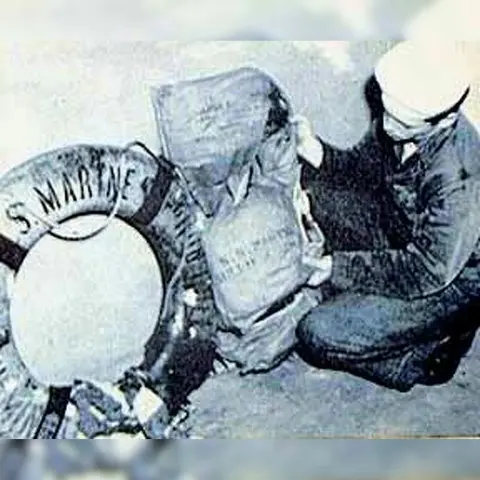
On February 20th, a U. S. Navy torpedo retriever boat operating about 12 miles southwest of Key West, Florida sighted and picked up a fog horn and life jacket stencilled with the vessel's name. This triggered a second phase of the search for the Sulphur Queen, with the search area focused from west of the Dry Tortugas, through the Straits of Florida, north along the Gulf Stream and The Bahamas, and up the east coast of Florida to Cape Canaveral.
Surface ships and multiple aircraft covered almost 60,000 square miles searching for the Sulphur Queen. Meanwhile, the U. S. Navy conducted an underwater search for the wreck using six surface vessels, Navy divers, and multiple aircraft, between February 20th and March 13th. This second phase of the search recovered additional debris, positively identified as coming from the Marine Sulphur Queen.
On March 14 1963, five weeks after the last communication from the vessel, the search for the Sulphur Queen was discontinued. The materials recovered consisted of 8 life jackets, 5 life rings, 2 name boards, 1 shirt, 1 piece of an oar, 1 storm oil can, 1 gasoline can, 1 cone buoy, and 1 fog horn. All of this evidence was sent to the US Coast Guard Station in Miami, Florida, and later sent on to Washington D.C. The evidence was analyzed by the Bureau of Standards, the Coast Guard, and the Bureau of Fisheries, producing a consensus opinion that two life jackets were likely worn by crewmembers, and a shirt found tied to a lifejacket had also been worn. The lifejackets had numerous tears, indicative of being bitten by marine life. No evidence of sulphur contamination, explosion, or fire was found on any of the recovered debris.
Edith Martin, the wife of engineer Adam Martin, lamented, “I never wanted to be a seaman’s wife, but he had to earn a living. I came to see him off. The poor soul. I felt sorry for him when he first saw his new ship. It looked like an old garbage can afloat.”
The US Coast Guard Marine Board of Investigation launched its inquiry in Beaumont on February 20. Texas Gulf Sulphur Company and MTL personnel testified before moving the inquiry to New York for additional testimony from MTL leadership. Its findings were published on March 17th, 1964. The Board concluded, and the US Coast Guard Commandant concurred, “The vessel apparently was lost on 4 February 1963 on its approach to, or in the vicinity of, the Straits of Florida. In view of the absence of any survivors and the physical remains of the vessel, the exact cause for the MARINE SULPHUR QUEEN could not be ascertained.” Her entire crew of 39 were presumed dead.
The Board could only speculate based on the little evidence available. The report puts forward the possibility that the sinking occurred so rapidly that there was no time to send a distress signal. The Board also suggests the recovered and worn lifejackets were likely worn by men on watch, who had them at the ready.
While it did not assign any cause as definitive or even likely, possible causes were suggested. These were, in no particular order of probability:
-
An explosion may have occurred in the cargo tanks
-
A complete failure of the vessel's hull girder may have caused it to break in two
-
Capsizing due to synchronous rolling
-
A steam explosion caused by rapid filling of the void space with water
Another theory suggests a mixture of explosive gases, specifically hydrogen sulphide and carbon disulphide, were released from the molten sulphur due to agitation from the rough seas. If so, and some form of an ignition source were to occur, an explosion could have been possible. Thermal expansion and longitudinal structural failure are also discussed, however, all of these possibilities were only conjecture.
The Board noted and documented the recurring, unaddressed fires beneath and alongside the sulphur tanks, and the T2 tanker’s well-known "weak back" tendency, resulting in keels splitting at points weakened by corrosion, typically around midships. The Board was critical of the condition of the vessel and its owners, MTL, citing widespread corrosion, including inoperable temperature gauges and a ruptured steam coil. While the vessel was inspected and recertified by the Coast Guard in January 1963, a more extensive drydock inspection was postponed by MTL, citing cargo deliveries were running behind.
The Board of Inquiry made a number of recommendations following its investigation, however, the Commandant of the US Coast Guard, Admiral Edwin J. Roland, did not concur with all of them. Notably, the Commandant agreed no other T2 tanker should be converted in the same manner as the Marine Sulphur Queen but rejected the Board's broader recommendation banning any conversion that deviated from original petroleum-carrying design. Instead, he set a case-by-case standard, suggesting a conversion's acceptability depends on the vessel's actual condition, proposed cargo, route, and service, and not a blanket rule. Notably, he explicitly approved one workaround already in use: joining a sound existing T2 bow and stern to an entirely new, purpose-built cargo midbody.
A recommendation to install fire hose stations in void spaces was rejected by the Commandment, citing concerns of the corrosive nature of water when fighting sulphur fires, and the logistics of putting such stations in the cramped void spaces.
The Commandant did concur with a number of other recommendations including increased training for crew and operators of molten sulphur carriers, and increased studies for proposed carriers of exotic cargo, such as molten sulphur.
Within weeks of the ship's disappearance, relatives of the 39 lost crew members filed suit claiming the vessel was unseaworthy, citing two federal maritime statutes: the Jones Act, and the Death on the High Seas Act. Claimants initially sought $2.5 million in damages from Marine Transport Lines, Marine Sulphur Transport Corporation, Bethlehem Steel Company, and the Texas Gulf Sulphur Company. The highly contested lawsuit dragged on for nearly a decade.
The Court for the Southern District of New York heard extensive evidence covering the ship's full operating history, her 63 round-trip voyages, her documented safety deficiencies, and expert testimony on possible causes of loss.
The case against Texas Gulf Sulphur was dismissed by the court, but lawyers for the remaining three defendants petitioned to limit damages to the post-loss value of the vessel. This is a standard tactic in such maritime-law cases, allowing shipowners to cap their damages exposure. In the case of the Marine Sulphur Queen, damages would be minimal if this petition was granted. However, the court did not agree, and allowed for compensatory damages to be sought.
The district court discovered the vessel actually carried 15,315 long tons on its final voyage, based on the bill of lading and weight certificate. The court specifically noted that this exceeded the ship's stated optimum cargo capacity of 15,211 long tons. The court found that the sulphur completely filled the cargo tanks and overflowed into the expansion trunks, and considered this both improper and dangerous. Even more significantly, the district court found that the optimum cargo figure had been exceeded on 45 of the previous 64 voyages, not merely on the final voyage. The district court characterized this as gross negligence by MTL, particularly because of the unusual design of the vessel.
By 1969, the amount sought by the families had grown to $20 million, due partially to inflation but also because the families were forced to wait many years for a resolution. On May 12th, 1970, the district court made a factual finding that "no one knows how the ship was lost” but did find the vessel to be unseaworthy at the time of her loss. Those reasons, in summary, were:
-
insufficient transverse strength after the conversion
-
inability to adequately withstand racking stresses at the corners of the vessel
-
inadequate provision for thermal expansion
-
concentrated cargo reducing the radius of gyration
-
increased shear stresses on bottom transverse frames
-
sulphur contamination and corrosion
-
potentially explosive hydrogen sulphide and carbon disulphide
-
inadequate warning systems
-
ineffective ventilation because the tanks were overfilled
-
dangerous loading practices
The court ruled that no punitive damages were warranted in this case, but compensatory damages could be awarded.
The case was then sent to the U.S. Court of Appeals for the Second Circuit. On April 25, 1972, 9 years after the loss of the Sulphur Queen, the court concurred with the lower court’s ruling. The decision included much discussion about the vessel being the first of its kind and experimental. During testimony, an engineer called the vessel, “a calculated risk.”
The Court also agreed with the lower court’s ruling that since nobody knew how or why the ship was lost, punitive damages did not apply.
Marine Transport Lines and Marine Sulphur Transportation Company were found liable for compensatory damages, but the case against Bethlehem Steel was dismissed.
According to a February 4th, 1973 report by the New York Times, the first of these payments went to Genoveva Phillips, the widow of ordinary seaman, James A. Phillips, of Port Arthur, Texas. She was awarded $115,000 in January of 1973. The lawsuits were filed individually, and not as a class action suit, and specific figures are not available. One report claimed $7.5 million dollars had been paid to the 39 families of the crewman, while a later report cited nearly fifteen million dollars. Exact figures paid out to the families could not be verified.
The T2's reputation among naval architects and maritime historians is complicated. They are revered as workhorses of the war effort, and hundreds of them served during the war and went on to be reliable commercial tankers for decades. On the other hand, the T2 tankers had a well-documented history of catastrophic structural failures involving the properties of wartime steel, welded construction, stress concentrations and brittle fracture. When shipping companies began purchasing surplus T-2s during the 1950s and 1960s, such as the Marine Sulphur Queen, their weakness was already known.
Notably, the SS Pendleton and SS Fort Mercer, both broke in half during a violent storm off the coast of Cape Cod in February of 1952. Both were converted T-2 tankers. The 2016 film “The Finest Hours” depicts the US Coast Guard’s heroic rescue of the crew of the Pendleton. Nine of the Pendleton’s 41 crew were lost, and 5 of the 43 on the Fort Mercer. Two years later in 1954, the SS World Concord broke in half while in the Irish Sea in 1954, and all 41 of her crew were rescued.
The deadliest example of the converted T2 tankers came in 1983, when the Marine Electric broke its back and sank off the coast of Virginia during a storm. 31 of its 34 crew were killed. The Marine Electric was also owned by Marine Transport Lines. You can hear the full story of the Marine Electric in episode 88 of Shipwrecks and Sea Dogs. Following the loss of the Marine Electric, MTL was spun off and sold, and was eventually acquired by Crowley Maritime in 2001. Very few T-2 tankers remained in service following the loss of the Marine Electric, and those that did were retired in the mid 1990s. The World War Two era tankers provided fifty years of service, an impressive record, but not without some catastrophic failures.
The US Coast Guard report includes mention of a curious, but dubious incident. On April, 29th, 1963, the Coast Guard was given a note that was reported to have been in a whiskey bottle found near Corpus Christi, Texas. The note was written on a piece of manila paper, was unsigned, and claimed their ship suffered an explosion and two men were hurt. The piece of paper also had a crude map with a circle surrounding an "X" marking the western approach to the Strait of Florida, and the word "SHIP." The bottle itself could not be located by the Coast Guard, but later was given the bottom of a bottle that showed no evidence of being in the water for several months. While the note was initially thought to have been written by a specific crewman, the US Coast and Geodetic Survey in Washington, D. C. determined that the currents in the Gulf could not have resulted in the bottle floating west across the Gulf to the Texas coast. This and other wild speculation lacking any credible evidence, including Bermuda Triangle theories, have flourished over the decades.
While we have nothing conclusive to suggest why the Marine Sulphur Queen went down, in light of the evidence of the structure of T2 tankers, the conversion into a molten sulphur carrier, and the problematic history of this class of vessels, the evidence points strongly toward a catastrophic failure involving the ship's known structural and operational deficiencies, and a sudden structural failure in heavy weather remains one of the most plausible explanations.
The wreck of the Marine Sulphur Queen has never been found. Its crew of 39 were lost forever, but their memory will not be forgotten. This episode is dedicated to those crewmen.
John C. Ardoin, Oiler
Everett E. Arnold, Able Seaman
Fred A. Bodden, Able Seaman
James M. Bodden, Able Seaman
Henry P. Clark, Fireman/Water Tender
Leon B. Clauser, Chief Engineer
Ceburn R. Cole, Able Seaman
Leroy Courville, Fireman/Water Tender
Frank J. Cunningham, 3rd Mate
John L. Denton, 1st Assistant Engineer
Nelaton E. Devine, Able Seaman
Charles L. Dorsey, Chief Steward
James V. Fanning, Master
Wesley Fontenot, Messman
Leroy B. Green, Utilityman
John Elmer Grice, Oiler
Henry P. Hall, 2nd Mate
Robert E. Harold, Utilityman
Aaron Heard, Wiper
Hugh D. Hunter, Galleyman
John Husch, Jr., Wiper
Willie T. Manuel, Able Seaman
Adam Martin, Jr. 3rd Assistant Engineer
Clarence McGuire, Ordinary Seaman
John M,. Nieznajski, Ordinary Seaman
Evans Phillips, Bosun
James Phillips, Ordinary Seaman
Walter Pleasant, Messman
Juan Santos, Wiper
Jack R. Schindler, Able Seaman
E.W. Schneeberger, 3rd Assistant Engineer
George E. Sloat, Radio Officer
Cornelius Smith, 2nd Cook and Baker
Alphan Tate, Fireman/Water Tender
Vincent Thompson, Chief Cook
Alejandro Valdez, Oiler
A.R. Van Sickle, 2nd Assistant Engineer
Jesse I. Vicera, Pumpman
George E. Watson, Chief Mate
That’s going to do it for Lost Without a Trace: The Marine Sulphur Queen. Thank you so much for listening. The primary source used for this episode is the United States Coast Guard Marine Casualty Report, dated March 17, 1964. You can access this document through the link in the show notes, or from the US Coast Guard web site at uscg.mil.