The Daniel J. Morrell: Torn in Two on the Great Lakes
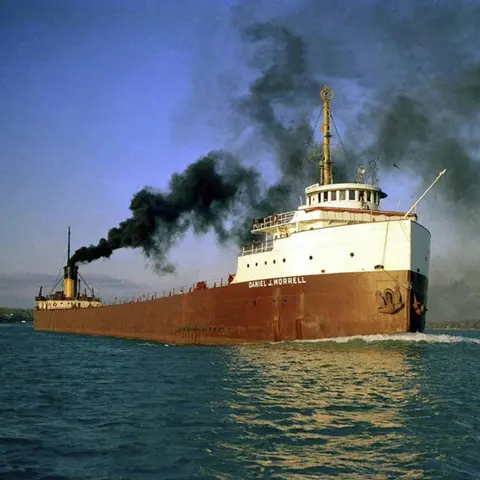
In November 1966, the SS Daniel J. Morrell broke apart in a Lake Huron storm. Of 29 men aboard, only one survived.

 Apple Podcasts

 Spotify

 iHeartRadio

 PocketCasts

 Goodpods

 Amazon Music

 Castbox

 Pandora

 Podchaser

 Youtube Music
On November 29, 1966, the Great Lakes freighter Daniel J. Morrell was torn in two during a violent late-season storm on Lake Huron. Within hours the ship had broken apart. Of the 29 men aboard, only Deck Watchman Dennis Hale survived to tell the story.
Built in 1906, the Morrell had worked the lakes for six decades, hauling bulk cargo through some of the most unforgiving fresh water on Earth. In this episode, host Rich Napolitano explores the ship’s long career and the events of her final voyage. You will also hear about watchman Dennis Hale, who endured 38 hours adrift in freezing weather before rescue arrived, and the Coast Guard's Marine Investigation conclusions.
The loss of the SS Daniel J. Morrell is one of the worst Great Lakes shipwrecks of the twentieth century. While the loss of the SS Edmund Fitzgerald is more widely known, the Witch of November has taken many other ships, and perhaps none more dramatically than the Daniel J. Morrell.
Whether you are a maritime historian, a wreck diver, a shipwreck hunter, or simply drawn to Great Lakes history, this episode offers a detailed account of the Morrell’s final voyage.
Written, edited, and produced by Rich Napolitano. All episodes, show notes, and transcripts can be found at shipwrecksandseadogs.com.
Original theme music is by Sean Sigfried and you can find him at seansigfried.com.
** No AI was used to create this episode.
**🎧 Support The Podcast | LISTEN AD-FREE + BONUS EPISODES**
👉Get exclusive bonus episodes and free merch on Patreon: https://www.shipwrecksandseadogs.com/patreon
👉Listen ad-free on on Apple Podcasts: https://www.shipwrecksandseadogs.com/apple
👉Shipwrecks and Sea Dogs is part of the Into History podcast channel. Subscribe here: https://www.intohistory.com/shipwreckspod
👉Get your Shipwrecks and Sea Dogs merchandise here! https://shop.shipwrecksandseadogs.com
👉Don't want any long-term commitments? You can support the podcast with a donation of any amount at: https://www.buymeacoffee.com/shipwreckspod
Deck officers
- Arthur I. Crawley, Master
- Phillip E. Kapets, First Mate
- Duncan R. MacLeod, Second Mate
- Ernest G. Marcotte, Third Mate
Deck crew
- Charles H. Fosbender, Wheelsman
- Henry Rischmiller, Wheelsman
- Stuart A. Campbell, Wheelsman
- Albert P. Wieme, Watchman
- Norman M. Bragg, Watchman
- Dennis N. Hale, Watchman (the only survivor)
- Larry G. Davis, Ordinary Deckwatch
- John M. Groh, Ordinary Deckwatch
- Arthur E. Stojek, Deckhand
- John J. Cleary Jr., Deckhand
Engine room
- John H. Schmidt, Chief Engineer
- Valmour A. Marchildon, First Assistant Engineer
- Alfred G. Norkunas, Second Assistant Engineer
- George A. Dahl, Third Assistant Engineer
- Wilson E. Simpson, Oiler
- Donald E. Worcester, Oiler
- Chester Konieczka, Fireman
- Arthur S. Fargo, Fireman
- Saverio Grippi, Coal Passer
- Leon R. Truman, Coal Passer
- David L. Price, Coal Passer
Galley and steward department
- Stanley J. Satlawa, Steward
- Nicholas P. Homick, Second Cook
- Joseph A. Mahsem, Porter
- Charles J. Sestakauskas, Porter
It’s November 29, 1966. 2:00 a.m.
The wind is blowing sixty miles an hour out of the northwest of Lake Huron. The freighter Daniel J. Morrell , six hundred feet of steel, rolls high in the water on the last run of the season, bound from Buffalo for Taconite Harbor. Waves the height of a house lift her stern and drop it again. Her sister ship turned for the shelter of the St. Clair River hours ago, but the Morrell pressed on.
Below deck, a twenty-six-year-old watchman named Dennis Hale sleeps through the storm, as only sailors can do in such circumstances.
A loud bang suddenly wakes him, but he decides it must be the anchor slamming against the bow. Then it comes again. Hale knows the difference between a loose anchor and trouble, and in an instant he is out of his bunk and moving.
On deck the wind takes his breath. The ship is groaning under him, in a deep roar, a sound it shouldn’t be making. Men are already gathered around the forward liferaft, shouting and working at the lashings.
The low roar of the Morrell then turns into a nightmarish screeching, ripping noise. Sparks fly as the metal tears like paper. Forward and aft, two halves of the same ship rip away from each other, and the stern, its engines still turning, drives on and grinds into the bow.
Hale and his shipmates are thrown over the side.
The near-freezing water takes his breath away, but he claws his way back to the surface. Around him is the terrible sound of a raging storm and darkness. But he is drawn to the carbide lamp burning on the life raft, appearing and disappearing in the massive swells of the lake. Hale swims, keeping his eye on the light until he finally reaches it. Three others have also made it, and they climb into the liferaft, exhausted.
He has no way of knowing that it will be thirty-eight hours before anyone finds him, or that the men beside him will not survive. Of the twenty-nine men aboard the Morrell tonight, one will live to tell this story.
The Sinking of the Daniel J. Morrell, today on Shipwrecks and Sea Dogs.
Hello and welcome to Shipwrecks and Sea Dogs, tales of mishaps, misfortune, and misadventure. I’m your host Rich Napolitano.
Every November, our thoughts turn to the loss of the SS Edmund Fitzgerald in 1975. Its fame and its story reaches beyond maritime history enthusiasts and into the general public’s consciousness, in no small part to Gordon Lightfoot’s legendary song.
But the Witch of November has taken other ships of the Great Lakes, and perhaps none so dramatically as the Daniel J. Morrell.
In 1906, the Cambria Steamship Company of Cleveland, Ohio launched two new bulk freighters: The SS Edward Y. Townsend, and the SS Daniel J. Morrell. The two ships were constructed simultaneously; the Townsend at Superior Shipbuilding Company of Superior, Wisconsin, and the Daniel J. Morrell at West Bay City Ship Building Company of West Bay, Michigan. The Cambria Steamship Company was a new subsidiary of the Cambria Iron Company of Johnstown, Pennsylvania.
While virtually identical sister ships, the Morrell was one foot shorter, with an overall length of 602 feet and beam of 58 feet, giving them both the title of ‘Queen of the Lakes’, for a time. The Morrell was named after Daniel Johnson Morrell, one of the earliest General Managers of the Cambria Iron Company, and an influential businessman and politician in Pennsylvania.
These and other ‘600 footers’ built in 1906 became the standard for Great Lakes bulk carriers. These steel-hulled Lakers were designed to carry bulk freight such as taconite (a form of iron ore), grain, and other cargoes throughout the Great Lakes.
Construction booms around the turn of the century caused an increased demand for steel, and the rich iron ore fields of Minnesota were meeting that demand. This ore needed to be shipped east to steel mills such as Detroit, Chicago, Buffalo, and Cleveland. These new freighters could be built quickly, and with their wheelhouses located forward, had an uninterrupted deck with 18 cargo holds with sliding steel hatch covers. These freighters were more efficient, could be loaded and unloaded faster, and therefore were more profitable. Designed for a crew of 29, quarters for deck officers and personnel were located forward, with quarters for engineering and other crew located aft.
Its lifesaving equipment included two 21-person lifeboats positioned aft, as well as two 15-person liferafts; one located between hatches 3 and 4, and another located on the aft boat deck. No survival suits or other equipment was on board to protect the ship’s crew from exposure. One AM and FM radio were equipped in the wheelhouse, with a remote station for each provided in the Captain’s cabin. Phones and an engine order telegraph produced communications between the wheelhouse and the engine room. The ship did not have a shipwide public address system, and nor an emergency radio.
In 1908, the Cambria Steamship Company and its vessels came under the management of the M.A. Hanna Company, a diversified company involved in the iron ore processing industry.
For decades, the Daniel J. Morrell carried cargos, mostly taconite, from Lake Superior ports such as Duluth and Taconite Harbor, Minnesota to eastern steel mills without much incident and occasionally carried record loads. Her early history reported some ongoing trouble with her compass and just one major incident. On August 13th, 1909, the Morrell collided with the Henry Phipps, another 600 footer, in heavy fog at Whitefish Point, Michigan. The Morrell required $10,000 of repairs but returned to regular service later that year.
In 1922, the Morrell became the first bulk freighter on the Great Lakes to use a gyrocompass. The first practical gyrocompass was created by German Hermann Anschütz-Kaempfe in 1906, and had begun being used in the United States in 1908. A gyrocompass finds true north rather than magnetic north, doesn’t suffer from magnetic interference, and is relatively stable during the typical pitching and rolling experienced by ships.
Management of the Cambrian Steamship Company shifted to Bethlehem Transportation Company in 1927 and the Daniel J. Morrell continued with its regular routes hauling iron ore for the next several decades.
In 1945, as a fifty year old veteran Laker, she was fitted with two new Babcock and Wilcox boilers and in 1956 with a three cylinder Skinner Unaflow engine, which nearly doubled its horsepower from its original configuration of two Scotch boilers and a triple expansion steam engine. After the various rebuilds, its length was measured to be an overall length of 609 feet.
Over the decades, advances in steel manufacturing had been made, providing for stronger, and more flexible steel. The steel used to build the Daniel J. Morrell, the Edward Y. Townsend, and other ships built prior to 1948 were prone to becoming weak and brittle in cold weather, especially when combined with rough, stormy conditions. The World War II era T2 tankers and Liberty ships that I have discussed in multiple episodes of this podcast are other examples of this trait. But unlike the T2s and Liberty Ships, the Morrell and Townsend were of riveted construction, not welded, and by 1966, they were still seaworthy, efficient, and profitable, and so remained in service.
The Coast Guard performed its annual inspection of the Daniel J. Morrell on April 15, 1966 in Toledo, Ohio, and a mid-season inspection on July 20 in Buffalo. While the aging ship showed signs of wear and tear and cosmetic defects, no deficiencies were found during either inspection, and the ship maintained its certification.
On November 26th, 1966, both the Daniel J. Morrell and her sister ship the Edward Y. Townsend were at the Lackawanna Dock at the Port of Buffalo, preparing to make their last run of the season. Both ships had unloaded their cargo and would be heading back west to Lake Superior and Minnesota with no cargo. Their previous voyage was to be their last, but another vessel that had been scheduled was experiencing engine problems, and both the Morrell and Townsend were tabbed to take its place.
During the last week of November of 1966, a sudden cold rush of Arctic air from the north rushed down and interrupted what had been a relatively mild November. The meeting of frigid northern air and the warmer air from the midwest had whipped up inclement weather around the region. Blizzards and strong winds had knocked over trees, disrupted traffic, and even resulted in some deaths. That storm was slowly moving south, and the Daniel J. Morrell and Edward Y. Townsend were heading directly into it.
In preparation for the adverse weather in Lake Erie, the Morrell’s ballast tanks were filled to increase the draft of the vessel. The fleet engineer for the Bethlehem Transportation Company noted no structural defects were observed on the Morrell.
The Master of the Morrell was 47 year old Captain Arthur I. Crawley. He was a veteran mariner, having served on bulk freighters from the time he graduated from high school. While had earned his master’s certificate several years before, it wasn’t until earlier in 1966 that he was assigned his first command. He took over as Master of the Daniel J. Morrell when its previous master, Captain William Hull, retired in July of 1966.
Crawley was in his first season with the Daniel J. Morrell, and had only had a few months under his belt to learn her tendencies and handling. He also had not yet experienced a severe fall storm on the Lakes, and the Witch of November had a way of appearing without warning.
The Morrell departed Buffalo on the evening of November 26th, bound for Taconite, Minnesota, with 29 men on board, including Captain Crawley. It was her 34th voyage of 1966, and scheduled to be her last of the season. It cleared the Buffalo breakwaters at 11:00 PM, and started west across Lake Erie.
Per company policy for daily check-ins, Captain Crawley checked in with Bethlehem dispatch in Cleveland to report his position. Around 9 AM on November 27th, Crawley reported he would be arriving at Detroit between 6:30 and 7 PM.
But the weather had become extremely nasty in the western end of Lake Erie that evening. Out of caution, Crawley anchored in the Detroit River south of Detroit, to wait out the storm, and he contacted Bethlehem again at 6:00 PM to report his position.
The Edward Y. Townsend was making the same run as the Morrell, and it departed Buffalo four hours later than its sister ship. The Townsend passed the Morrell while the latter was anchored. Captain Thomas J. Connelly of the Townsend and Captain Crawley were in communication at the time to discuss the worsening weather in Lake Huron to the north.
Ships traveling north, or upbound from the Detroit River enter into Lake St. Clair. The St. Clair River then connects Lake St. Clair to Lake Huron. Connelly communicated his intention to Crawley to anchor at Stag Island in the St. Clair River to wait out the storm in Lake Huron, and he reached that destination at 4:00 AM on the 28th of November.
Meanwhile that same morning, the Daniel J. Morrell weighed anchor at 6:55 AM and got underway again, and arrived at the Consolidation Fuel Dock at Windsor, Ontario, on the Canadian side of the Detroit River opposite Detroit at 7:05 AM. The Morrell took on 221 tons of coal and departed at 7:30 AM. The J.W. Wescott Company, an automated reporting station for Bethlehem Transportation Company, reported that the upbound Daniel J. Morrell passed Detroit at 7:53 AM.
The Morrell continued north up the Detroit River and entered Lake St. Clair.
At 9:00 AM, Captain Crawley contacted Bethlehem dispatch again, reporting he had passed Detroit. This was the last contact Bethlehem headquarters in Cleveland had with the Daniel J. Morrell.
At 1:00 PM on the 28th, the Morrell passed the anchored Townsend, and once again the two captains were in communication. They discussed the most recent weather report and what they could expect in Lake Huron, with the wind at Stag Island at that time recorded as light and westerly, between six and eighteen miles per hour.
At approximately 2:30 PM, Captain Connelly overheard conversations between unknown vessels in Lake Huron discussing the weather conditions, and learned of winds up to 28 miles per hour in the southern part of the Lake. Just before departing Stag Island, Connelly and Crawley once again conferred about the weather. The Morrell was approaching the Lake Huron Lightship in south Lake Huron when the Townsend departed Stag Island at 2:53 PM.
The two vessels continued on separately, but stayed in communication. At 6:28 PM, further discussions were had about the increasingly deteriorating weather. At that time, winds were northerly up to 35 miles per hour with waves up to eight feet, but building. At 10:00 PM the two captains spoke again, with winds now at 50 miles per hour and seas up to 12 feet. At that time, the Townsend was beginning to pound and roll, prompting Captain Connelly to restrict movement of all crew, prohibiting them from moving between the forward and aft sections of the vessel out of fear of broaching. Captain Crawley told Connelly he was correcting his course to 341 degrees true north, to stay on the recommended upbound course.
By 11:15 PM, winds had built to 55 miles per hour. Some discussion had taken place between the two captains about turning back to Port Huron, or seeking shelter at Thunder Bay on the northeast coast of Michigan, but neither captain took that option. Captain Connelly later said he feared the increased twisting action of his vessel in a quartering sea and of his light vessel broaching in a deep trough.
At 11:50 PM, Captain Crawley called the Townsend again, but Connelly abruptly told him, “I will call you back” and hung up the phone. At that moment, the Edward Y. Townsend was being pounded and blown around, rolling as much as 22 degrees to starboard. Connelly was able to stabilize the vessel and at 12:15 AM of November 29th, he did call Crawley back. Crawley reported similar circumstances and that the Daniel J. Morrell had been blown off course. This was the final communication between the two ships, and the last known contact anyone had with the vessel.
Connelly logged the winds at 65 miles per hour and waves up to 25 feet at 2 AM, while about 8 miles off Point Aux Barques, Michigan. Connelly later said he could not recall ever experiencing sea conditions of this magnitude on the Great Lakes, and he could not have launched the lifeboats safely in such conditions.
The Captain of the Townsend continued to monitor Channel 51 on the radio and attempted to make contact with the Morrell, but these efforts were unsuccessful. Although he could not be certain, Connelly estimated the Morrell to be 20 miles distant.
The Townsend was badly battered throughout November 29th in the fierce Lake Huron Storm, and notably, there was no sign of the Daniel J. Morrell. The Townsend limped into the Lime Island Fuel Dock in the St. Marys River on November 30th. She had taken on almost four feet of water in its aft cargo holds. Further inspection found a crack in her hull at cargo hatch number 10 and loose rivets in her deck plating on the starboard side weather deck. Ultimately, she was deemed to be unseaworthy, pulled from service, and was laid up at Sault Ste. Marie for two years. She never returned to service and was later sold for scrap and sank off the coast of Newfoundland in 1968 while being towed to Spain.
The Edward Y. Townsend made it safely into port, although not unscathed. The Daniel J. Morrell was never seen again. What we know about the Morrell comes largely from its single survivor, Dennis N. Hale.
26-year-old Dennis Hale and 21-year-old John Groh, both Watchmen serving on the Morrell, were not on board the ship when it departed the docks at Lackawanna, New York. While the Morrell was waiting to be unloaded, Hale used the opportunity to drive three hours to his home in Ohio. He calculated he could spend a couple hours at home with his family, then drive the three hours back in time for the vessel’s departure. Groh went with him to visit his own family in Erie, Pennsylvania. But when the two men arrived back at the Bethlehem plant in Lackawanna, they could see the lights of the Morrell in the distance, passing the breakwater of the port. They were too late, and Crawley left without them.
Not wanting to miss out on their significant annual bonus, the men contacted Crawley from the nearby Coast Guard Station. While Crawley was not about to turn around, he was down two crewmen, and told the men they could meet the ship when it stopped at Windsor for coal. Hale and Groh boarded the Morrell shortly after 7AM in Windsor, to a fair amount of good-natured ridicule by their shipmates.
Hale’s duty as Watchman included the 4:00 AM to 8:00 AM watch, and the 4:00 PM to 8:00 PM watch. After completing his evening shift on November 28th, Hale went to the galley for food, and returned back at his cabin at 9:30 PM to get some sleep. Being a watchman, his quarters were located in the forward part of the ship.
At 2:00 AM of November 29th, Hale was awakened by a loud bang. This is not entirely uncommon on a ship. He could hear the anchor banging against the bow, and tried to go back to sleep. But a few minutes later he heard an even louder bang, and books flew from his bookshelf. His bunk light was not working, indicating a loss of power. Moments later the general alarm was sounded and he jumped out of bed, grabbed his lifejacket and ran out into the starboard side passageway.
He found himself in the dark, as all the lights were out in the forward section of the vessel, although he could see lights on the aft section superstructure. Standing in the passageway he couldn’t help but notice the center section of the ship was raised higher than the aft section, a condition known as “hogging” that can result in extreme stress on a ship’s hull.
Wearing just shorts, a peacoat, and a lifejacket, Hale arrived on the deck and could see the ship ripping apart amidships. At the forward liferaft, he found the officers and deck crew surrounding the liferaft, some of them already seated in the liferaft. The sound of crunching and cracking metal could be heard, and there was talk about the damage amidships.
Some of the men were already seated in the pontoon liferaft and waited for the ship to sink. Captain Crawley instructed the men to use the flares once the liferaft was free of the ship.
From his position in the raft, Hale could see the crack in the starboard side, near hatches 11 and 12, and it continued all the way across to the port side. The bow section was now twisting apart and sat lower in the lower. Sparks flew from the metal scraping and grinding together.
Then suddenly, the two halves of the ship broke free of each other. In the darkness, Hale could see the stern section pushing forward toward, still under power. The bow was forced to the port side as the stern section pushed past, its engines still running. The two sections separated and drifted apart.
Moments later, the bow began settling low in the water, a wave crashed over the deck, washing the liferaft and crew on the deck over the starboard side. The raft was thrown clear of the sinking bow, although none of the crew remained inside. Within just 8 minutes of hearing the general alarm, the ship had ripped in half and Dennis Hale found himself in water of just 44 degrees Fahrenheit - about 7 degrees Celsius.
Hale popped up about 10 feet from the liferaft and quickly swam toward its shining carbide light. He struggled to gain his breath in the frigid water, but pushed on one stroke at a time. When he reached the raft, two sets of hands reached down for him and pulled him in. Fellow deckhands Arthur E. Stojek and John J. Cleary had reached the raft just moments before. Wheelsman Charles “Fuzzy” Fosbender was then pulled on board as well. Of the four men, Fosbender was the only man who was fully dressed, as he had been on duty at the time. Once in the raft, Hale could see one man still standing on the forecastle of the sinking bow, but could not identify him. He could not see any other liferafts, or any of his shipmates in the water. For roughly 15 minutes, the four men watched the bow section of their ship quietly sink under the waves. No distress signal was ever sent from the Daniel J. Morrell.
In the distance, Hale could see the lights of the stern section about a mile off, getting ever further distant. It chugged along for about 90 minutes before it too disappeared out of sight.
Hale’s liferaft was equipped with emergency flares, and, knowing there were at least two other vessels in the area, including the Townsend, Hale shot off several of the flares before the flare pistol broke into two pieces. He managed to hold it together with his hands and fire off the remaining flares.
The bright red, wooden and metal pontoon liferaft had plenty of space for the four men. However, they laid together, huddled in one end of the raft to stay warm. All of the men were wet, and in the below freezing late November temperature, hypothermia was a very serious danger. Waves continually crashed over top of the raft, and while each of them had a lifejacket, none of them were wearing clothing that could protect them from the elements.
The men laid in the raft, hoping a vessel might see them, throughout the early morning hours of November 29th. They rubbed their arms and legs, put their fingers in their mouths, and tried to move around to stay warm and keep their blood pumping. Dennis Hale later described how he would talk to each man, trying to keep them awake. But Arthur Stojek and John Cleary very quietly died around 6:00 AM. Fosbender was severely injured when he was thrown from the ship. He complained about his chest feeling heavy, like his lungs were full of something, and that he couldn’t breathe. Hale begged his friend to stay with him, and nudged him with his knee. Fuzzy gasped, “Still hanging in there.” But at 4:00 PM that afternoon, Fosbender slumped over Hale’s legs and died, leaving Dennis Hale as the lone survivor.
For the next 24 hours, Hale drifted helplessly in the cold, fighting off death. He had no more flares and could only hope a passing vessel might spot him. Hale laid silently in the raft, and kept his mind busy thinking of his family, and willing himself to stay alive. Cold and exhausted, he desperately needed sleep but fought against it, fearing he would never wake up.
The Daniel J. Morrell was expected to arrive at Taconite, Minnesota at 9:00 PM on November 29th. That time came and went while Hale was alone, fighting for his life, in Lake Huron. The shoreline came tantalizingly close a few times, with the wind and waves moving him close, only to send him back out to sea again.
Throughout the night and into the morning of November 30th, Hale was suffering from exposure and experiencing symptoms of hypothermia. He drifted in and out of consciousness, began hallucinating, and was terribly thirsty. He occasionally used a portion of the flare piston to scoop water from the lake, but he knew drinking too much of the cold water would drop his body temperature. When he lost the gun, he began breaking off ice from his pea coat and allowed it to melt in his mouth.
According to Hale’s later comments, he saw a man with a white beard and wearing a robe appear on the edge of the raft. It spoke to him, saying, “Stop eating the ice off your coat,” in a thunderous voice before vanishing. Hale called the man ‘Doc’ and did as commanded; he stopped eating the ice.
Hale had another hallucination, experiencing himself floating up off the raft, then high into the sky, above the clouds, to a land with people dressed very much like ‘Doc.’ He was reunited with relatives and his shipmates, and saw scenes of his life. Hale later said, “The time I was in the cloud all you could feel was love all around you.” When former shipmate George Dahl told him, “Dennis, what are you doing here? It’s not your time yet. You have to go back.” And then Hale was suddenly back on his cold and miserable raft. He again picked some ice off his peacoat, and the vision of Doc appeared to him again, with another warning. Hale did not attempt to eat any more ice.
As the afternoon of the 30th pushed on, Hale was only semi-conscious. He remembered thinking he would never survive another night in the raft. Meanwhile, the freighter C.G. Post spotted a man floating face down in the water near the Harbor Beach Breakwater Lighthouse. The man had on an orange lifejacket, with the name “Daniel J. Morrell.”
At 12:15 PM of November 30th, Bethlehem Steel reported the vessel as missing. This was 34 hours after the vessel broke apart, and 15 hours after being reported overdue at Taconite.
The Cleveland Coast Guard Station quickly assembled a search and rescue team consisting of Coast Guard Cutters, helicopters, airplanes, and freighters to search for the missing vessel. The immediacy of the rescue was felt, because they knew in these conditions, nobody could survive for long.
Hale’s liferaft was spotted by a Coast Guard helicopter at 4:00 PM on November 30th, in shallow water near Huron City. At first, Hale thought it was seagulls hovering over him, or that he was hallucinating again. The helicopter, which had pontoons, landed nearby and two coastguardsmen waded through the knee-deep water over to the raft. Hale, in his weakened state, simply repeated, “I love ya…”
Another helicopter landed on the opposite side of the raft to assist in the rescue. Dennis Hale was barely conscious and could not move on his own. After carrying him to the helicopter, he was taken immediately to Harbor Beach and taken to a nearby hospital.
The three deceased crewmen from the Morrell were recovered as well. Coastguardsman Al Massey later said, “They were frozen like statues, in the positions they were in when they died.”
Hale had been in the liferaft for 38 hours. He arrived at the hospital suffering from hypothermia, frostbite on his feet, and dehydration. Dr. Robert Oakes was the first to treat Hale at the hospital and later said, “It was the coldest I’d ever felt anyone that was alive.” Hale’s body temperature was 94.6 degrees when he arrived at the hospital. It is thought Hale’s large size, at 220 pounds, helped protect him from hypothermia, and his lack of pants, which have been soaking wet, prevented his legs from freezing.
The rescue of Dennis Hale provided some hope for the rescue team, and as he recovered in the hospital, the search for his shipmates continued. The search and rescue operation included the Coast Guard Cutters Mackinaw, Bramble, and Acacia, 4 Coast Guard motorized lifeboats, two helicopters and two fixed-wing aircraft from the Traverse City, Michigan Coast Guard Station, and two helicopters from the Detroit Coast Guard Station.
By the end of November 30th, a total of 11 bodies were recovered. Nine more were found on December 1st. The active search was called off on December 4th, but shorelines continued to be monitored. Two more bodies were found over the following week. Blizzards and foul weather hampered rescue efforts throughout the entire duration of the operation. Eventually, 26 of the 28 deceased crew of the Daniel J. Morrell were recovered. The two men who remained missing, including Hale’s friend John Groh, were declared legally dead in May of 1967. The names of all of the crew of the Daniel J. Morrell are listed in this episode’s show notes.
The loss of the Daniel J. Morrell and 28 of its crew hit the Great Lakes community hard. Reporters flocked to the hospital to interview the sole survivor, but the hospital staff kept them at bay. Hale was the center of attention and portrayed as a hero, but he felt otherwise. While glad to be alive, he wanted the focus to be on finding his lost shipmates.
Over the course of the next few days, Hale spoke with Bethlehem Steel officials, the Coast Guard, and then finally the media. His wife Bertha arrived, along with his stepbrother and stepmother, and Hale recounted his story over and over to the press, eager to get their stories printed. He only mentioned his hallucinations, Doc, and his trip to the clouds to a priest, who advised him not to speak of it with anyone else.
The tragedy set off many questions from the public, the Coast Guard, the media, families of the victims, and the shipping industry. The event triggered a debate about the age and condition of the Great Lakes fleet. The Morrell was built in 1906, and Hale insisted the ship broke apart in a storm that other vessels survived. This raised concerns about whether old steel freighters were still safe in severe weather, which was a common occurrence on the Great Lakes late in the season.
In addition to tearing the Morrell in two and putting an end to the career of the Edward Y. Townsend, the late November storm over Lake Huron impacted several other vessels. The freighters Howard L. Shaw, Robert Hobson, Harry Coulby, and Henry Steinbrenner, all sought refuge at Port Huron rather than take on the adverse conditions. However several others, including the Fred A. Manske proceeded on through the storm and arrived safely at their destinations.
The Coast Guard Marine Board of Investigation began its hearings to look into the loss of the Daniel J. Morrell in December 1966, in Cleveland. Dennis Hale, being the only survivor, was a key witness. On December 23, 1966, Hale, who had been transferred to Ashtabula General Hospital in his hometown, provided an emotional testimony. Survivor’s guilt was already plaguing him, something he dealt with for the rest of his life. The stress of answering so many questions, forcing him to relive the experience proved emotionally damaging. He struggled both physically and psychologically during the interviews. Hale told the Board that the Morrell “leaked like a sieve” and estimated 25 percent of the rivets on the Morrell were bad. “There has never been a time since I have been sailing that there’s never been holes in it.” he added.
The five-member board, released its findings, along with the Commandant’s action, were published on March 4, 1968.
The Board concluded that the cause of the sinking of the Daniel J. Morrell was the failure of the main hull girder amidships, which split the ship resulting in the sinking of both halves. It listed several contributing factors: heavy wave stress, a thin original design for such a long, shallow hull, steel that turned brittle in the cold, a notch in the structure where the fracture began, and metal fatigue. For the loss of life, it cited the lack of any distress signal, the late overdue report, and lifesaving gear that gave no protection from the weather.
The Board made twelve recommendations, which included the following:
-
inflatable rafts to accommodate everyone quartered in each end of the ship
-
a fix for signal pistols whose screws could back out.
-
An emergency radio power equipped in the wheelhouse
-
a datum marker buoy
-
independently powered general alarms at each end
-
a regular vessel reporting system with check-ins about every 24 hours.
-
special hull inspections for Great Lakes vessels built before 1948, loading manuals showing hull bending stresses, and watertight compartmentation in new cargo ships.
-
It also recommended further study of whether hatch covers need tarpaulins, and a request that sea conditions be added to weather broadcasts.
-
No action was taken against the deceased master, Captain Arthur Crawley.
The National Transportation Safety Board reviewed the Coast Guard’s report in February 1968 and worried that similar failures could hit other older bulk carriers. It urged the Coast Guard to either strengthen the midships deck structure on pre-1948 ships over 400 feet or restrict their fall operations, and to follow the inspections with a progressive structural renewal program.
The Daniel J. Morrell broke in half about 20 miles northeast of Harbor Beach, Michigan in Lake Huron. The search for its wreckage began immediately, coinciding with the search for survivors. A broken lifeboat and oars were found in the vicinity of the sinking, and lifejackets had been found on shore near Harbor Beach. The late season, frigid temperatures and inclement weather made the initial search for the wreckage extremely difficult, and by December 20th, the search for the wreck was abandoned.
After the new year in 1967, Coast Guard Admiral Willard J. Smith contracted with Ocean Systems, Inc, of Alexandria, Virginia to find the wreck. It didn’t take long. On January 6th, a Navy plane spotted a potential target and directed the US Coast Guard Cutter Bramble to the spot. The Bramble painstakingly combed over the area in a grid formation. Finally on January 6, 1967, they found what could be the Daniel J. Morrell. The Ocean Systems team lowered a remote control camera down to the spot, and soon enough the words “Daniel J. Morrell” were seen. They had found the stern section standing upright, in 216 feet of water, about 16 miles from Point Au Barques lighthouse at the tip of Michigan’s “thumb.” One of its lifeboats could still be seen, along with intact cabins, dishes in the galley, and the machinery in the engine room. A clock in its interior had stopped at 3:28 AM.
The bow of the Morrell proved to be more elusive, but in May of 1979, shipwreck hunter David Trotter found it with assistance from Long Range Navigation equipment. Trotter and his team found the wreck of the bow standing upright and with its anchors still in place. Its funnel still stood tall and proud and the Cambria logo still visible on the foremast. Inside the pilothouse, a clock had stopped at 1:55 AM. The bow and stern lie roughly 5 miles from each other, demonstrating how far the stern continued on its own power after the Morrell was torn in two.
The mangled and torn steel can still be seen as a reminder of the powerful forces that tore the ship in half. Diving on the wrecks is permitted, but removing or disturbing artifacts from the two sites is strictly prohibited.
The Great Lakes Shipwreck Museum at Whitefish Point, Michigan opened a Daniel J. Morrell exhibit in 2021, including Dennis Hale’s lifejacket, the ship’s bell, and other items honoring the loss of the ship and its crew. Visitors to the Pointe aux Barques Maritime Museum can see a portion of Hale’s liferaft, and the Milwaukee Central Library hosts the Morrell’s nameboard.
Historical markers at Harbor Beach and Point aux Barques, recount the sinking, the loss of the 28 crew members, and Dennis Hale's survival.
The Great Lakes Lore Maritime Museum in Rogers City, Michigan inducted 23 of the Morrell’s sailors into its Hall of Fame, and holds an annual bell-ringing ceremony every November to honor the lost crew.
For many years, Dennis Hale did not want to talk about the Daniel J. Morrell. He had talked about it enough already, and his survivor’s guilt was very real. He once said, “I was glad to be alive but questioned why I had lived when all my shipmates perished.”
Dennis Hale suffered permanent nerve damage as a result of his experience, and never again sailed on the Great Lakes. His injuries required 11 surgeries over his lifetime, including the amputation of his left toe in 2010.
But the psychological damage may have been worse. Hale battled substance abuse and depression for decades while his marriages fell apart. Later in his life, he recalled, “I just felt shame. Embarrassment. I didn't want to be the sole survivor. I just wanted my old life back. There were 28 other people on board. It was quite a loss - my whole family."
After three decades, Hale was able to overcome those challenges and began speaking publicly of his trauma. He even wrote his autobiography, Shipwrecked: Reflections of the Sole Survivor, published in 2010.
Dennis Hale passed away from cancer at age 75 in Ashtabula, Ohio, in 2015.
That’s going to do it for The Sinking of the Daniel J. Morrell, thank you so much for listening.