SS United States: The Fastest Ocean Liner Ever Built
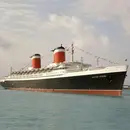
The once glorious ocean liner SS United States was sunk off the coast of Florida in November 2026 as an artifical reef.

 Apple Podcasts

 Spotify

 iHeartRadio

 PocketCasts

 Goodpods

 Amazon Music

 Castbox

 Pandora

 Podchaser

 Youtube Music
The SS United States still holds the transatlantic speed record for an ocean liner, set on her maiden voyage in 1952. Decades later, the ship that beat the Queen Mary for the Blue Riband became the largest artificial reef in the world, sunk in the Gulf of Mexico off Florida.
This episode traces the full history of America’s flagship ocean liner. Designed by naval architect William Francis Gibbs and built at Newport News Shipbuilding, the SS United States was a Cold War-era marvel, engineered with a hull and propulsion plant whose capabilities were closely guarded for years. We follow her record-setting crossing, her service carrying celebrities and heads of state, and the arrival of the jet age that made her obsolete after just 17 years.
Then comes the long decline: decades of layup in Norfolk, Turkey, Ukraine, and finally Philadelphia, where she sat on the Delaware River as preservation plans, redevelopment schemes, and legal battles rose and fell. We examine why so many efforts to save her failed, and how Okaloosa County, Florida came to purchase the ship and sink her on purpose as a reef for divers and marine life.
Shipwrecks and Sea Dogs is a weekly maritime history podcast, written, edited, and produced by Rich Napolitano. All episodes, show notes, and transcripts can be found at shipwrecksandseadogs.com.
Original theme music is by Sean Sigfried and you can find him at seansigfried.com.
**🎧 LISTEN AD-FREE + BONUS EPISODES**
👉Get exclusive bonus episodes and merch on Patreon: https://www.shipwrecksandseadogs.com/patreon
👉Subscribe on Apple Podcasts: https://www.shipwrecksandseadogs.com/apple
👉Shipwrecks and Sea Dogs is part of the Into History podcast channel. Subscribe here: https://www.intohistory.com/shipwreckspod
👉Shipwrecks and Sea Dogs Merchandise is available! https://shop.shipwrecksandseadogs.com
👉You can support the podcast with a donation of any amount at: https://www.buymeacoffee.com/shipwreckspod
November 11, 2026. Off the coast of Florida's Panhandle, a remarkable chapter in American maritime history comes to an end.
For more than five hours, the nearly 1,000-foot SS United States slowly surrendered to the waters of the Gulf of Mexico. Seawater poured into her hull as crews carried out the carefully planned operation. As darkness settled over the Gulf, the great ocean liner began to list. Her enormous hull tilted to one side, and then, in a matter of moments, the ship that had once crossed the Atlantic faster than any passenger liner in history disappeared beneath the surface.
Her final resting place is approximately 180 feet underwater. But this was no maritime disaster. The SS United States had been scuttled to become the world's largest artificial reef.
It was a remarkable ending for a remarkable ship.
When she entered service in 1952, the United States represented the very best of American engineering and ambition. She was designed to be the fastest, safest, and most technologically advanced passenger liner in the world. She carried presidents, celebrities, and thousands of passengers across the Atlantic, setting a speed record that has never been broken by another ocean liner.
She was a symbol of American prestige, a floating monument to an era when the great ocean liners were among the most celebrated achievements of modern engineering.
But that era would not last.
Within two decades, the age of the ocean liner was giving way to the age of commercial aviation. In 1969, the United States was withdrawn from service. What followed was more than half a century of changing ownership, failed restoration plans, mounting expenses, and years of neglect.
The ship that had once represented the pinnacle of American maritime achievement eventually became an abandoned relic, waiting for someone to decide what should become of her.
So how did America's greatest ocean liner go from a symbol of national prestige to a rusting hulk at a Philadelphia pier, and ultimately to the bottom of the Gulf of Mexico?
This is the story of the SS United States, today, on Shipwrecks and Sea Dogs.
The first purpose-built transatlantic steamship was the SS Great Western. Designed by legendary engineer Isambard Kingdom Brunel, built in Bristol, and launched in 1837, the wooden-hulled, sidewheel paddle steamer also had four masts to take advantage of sail power when winds were favorable. In 1838, she made the crossing in 15 days. Cunard launched the Britannia three years later, making the voyage in 14 days. These early ocean liners spurred innovation, waves of immigration, and fierce competition.
American, Canadian, and European shipping lines continued to build bigger, faster, and more luxurious ocean liners, catering to the rich and famous in beautifully appointed first class staterooms, as well as immigrants traveling in sparse but comfortable third class accommodations hoping for a better life.
The period between 1900 and 1950 could arguably be called the Golden Age of Ocean Liners. Ships such as Cunard’s RMS Queen Mary and RMS Queen Elizabeth, and Compagnie Générale Transatlantique ships SS Ile de France and SS Normandie, were considered the height of luxury, offering a scenic and pleasurable getaway across the Atlantic.
Post World War Two in the United States was a prosperous time, but American ocean liners could not compare with the luxurious European ships. But it was the passion of American naval architect William Francis Gibbs that would change that.
Gibbs and his brother Frederick formed Gibbs Brothers Inc. in 1922. Their first project was to convert the German liner Vaterland, a prize from World War I, into the luxury liner SS Leviathan. Later, Gibbs Brothers partnered with successful yacht designer Daniel H. Cox to form Gibbs & Cox in 1929. William Gibbs went on to design many steamships in the 1930s including SS Malolo for the Matson Line, and SS Santa Rosa for the Grace Line, and but none of these ships were of the size, scale, and luxury of the European liners. Nevertheless, William Gibbs became known as America's foremost naval architect, despite having no formal training as an engineer or architect.
Gibbs had visions of a supersized American-flagged luxury liner to rival or even surpass its European counterparts. When the American government wanted a new ocean liner that could be converted into a troop ship during times of war, Gibbs saw an opportunity to build his passion project. While he didn’t get to fulfill his dream just yet, he was selected to design a revised and scaled down version, the SS America, which began service in 1940 for the United States Line.
During World War 2, over 5,400 ships for the US Navy were designed by Gibbs & Cox, including destroyers, destroyer escorts, light cruisers, landing ships and amphibious assault vessels, minesweepers, icebreakers, tankers, tenders.
European and American ocean liners were requisitioned by their respective navies during the war to be used as troop ships, hospital ships, and even armed auxiliary cruisers. The aforementioned ships Queen Mary, Queen Elizabeth, and Normandie, as well as the German SS Wilhelm Gustlaff, were all requisitioned for war service. The SS America was renamed the USS West Point, and converted into a troopship. It carried half a million service personnel, more than any other American transport ship during the war.
In 1945, the U.S. Maritime Commission again partnered with the United States Lines to develop a new dual-purpose ship. The goal of the top-secret project was to build the fastest and most advanced vessel in the world. This ship, the SS United States could easily be converted into a troop ship during times of war, capable of transporting 14,000 military personnel for 10,000 miles without refueling. And it could do it faster than any ship ever had before.
Gibbs dusted off and revised his old plans for his mega-ship, and won the contract. Heavily subsidized by the United States government, keel of the SS United States was laid down on February 8th, 1950 at the Newport News Shipbuilding and Dry Dock Company. In unique fashion and for purposes of secrecy and efficiency, she was constructed entirely in dry dock.
The new ship was built using the most rigid U.S. Navy standards, including watertight compartments and separated dual engine rooms for redundancy. Its sleek design, and low profile superstructure built entirely out of aluminum gave it a deadweight of just 45,500 long tons, compared to the similarly sized RMS Queen Mary and RMS Queen Elizabeth, which came in at 77,000 long tons.
Another unusual building technique used by Gibbs was a modular construction, which reduced construction time down to just 16 months, and allowed her engines to be installed prior to launching.
The ship’s interior design fell to Dorothy Marckwald, of Smyth, Urquhart & Marckwald of New York, who had been collaborating with Gibbs & Cox ships for many years.
With the Navy’s strict standards, the vessel’s 23 public rooms, 395 staterooms, and 14 first-class suites had to be fireproof as well as beautifully appointed. Color drove the design. Rich reds, blues, greens, and golds, provided contrast to the oyster-white walls and black linoleum floors in the corridors. Decorative art favored glass and spun fibers and carried patriotic themes: sculptures of the four freedoms in the first-class dining room, and murals of ocean currents and constellations in the Observation Lounge.
Safety also highly influenced her design. Her 24 aluminum lifeboats and additional rafts could hold 4,060 people, over 1,000 more than her full capacity, and even the shuffleboard pucks were plastic to avoid anything combustible. A large rudder and four propellers gave her speed with good handling, and she was among the first ocean liners fitted with radar. At 65 feet high, her patriotically striped red, white, and blue funnels were the tallest ever installed on a ship. They were raked backward to suggest motion, and rear “wings” deflected exhaust away from passengers on deck.
For fire safety testing, Gibbs had a full mock-up cabin constructed, complete with Marckwald’s fireproof pieces and samples of everything a passenger might have with them. The mock-up cabin was burned at the National Bureau of Standards. The passenger’s belongings were all destroyed, but all of the ship’s fittings, decorative pieces, curtains included, were merely scorched, but survived. Gibbs was insistent on making the ship virtually fireproof, so much so, that nothing made of wood was permitted in any of the ship’s public rooms, cabins, or crew quarters. The only exceptions were the grand pianos furnished by Steinway, and the butcher blocks in the galley.
The SS United States was launched on June 23rd, 1951, in Newport News, Virginia. Thousands turned out to watch as she was christened by Lucille Connally, wife of Texas senator Tom Connally, in 100-degree heat. Hundreds of thousands more watched the launch on live television.
At 990 feet long, she was slightly shorter in length than her Cunard cousins, but she was a beautiful, sleek, luxurious and modern ship. Her light weight and highly impressive 247,785 horsepower turbines made her a marvel of her time. With a beam of 101.5 feet, she could fit through the Panama Canal, with two feet of clearance on either side.
Gibbs designed the ship using the traditional three-class layout of the old Atlantic liners. Each class had its own dining rooms, bars, lounges, and decks, and passengers were expected to stay in their own areas. Only the gymnasium, pool, and theater allowed the mingling of passengers from all classes.
First class accommodations included a ballroom, observation lounge, grand staircase, and promenades located amidships, far from engine vibration and outside noise. Celebrities favored the ship for its prestige, the priority service, and the spacious cabins. Its best-known stateroom was the Duck Suite, made famous by the Duke and Duchess of Windsor. Three staterooms were combined into one suite with two bedrooms, a living room, and four beds, and it took its name from the waterfowl paintings on the walls. Up to 14 of these deluxe suites could be created when needed.
The First Class dining room was perhaps the gem of the ship. Placed amidships to minimize motion, it was spacious and tall, spanning the entire width of the ship. Navy requirements limited the seating capacity to 390 passengers, necessitating two sittings for meals. Diners enjoyed meals crafted by Head Chef Otto Bismarck, music by the Meyer Davis orchestra, beautiful artworks on the walls, and a large sculpture created by Gwen Lux. Nearly everything was adorned with patriotic American symbols, from the crockery and silverware to the napkins and swizzle sticks.
SS United States historian and frequent passenger Frank Braynard said, “It was like being in a palace. One magnificent room led to another.” Serving six meals a day from early morning breakfast to a late-nigh buffet, Braynard quipped, “You could kill yourself eating.”
The customary Captain’s Table was reserved for only the most important and well-connected passengers. These were most often celebrities, dignitaries, members of the United States Lines management, and even members of the press.
Second class, or Cabin class, was built for the American middle class. Featuring four-bed cabins located mostly aft, these passengers had it almost as good as first class. They ate the same food, and had access to the first class pool and theatre.
Third class, or Tourist class, often included migrants and students. Located on the edges of the ship, its small cabins experienced the most noise and motion. They were small and sparse, containing little more than two bunk beds, and bathrooms were communal. Still, these accommodations were superior to third class on many other ships at the time, and a far cry from the steerage class of decades past.
With capacity for 894 first-class, 524 cabin-class, and 554 tourist-class passengers, she could accommodate a total of 1,972, plus a crew of 1,044. In addition, her deep, spacious cargo holds could carry 148,000 cubic feet of cargo.
Her sea trials took place in June of 1952, under heavy secrecy. However, it was later learned that she exceeded 38 knots, or 44 miles per hour, and even made 20 knots while in reverse; almost as fast as RMS Titanic could go forward. The excitement and expectations surrounding the new American ship prompted Newsweek to label her as “The First Lady of the Seas.”
The SS United States departed New York on her maiden voyage on July 3, 1952, timed, not surprisingly, to coincide with the Fourth of July holiday. Her captain, Commodore Harry Manning, was already a celebrity in his own right, having once flown with Amelia Earhart. Heavy fog slowed the ship during its first day at sea, but when the weather cleared, Manning ordered full ahead. Throughout the voyage, a strong gale and heavy seas caused uncomfortable conditions. Being out on the open decks was nearly impossible and most passengers stayed indoors. Some passengers described being outside felt like being punched in the face. However, despite the speed and conditions, the usual vibration felt by ocean liners was almost non-existent; a testament to the design of William Francis Gibbs, and the quality construction of the vessel. All of the amenities and luxuries provided the passengers with a memorable experience. The ship even stocked 7,935 quarts of ice cream and 500 pounds of caviar for the voyage.
Despite the rough conditions, it took her only three days, ten hours, and 40 minutes to travel between Ambrose Lightship in New York Harbor, to Bishop Rock off Cornwall, averaging 35.6 knots. This smashed the record held by the RMS Queen Mary for the past 14 years by better than 10 hours, winning her the Blue Riband for the fastest transatlantic crossing by an ocean liner.
She followed that up by breaking the Westbound transatlantic record during her return voyage, taking three days, 12 hours and 12 minutes, with an average speed of 34.5 knots. When she pulled into New York Harbor on July 14th, she was flying the large blue banner of the Blue Riband, and was greeted by small boats, helicopters, bands, and a celebratory crowd of thousands. A ticker tape parade was held a few days later for her crew, with a crowd of 150,000 people on hand. Her owners then awarded her with the Hales Trophy, honoring her as the holder of the Blue Riband. This was Captain Manning’s second ticker tape parade in New York, the first being for his role in the lifeboat rescue of 32 crew from the Italian cargo ship SS Florida, which sank off Cape Hatteras in 1929.
The SS United States was an instant favorite among American ocean-liner aficionados, especially the rich and famous. Anyone who was anyone wanted to travel on the SS United States. Just some of the notable personalities who repeatedly appeared on her passenger list were Marilyn Monroe, Bob Hope, Grace Kelly - a.k.a Princess Grace of Monaco, Walt Disney, Salvadore Dali, Rita Hayworth, President Harry Truman, the Duke and Duchess of Windsor, and musician Duke Ellington. She was arguably the most beloved ocean liner serving the North Atlantic during the 1950s.
After the introduction of the commercial jet liner in 1958, the fate of the SS United States and transatlantic ocean liners was all but sealed. With the 1960s came labor disputes with the Masters, Mates, and Pilots Union, resulting in canceled voyages, and frustrated passengers moved more and more to air travel. While air travel was not as luxurious or comfortable, it made up for in speed and convenient, reliable schedules. Combined with skyrocketing oil costs, the industry itself was in dire straits.
The 1960s was a rough time for the SS United States and other ocean liners. In 1964 the United States Line sold the SS America to the Greek owned Chandris Group. Even her long-time rivals were pulled from service, the RMS Queen Mary in 1967, and the RMS Queen Elizabeth in 1968.
William Francis Gibbs died in 1967 and two years later on November 14, 1969 the SS United States was abruptly pulled from service while undergoing an annual overhaul. Gibbs’ supership, the manifestation of his life’s passion, would never see active service again.
The sudden retirement of the beloved ocean liner came as a shock to her officers and crew. The move came so suddenly that many personal items were left on board, with the expectation of returning to work the next day. Instead, they found the gangway doors sealed shut; her funnels still only halfway repainted.
As a reserve ship for the US Navy, she was sealed up tight and dehumidified in order to prevent decay, and access was forbidden to all except to authorized personnel. The changing economy, labor struggles, rising costs, and competition from airline travel cut into her profits. In 1968, she operated at a loss of four million dollars.
She remained in Newport News until June of 1970, when she was moved across the James River to Norfolk. In 1973, United States Lines sold her to the United States Maritime Administration, and the ship sat idle in Norfolk, ready to be deployed if needed.
By 1978, the US Maritime Administration deemed the ship obsolete and put her up for sale. She passed from owner to owner over the years; Richard Hadley bought the ship in 1980 with plans to convert her into floating condominiums. That plan fell through and he auctioned off the ship’s interior fittings in 1984. The ship was neglected under Hadley’s ownership, and fell into disrepair. The US Marshals Service seized the vessel and handed it back to the US Maritime Administration.
In 1992, the ship was sold at auction to Fred Mayer of Marmara Marine Inc, for 2.6 million dollars. The ship was towed first to Turkey, then to Ukraine for asbestos removal. By 1996, the company had spent so much money refurbishing the vessel that it was out of money. She was once again seized by the US Marshals Service and towed back to Philadelphia.
The ship was sold again in November of 1997 to Edward Cantor who had plans of returning it to active service, in some manner. However, the vessel never left its berth in Philadelphia, and Cantor in 2002. In 1999, the SS United States Foundation and the SS United States Preservation Society, Inc. (the forerunners of what would become the SS United States Conservancy), successfully lobbied to have the ship placed on the National Register of Historic Places.
Norwegian Cruise Lines bought the vessel from Cantor’s estate in 2003 with plans to place it into its American-flagged service to Hawaii. However by 2009, economic factors and rising costs caused the company to abandon those plans, and looked into scrapping the vessel.
In 2009, the SS United States Conservancy was formed to raise funds to help preserve and protect the venerable vessel. It began raising money to help purchase the ship, and in 2010 received a generous matching donation of $300,000 from Philadelphia philanthropist H.F. “Gerry” Lenfest. In 2011, the Conservancy purchased the SS United States for three million dollars, with assistance from Lenfest.
The SS United States remained at her berth in Philadelphia, while the Conservancy maintained her and looked after her. The organization sought a permanent home for the ship, including at Philadelphia, New York, and Miami, but all of those plans fell apart or were unfeasible.
Meanwhile, the Conservancy diligently sought mixed-use redevelopment opportunities, collected artifacts, artwork, documents, and other pieces for a museum collection, and remained faithful caretakers for the vessel in hopes it could one day find a suitable use rather than ending up in a scrap yard.
In July 2011, the Conservancy launched its ‘Save the United States” campaign, offering donors a chance to have their name on a ‘Wall of Honor’ at a future SS United States Museum.
Over the next decade, plans came and went. In 2014 the group said it was close to a deal to permanently relocate the ship to New York, but those plans fizzled. The Conservancy was forced to begin selling off obsolete portions of the ship to pay the $80,000 a month rental for her berth.
The most promising rescue came in February 2016, when Crystal Cruises announced plans to return her to ocean service as an 800-guest ship. After a feasibility study of more than one million dollars, the company concluded it was not feasible. However, it donated its research findings, which showed the hull to be remarkably intact and structurally sound. In December 2018 the Conservancy signed an exclusive option agreement with the New York developer RXR to explore redeveloping her.
Trouble began in 2020. That August, the Philadelphia Regional Port Authority raised concerns that the ship was damaging the pier and asked that she be moved. By 2023 the pier's landlord, Penn Warehousing, was suing over unpaid rent increases and seeking her removal. In 2024, a federal judge sided with the landlord and ordered the ship to be out by September 12.
With scrapping the alternative, the Conservancy sold the liner to Okaloosa County, Florida, in October 2024 to become an artificial reef. She was towed down the Delaware River in February 2025 for Mobile, Alabama. There, crews spent 20 months stripping her, removing the funnels, cleaning out fuel, chemicals and contaminants, and removing propellers, radar mast, and interior fixtures, which the Conservancy plans to display in a future museum.
The end came on Veterans Day, November 11, 2026. She was towed 22 nautical miles off the coast of Destin, Florida to her final resting place. Without using explosives, the liner was intentionally sunk to become the world's largest artificial reef. It took several hours longer than planned as the well-built, former icon of an ocean liner refused to go down without a fight. Finally, after unexpectedly listing over to her port side, she said her final goodbye, and slipped under the waves.
On November 12, divers from the RV Explorer took the first images of the sunken vessel, showing her resting majestically upright on the bottom of the Gulf of Mexico.
The SS United States was a beloved treasure during her memorable service from 1952 through 1969. She completed 800 transatlantic voyages, and carried over a million passengers, and was a source of pride for Americans everywhere. After almost 60 years of uncertainty she has finally found a peaceful resting place. Instead of being dismantled for scrap, she will provide a sanctuary for marine life, a fishing hotspot for anglers, and a scenic underwater experience for wreck divers.