Faded Luxury: The Sinking of the Principessa Mafalda
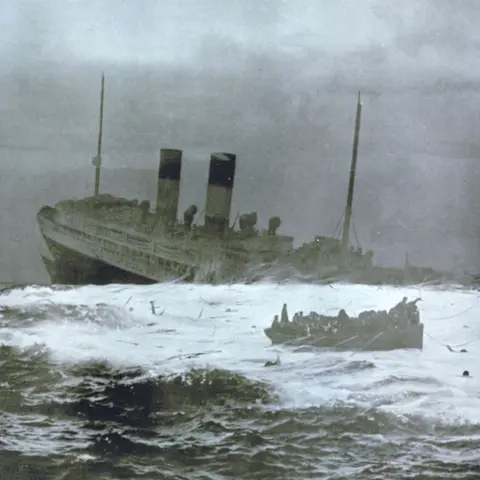
The Italian ocean liner Principessa Mafalda sank off the coast Brazil in 1927, leaving 314 dead and many questions behind.

 Apple Podcasts
 Spotify
 iHeartRadio
 PocketCasts
 Goodpods
 Amazon Music
 Castbox
 Pandora
 Podchaser
 Youtube Music
 Faded Luxury: The Sinking of the Principessa Mafalda
On October 25, 1927, off the coast of Brazil, one of Italy's grandest ocean liners took over four hours to sink, in clear weather, calm seas, in daylight, with rescue ships already alongside.
The Principessa Mafalda had carried tens of thousands of Italian emigrants across the Atlantic for nearly two decades, and was a symbol of national pride on the Genoa-Buenos Aires run. But by 1927, she was a tired ship on what should have been her final voyage that was plagued by breakdowns, food spoilage, and a mysterious list to port that nobody explained to the passengers. When her propeller shaft finally failed near the Abrolhos Islands, what followed was four hours of chaos, panic, and preventable death, followed by a government-shaped press cover-up and an official inquiry that never asked the hard questions.
314 people perished that day, including many by shark attack. The wreck has never been found, and a century later, the Principessa Mafalda remains one of history's least-remembered maritime disasters, despite being the deadliest peacetime shipping catastrophe the Southern Hemisphere has ever seen.
Written, edited, and produced by Rich Napolitano. All episodes, images, and sources can be found at shipwrecksandseadogs.com.
Original theme music by Sean Sigfried. You can find him at seansigfried.com.
**🎧 LISTEN AD-FREE + BONUS EPISODES + MERCH**
👉Subscribe on Patreon: https://www.shipwrecksandseadogs.com/patreon
👉Subscribe on Apple Podcasts: https://www.shipwrecksandseadogs.com/apple
👉Subscribe on Spotify: https://www.shipwrecksandseadogs.com/spotify
👉Shipwrecks and Sea Dogs Merchandise is available! https://shop.shipwrecksandseadogs.com
👉You can support the podcast with a donation of any amount at: https://www.buymeacoffee.com/shipwreckspod
Learn more about your ad choices. Visit megaphone.fm/adchoices
In my boat, there were 27 or 28 people, almost all mothers with their children and an entire family from Buenos Aires. Once the boat was lowered, we headed for the Alhena, which was about 200 meters away. We reached it easily, and after all the passengers had boarded, the boat, which was violently thrown several times against the side of the Alhena, began to take on a lot of water and became unusable. We had, therefore, to abandon it and boarded the Dutch steamer, saddened that we could no longer provide our services, and inactive under a great nervous tension. From the ship, we witnessed the last act of those women. No one could describe what those brave Dutchmen of the Alhena did. Only the Commander, a pilot, and the engine room men remained on board; the rest of the crew approached the Mafalda as closely as possible to help the hundreds of people who, already disheartened and gripped by panic, were throwing themselves into the sea without life jackets, perhaps trusting in their own strength. I have 41 years of experience at sea, I have witnessed various shipwrecks, and I have had to rescue several ships in circumstances similar to those of the Principessa Mafalda, but I confess that I have never seen such a horrifying spectacle.
The statement you just heard is the testimony of Carlo Longobardi, Chief Purser of the ship Principessa Mafalda. The 1927 sinking of the Italian ocean liner left behind many questions and controversies, including the role of Longobardi himself.
The Principessa Mafalda today, on Shipwrecks and Sea Dogs.
Hello and welcome to Shipwrecks and Sea Dogs, tales of mishaps, misfortune, and misadventure. I’m your host Rich Napolitano. The Principessa Mafalda is among the most significant civilian shipwrecks in history, yet very few have even heard of it. In fact, there is shockingly little written about the event, and official sources are few. What we do have is largely from the testimony of eyewitnesses and survivors which sometimes contradict each other, exaggerate, or otherwise provide a murky picture of a tragic event. Even the details such as the number of passengers and crew on board are inconsistent. However, we do know enough to paint a pretty solid picture of the events of October 25th, 1927.
A Princess's Namesake, A Ship's Golden Age
The Italian ocean liner Principessa Mafalda was launched on October 22, 1908, at the Riva Trigoso shipyard in Genoa, Italy for the Lloyd Italiano line. Her royal name was in honor of Principessa Mafalda Maria Elisabetta of Savoy, the daughter of Italy’s King Victor Emmanuel III and Queen Elena. Her sister ship, the Principessa Jolanda was named after the King and Queen’s eldest daughter. She launched over a year earlier on September 22, 1907, but immediately rolled over to port. Water rushed in through its open portholes, and she capsized and sank where she was launched, directly adjacent to the slipway. Prior to launching, she had been completely fitted out with machinery, interior fittings, superstructure, and funnels, and construction flaws compounded the ship’s stability.
The Lloyd Italiano ship designers corrected those mistakes with the Principessa Mafalda, and her fitting out was completed in March of 1909 as Lloyd Italiano’s flagship. She was 463 feet long and 56 feet wide, about 141 by 17 meters, and its two triple-expansion steam engines powered twin screw propellers, to reach speeds up to a respectable 18 knots.
The new Italian ship took part in scientific history when Guglielmo Marconi tested his new wireless radio technology from the Mafalda’s decks in 1908. Marconi performed his experiments during the ship’s fitting out and sea trials, and was able to determine that radio waves travel farther at night, to put it simply. Marconi went on to win the 1909 Nobel Prize for Physics and legendary renown.
Lloyd Italiano built the Principessa Mafalda to place her into service between Genoa and Buenos Aires. Italy was in the midst of a massive wave of emigration at this time, especially from its poorer regions. It is estimated about 9 million Italians left Italy between 1901 and 1915. Many Italians chose to travel on the Mafalda not because they desired a pleasure cruise across the Atlantic, but out of necessity, hoping for a new and better life in Brazil or Argentina. In addition to those permanently leaving Italy, a large number of Italians traveled to South America to work as temporary farm labor, and would return after the harvest. This provided a reliable and profitable passenger base between Europe and South America. However, the ship did attract its share of first class passengers as well, such as Tango legend, Carlos Gardel.
The Mafalda offered accommodations for 180 first class passengers, 150 second class, and 1,200 third class. While not nearly as large as contemporaries such as the Lusitania, Mauretania, or Baltic, she was well-suited for her intended route. And she did have some luxuries of her own to brag about such as spacious cabins, a Louis XVI inspired design, a two-tiered ballroom, vaulted skylights, elegant first class dining, ladies writing room, and a gorgeous winter garden room.
Upon entering into passenger service, the Principessa Mafalda was considered the most modern and luxurious liner serving between Italy and South America, and she was the largest in the Italian fleet. Her maiden voyage departed Genoa for Buenos Aires on March 30th, 1909, with stops at Barcelona, Rio de Janeiro, Santos, and Montevideo. The Mafalda soon became a favorite for affluent families of Brazil, Uruguay, and Argentina wanting to travel in style to Europe.
Her one and only voyage to New York came on August 22, 1914, when she transported Americans fleeing Europe following the outbreak of World War I. After being requisitioned for war service by the Italian Navy, she was attacked and damaged by an Austrian submarine. She was then sent to Taranto for repairs, and used as a floating hotel ship for military officers in the city’s sheltered harbor. At the conclusion of the war in 1918, she resumed her regular civilian service between Genoa and Buenos Aires. Also in 1918, her owner, the Lloyd Italiano line, was acquired by Navigazione Generale Italiana, or more simply, NGI.
A Ship in Decline
Between 1918 and 1927, the Principessa Mafalda had made nearly 90 round trips between Italy and Argentina, tracing and retracing her usual route without much of a fuss. But 18 years of transatlantic service began to show on the aging ship. Newer, more modern ships began service from Europe to South America such as the SS Cap Arcona of the Hamburg South America Line and NGI’s own SS Giulio Cesare. [JOO-lee-oh Chez-ARR-ay].
German diplomat and writer Harry Graf Kessler traveled on the ship in 1926 from Genoa to Barcelona, and described the old workhorse as, “A lovely ten-thousand-ton ship, really pleasant and even luxurious, though the luxury is somewhat faded.” While her appearance could be patched up and painted over, mechanically, she was tired and obsolete. The ship’s reputation as being “faded luxury” was well known in the Italian Press.
In 1927, NGI reassigned her to the shorter and less demanding Genoa-Alexander route. However, she would make one more round trip between Genoa and Buenos Aires before being relegated. The final voyage of the Principessa Mafalda would be under command of Captain Simon Gulì. The 55 year old Captain had been at sea for 40 years, including 30 years with NGI. The veteran mariner had a bad feeling about the voyage, according to his wife, and he requested to be transferred. His request was denied.
On October 11th, 1927, the Mafalda was preparing to depart but was ultimately delayed for 5 hours while mechanics made repairs to her engine.
Despite the problems, she finally got underway on her 90th and final transatlantic voyage to South America on October 11th under command of Captain Simon Gulì. Also on board were 977 passengers, 287 crew, over 600 bags of mail and 250,000 gold Italian lire, to be delivered to the Argentine government. After reaching Barcelona, she was delayed again, this time for 24 hours while repairs to the pump were made.
It wasn’t a great start for the Mafalda, and the problems would continue to mount. Her engines stopped eight times before leaving the Mediterranean, including one motionless stint of 30 hours. Water systems failed causing toilets and sinks to be nonfunctional. Refrigeration units malfunctioned causing tons of spoiled food to be disposed of. More stops were made in Dakar and Cape Verde, each time to make repairs to failing systems and to resupply. Frustrated by the numerous problems and engine failures, Captain Gulì sent a telegram to NGI while at Cape Verde, requesting a replacement ship. An NGI official sent a reply, "Continue to Rio and await instructions." This proved to be an unfortunate missed opportunity, and the Principessa Mafalda began her transatlantic crossing, departing Cape Verde on October 18th.
Mechanical problems continued to plague the ship, including a malfunctioning boiler. By October 23, she developed a very noticeable list to port. Some later claimed the list was so severe that cups, saucers, and other items couldn’t be set down on the tables during breakfast. Passengers were alarmed when the captain ordered lifeboat drills but were assured by the crew that everything was under control.
By this time, the Mafalda was off the coast of Northern Brazil, and the passengers settled back into their daily routine of socializing, relaxing, and dining in comfort. A celebration was held on the main deck to mark the crossing of the equator, which included a live orchestra and an enormous cake.
By October 25th, the Mafalda was far behind schedule as she continued south off the coast of Brazil. Although still listing to port, Captain Gulì ordered the ship to its maximum speed of 18 knots make up for lost time. It was a beautiful Spring day with blue skies overhead and calm seas below, and content passengers soaked up the beautiful tropical climate. After the midday meal, many passengers returned to their cabins for an afternoon siesta where they opened their porthole windows to get some relief from the heat and humidity.
As the Mafalda approached the Abrolhos archipelago, the steamer Empirestar of the Blue Star Line sailed past the Mafalda en route to Europe. The two ocean liners exchanged a friendly acknowledgement with a long single blast from their horns. She also passed the Dutch ship SS Alhena at approximately 4:30 PM.
At 4:45 PM, the ship was 85 miles, about 137 kilometers, offshore of the Brazilian state of Bahia, when suddenly, a deep, groaning rumble shook the vessel, and the Mafalda slowed. Worried passengers gathered in the corridors and decks, trying to find out what was wrong. Some reported hearing three loud bangs. Again, the ship’s crew reassured them, explaining the ship had only lost a propeller, and that its remaining propeller would get them to their destination. Satisfied with the explanation, the passengers went back walking on the sundrenched deck, socializing in the saloon, or relaxing in their cabins. The orchestra continued to play, belying the significant problem of which nobody was yet aware.
Captain Gulì was in the ship’s library when the ship first began to shudder. He immediately raced to the bridge to discover what had happened. The Chief Engineer reported that the port propeller shaft had fractured and detached while turning at 93 revolutions per minute. Worse still, the propeller blades struck the hull while still spinning wildly out of control, opening a gash in the hull at the stern. Captain Gulì ordered the wireless operator to send out a distress call, and the message was tapped out immediately on the telegraph. The request for aid was received by multiple ships in the busy shipping lane, but the message was short on details. The Empirestar and Alhena, which had only passed the Mafalda a short time prior, immediately turned around to assist.
Water entered through the hull of the vessel and gushed through a hatch between the propeller tunnels and the engine room. The Mafalda’s aging and inefficient watertight bulkheads failed, allowing water to move through the ship.
The flooding of the engine room caused the engine’s boilers to shut down and the ship was plunged into darkness when the generators failed. With no emergency generators, passengers descended into a panic.
Within just minutes, the ship began to sink slowly by the stern. Passengers began scrambling to the lifeboats, with over 800 third class passengers having the most difficult time climbing the stairs from the lower decks. Captain Gulì understood the seriousness of the situation and that it would be impossible to save the ship. He made the difficult decision to abandon ship, and ordered all passengers to the lifeboats while he remained on the bridge to direct the evacuation.
The Empirestar approached the Principessa Mafalda at approximately five o’clock, followed shortly later by the Alhena. But these rescue vessels received unclear messages about how to assist, and remained at a cautious distance for a time fearing a boiler explosion. But their lifeboats were sent toward the Mafalda with all available crewmen to help take passengers off of the sinking vessel. Empirestar, Alhena, and numerous other ships would approach much closer as the rescue operation progressed.
Meanwhile, by all accounts there was chaos on board the Mafalda. The ship’s officers had been able to keep the passengers relatively calm for a time, but the order to abandon ship, and a sudden increase in the ship’s list to port triggered utter chaos. Captain Gulì shouted down from the bridge, “Women and Children first!” while holding a pistol, and the ship’s crew forcibly held back an unruly mob. Third class passengers began to stream out onto the deck, going to whatever lifeboat stations were closest rather than their assigned stations.
There were later claims of lawlessness including looting of cabins, raiding of the liquor and food stores, robberies at knifepoint, and dagger wielding passengers forcing their way onto lifeboats. Whether these claims are true, partially true, or greatly exaggerated, it is certain that there was absolute pandemonium in the early stages of the sinking. Some even reported hearing gunfire.
The Mafalda’s starboard side lifeboats were useless due to the listing of the ship to the port side. According to some accounts, the first lifeboat to be launched contained panicked crewmembers who took the opportunity to save themselves. Passengers pushed and shoved, and struggled with each other over lifebelts and a seat in a lifeboat. Some brought their suitcases, rushed through the crowds and threw themselves into lifeboats.
Many lifeboats did not have a member of the crew on board. Without proper guidance, the boats were overloaded, unsteady, and were lowered haphazardly. Some capsized, throwing everyone into the water to their fates. At least some of the lifeboats proved to be unseaworthy and leaked badly.
Those who were not willing to wait for a lifeboat jumped directly into the water, believing they could swim through the calm water to one of the rescue ships. But the appearance of sharks in the water made for a grizzly site. As darkness fell, the screams coming from the water were horrendous. Cries for help, horrific wailing, and final desperate pleas rang out in the night in multiple languages.
Some of the Mafalda’s lifeboats had gotten away safely and rowed toward the rescue boats. Lifeboats from the Empirestar and the Alhena pulled terrified people from the water, placed them on board a rescue ship, and then went back out to search for more. The entire crew of the Alhena, save for Captain Smoolenaars and a handful of engine crew, had gone out in lifeboats, including Fourth Officer Hendrik Jacob Krijnen, who directed one of the ship’s lifeboats.
Numerous other rescue vessels had also arrived to assist by this time as well, including the Avelona, Formosa, Rosetti, and Moselle. Their lifeboats searched the waters for survivors, and their searchlights illuminated the area, revealing the carnage of floating debris and bodies.
In the chaos, many of the first and second class passengers chose to place their faith in the Captain, and stood back during the chaos. At least 80 women and children remained on the ship. This turned out not to be the wisest decision, as it turned out.
Shortly after 10:00 PM, with a severe list to port and her stern underwater, the Principessa Mafalda was in her final moments. Furniture, glassware, and other items slid across the floors and decks toward the stern. A rescued passenger who had been taken on board the Formosa later described seeing an explosion from the sinking ship, producing a huge cloud of smoke that enveloped her. When the smoke cleared, the ship was gone.
The captain of the Alhena claimed to have seen Captain Gulì standing on the bridge smoking a cigar. As the ship sank, her prow rose vertically out of the water, and the Captain blew the ship’s whistle three times. The Principessa Mafalda then slipped under the waves by her stern.
By daybreak of October 26th, the rescue vessels had picked up all the survivors. The breakdown of survivors picked up by each ship varies widely across numerous sources, but the Dutch vessel Alhena rescued about 450 people, the most of any of the ships. Others participating in the rescue were the Empirestar, Avelona, Formosa, Baden, Rosetti, and Moselle.
Although it took her over four hours to sink, 314 people of the 1261 on board were killed. It has been speculated that many of the dead were killed by sharks.
Captain Gulì went down with the ship. Radio operators Luigi Reschia and Francesco Boldracchi bravely stayed at their posts. They were posthumously awarded for their bravery, along with Captain Gulì. Chief Engineer Silvio Scarabicchi allegedly took his own life using a pistol as the ship went down.
While 228 of the dead came from Third Class, more than any other group, 27 First Class passengers perished, a rate of 52%. This is compared to 39% of second class passengers, 28% of third class passengers, and just 11% of the crew. Many families were torn apart. Some others were wiped out completely. The majority of the dead were emigrants, including a significant number from Syria, Yugoslavia, and Spain.
Newspapers from around the world, especially in Brazil and Italy, reported the news to a shocked public. Misinformation and rumors appeared in the news, including that the Mafalda had struck a mine, close to 700 had perished, and that most of the dead were first class passengers. Corriere della Sera's October 27, 1927 issue ran a headline minimizing the disaster, claiming only a few dozen had died, and Italy's Minister of Communications, Costanzo Ciano, issued a statement blaming "adverse fate" rather than acknowledging the ship's poor condition. For frame of reference, Italy was under the control of Benito Mussolini’s fascist regime at the time. It wasn’t until survivors provided eyewitness statements that a clearer picture emerged.
Many questions were asked regarding why this ship was permitted to embark on its final voyage when it was well known to be in such poor condition. And why, in calm seas and pleasant weather, were more people not rescued? There were over 10 rescue vessels on site, and while they did launch their lifeboats and assist, why wasn’t a higher percentage rescued? And was the final, fatal explosion caused by an exploding boiler? If so, why had it not been depressurized by then? The second and third engineers were rescued in lifeboats, suggesting, possibly, they had abandoned the engine room before depressurizing the boilers.
Testimony from surviving passengers and crew was mixed and somewhat contradictory. Over the four-plus hours of the sinking, passengers had different experiences depending on where they were, and when they departed the ship. However, one theme was consistent; panic and chaos gripped the ship when the evacuation order was given.
Claims of cowardly crewmembers swirled. According to the Italian newspaper La Vanguarda, angry passengers shot four of the ship’s officers who had put on lifebelts, intending to leave the ship and abandon the passengers.
Another passenger reported to have been on the first lifeboat to get away from the Mafalda, and that he was only one of two passengers out of the 42 others on board. All the others were members of the ship’s crew. Some sources place Chief Purser Carlo Longobardi on this lifeboat, contrary to his own testimony that you heard at the top of this episode. As the person responsible for the ship’s cash and important documents, it is plausible to believe he would have boarded the first lifeboat. Further testimony from passengers described rescued crewmembers, including Longobardi, who stood idly by on the Alhena while passengers pulled up survivors with ropes. We don’t know whether Longobardi stretched the truth of his story, or perhaps the passenger was mistaken. What really happened to Carlo Longobardi in those first chaotic minutes remains one of many questions about the loss of the Principessa Mafalda.
There were, however, verified acts of selfless bravery. Notable among them is Anacleto Bernardi, an Argentinian man who boarded the Mafalda in Genoa. He volunteered his service to the captain as soon as the ship began to sink. With no regard to his own safety, Bernardi assisted women and children board the lifeboats, gave his own lifebelt to an elderly man who couldn't swim, and otherwise helped those who could not help themselves. Bernardi and his companion Juan Santoro jumped into the water just moments before the Mafalda sank. Santoro survived, but he helplessly watched in horror as Bernardi was attacked and killed by sharks while swimming to a lifeboat; a fate shared by many who found themselves in the water that night. There is little doubt that numerous acts of bravery by the crew of the Mafalda have gone untold and have since been lost to time.
An investigation by the Italian Navy Board into the sinking determined the cause of the accident was a faulty joint in the propeller casing. It also found several of the ship’s lifeboats to be unusable due to improper placement, and that several more were in disrepair.
The Board ordered all Italian registered vessels to install new equipment that would prevent this particular type of damage in the future. The investigation noticeably avoided passing judgment on Captain Gulì, the ship’s officers and crew, or NGI itself. The issue of the seaworthiness of the Mafalda, its age, and its maintenance record were not investigated. However, NGI was ordered to pay a hefty compensation to the families of the victims, although financial terms could not be verified.
The sinking of the Principessa Mafalda is the greatest loss of life in the history of Italian merchant shipping. The 1956 sinking of the Andrea Doria is far better remembered today, despite having a significantly lower loss of life. The Mafalda is also the deadliest peacetime shipping disaster ever in the southern hemisphere. Perhaps her lack of notoriety is because she largely carried third class emigrants, and unlike the Titanic, no celebrities, wealthy bankers, or movie stars were on board.
There is one loose connection to a celebrity - of sorts. Mario José Bergoglio and his parents had tickets to travel to Argentina on the Principessa Mafalda’s final voyage. But the family had to postpone their travel plans at the last minute, and exchanged their tickets to board another ship in February of 1929. Mario José Bergoglio was the father of the future Pope Francis.
The ship’s namesake, the Principessa Mafalda of Savoy, married German Prince Phillip of Hesse and she became a German citizen. Her husband worked for Adolph Hitler, but Hitler did not trust the Princess, calling her, “the blackest carrion in the Italian royal house.” She was arrested in 1943 and sent to the German concentration camp at Buchenwald. She was severely injured in August of 1944, when the Allies bombed an ammunition factory at the camp. She died while a German surgeon, a member of the SS, amputated her arm. The Nazis labeled the Princess’s body as “unknown woman” and unceremoniously dumped her body in a crematorium. The Italian government later honored her by placing her image on a postage stamp in 1995.
The wreck of the Principessa Mafalda rests on the bottom of the Atlantic Ocean, roughly 80 miles, or 129 kilometers from Porto Seguro, Brazil. It has not been found, and just like the circumstances of its sinking, its exact location remains controversial.
Researchers reconstructing the sinking found conflicting position reports. The positions differ by 4 degrees of latitude and 3 degrees of longitude, making for an incredibly large area to search. Estimates of the depth of the wreck also differ. One group suggests 300 meters, while another claims it to be only about 40 meters.
The Principessa Mafalda went down in a heavily trafficked shipping lane, not far from the Abrolhos archipelago, and it is just waiting for somebody to find it and undercover her secrets.
That’s going to do it for the Principessa Mafalda, thank you so much for listening.
I want to take a moment and thank all of you who are premium subscribers on Patreon, Apple Podcasts, and Into History. If you subscribe through Apple Podcasts and Into History, I don’t know your names, but please know you are appreciated. But I do know my Patreon subscribers!
Thank you to Admiral’s Circle member John M, Captain’s Table member Joe D, and Officer’s Club members Ken Checinski, Kevin Urbanek, Michael Powell, Andrew James, Cody Tennant, Tim K, Tiffany Smith, Joe DePaolo, Smashley, David webb, Nancy Mai Tai, Dawn D, Matt Gabry, ryan ostrom, Gillian Seymour, Kylie Amorim, Jonathan Daniel, Andre G, Yasmin L, Connie M, Michele Tredici, Dawn N, Stuart E, Kim N, Al Tynon, Silver, Debra Claire, Lisa Johnson, Jon Vogel, Emma Dubinsky, Tracy , Joe Dobson, Shaun Gritten, Tavi Greiner, Keira Kingdom, John, and Julie Rooney.
Shipwrecks and Sea Dogs is written, edited, and produced by me, Rich Napolitano. Original theme music is by Sean Sigfried, and you can find him at seansigfried.com.
Please join me again next time, but until then, don’t forget to wear your lifejackets.