The Stargazer of Nantucket w/Julie Gerstenblatt
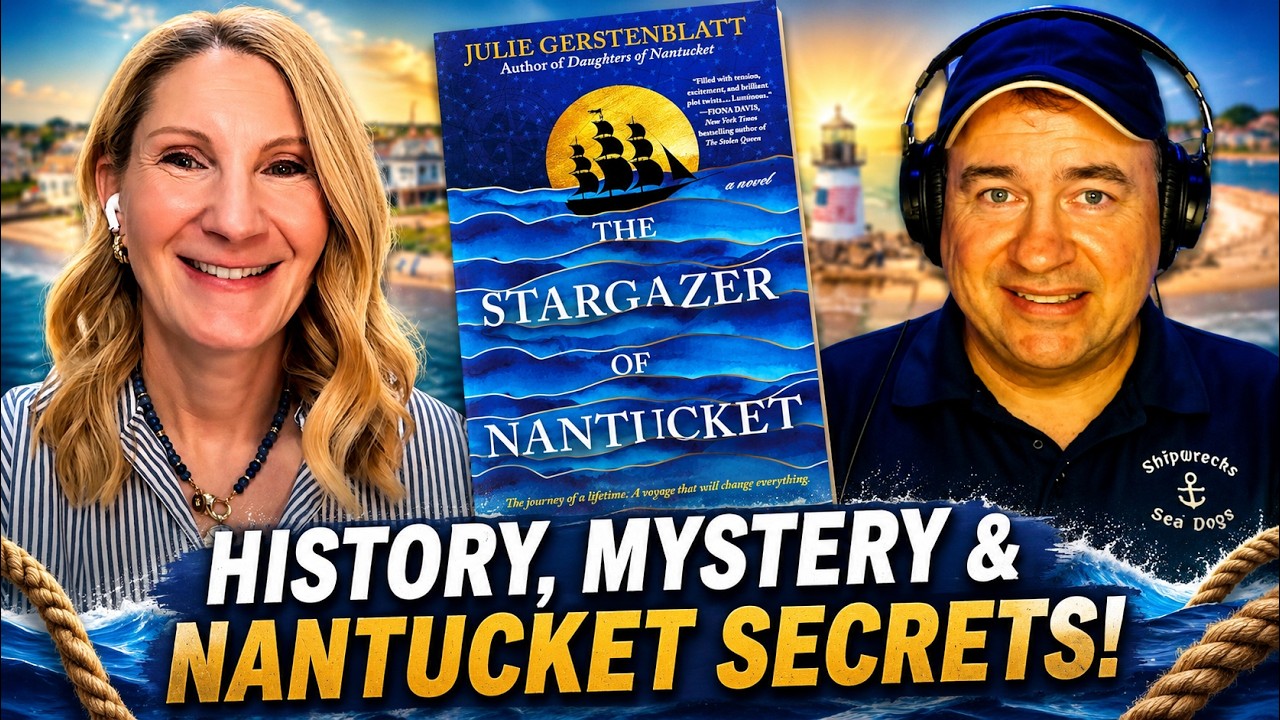
A gripping historical novel set in the golden age of Clippers.

 Apple Podcasts
 Spotify
 iHeartRadio
 PocketCasts
 Goodpods
 Amazon Music
 Castbox
 Pandora
 Podchaser
 Youtube Music
 In this episode, Rich speaks with author Julie Gerstenblatt, author of Daughters of Nantucket, which won the New England Society Book Award for Fiction, to discuss her new historical novel, The Stargazer of Nantucket.
Set in 1851, the novel follows Winifred Starbuck, an eighteen-year-old who stows away on her parents' final merchant voyage from Nantucket Island to San Francisco and across the Pacific to the ports of China, only to uncover a long-buried secret that reveals the truth behind her parents' desperate fear. Gerstenblatt and Rich dig into the real maritime history behind the fiction, including the novel's connection to the record-setting maiden voyage of the clipper ship Flying Cloud, the golden age of sail, the dangers of 19th-century trade voyages, and what it took to bring this seafaring world to life on the page.
To purchase Stargazer of Nantucket, please visit https://bookshop.org/beta-search?keywords=Julie+Gerstenblatt
For more information about Julie Gerstenblatt please visit https://www.juliegerstenblatt.com/.
**🎧 LISTEN AD-FREE + BONUS EPISODES**
👉Shipwrecks and Sea Dogs is part of the Into History podcast channel. Subscribe here: https://www.intohistory.com/shipwreckspod
👉Get exclusive bonus episodes and merch on Patreon: https://www.shipwrecksandseadogs.com/patreon
👉Subscribe on Apple Podcasts: https://www.shipwrecksandseadogs.com/apple
👉Shipwrecks and Sea Dogs Merchandise is available! https://shop.shipwrecksandseadogs.com
👉You can support the podcast with a donation of any amount at: https://www.buymeacoffee.com/shipwreckspod
*No remuneration was received by or paid by Rich Napolitano or Nautilus Media, LLC for Ms. Gerstenblatt's appearance on Shipwrecks and Sea Dogs. An advance copy of the author's work was provided by the publisher for review.
** No AI was used to create this video.
Written, edited, and produced by Rich Napolitano. All episodes, images, and sources can be found at shipwrecksandseadogs.com.
Original theme music by Sean Sigfried. https://www.seansigfried.com
You can also listen to Shipwrecks and Sea Dogs podcast on Spotify, Apple Podcasts, or wherever you listen to podcasts. https://www.podfollow.com/shipwreckspod
Learn more about your ad choices. Visit megaphone.fm/adchoices
Rich Napolitano (00:07.458)
Hello and welcome to Shipwrecks and Sea Dogs, Tales of Mishaps, Misfortune, and Misadventure. I'm your host, Rich Napolitano. Today I'm very excited to have with me author Julie Gerstenblatt to talk about her new book, The Stargazer of Nantucket. Julie, thanks so much for joining me today.
Julie Gerstenblatt (00:23.928)
Thank you for having me.
Rich Napolitano (00:26.134)
Now the the Stargazer of Nantucket is a fictional novel. however, it includes a lot of themes and topics that are very real and and significant to history. could you give a quick synopsis of the story without giving away too much?
Julie Gerstenblatt (00:41.176)
Sure. So the Stargazer of Nantucket is set on a clipper ship that goes from Nantucket on june first, eighteen fifty one around Cape Horn to San Francisco at the height of the gold rush and on to China where calamity ensues. The family aboard the ship are the Stargazers Stargazers, no, the Starbucks of Nantucket, who name all of their ships after Star something or other.
So this time they're on the Stargazer. They are a husband and wife team. He's the captain, Peter. Nell, the wife, is the merchant who heads to China to shop and bring back not just tea, but all of the gorgeous, glorious goodies from the Far East. And they have a daughter who is now 18 who wants to come with them. And they forbid her from coming because of something that happened when she was little that she doesn't remember, but that
We get to read in the prologue so we know what went wrong on the ship all those years ago, on the shooting star of eighteen thirty-eight. So when we arrive in eighteen fifty-one, we find Winnie at eighteen begging to go out to sea, and when her parents forbid her, she stows away on their ship.
Rich Napolitano (02:00.322)
There's obviously a lot that goes on between Nantucket and China and and back, but the themes that you present are all inspired by real life events, obviously, with the the trade to China on the clippers. But what was the original inspiration, the historical inspiration behind the fictional Starbucks family and their clippership, the Stargazer?
Julie Gerstenblatt (02:25.304)
So when I was researching my first novel, which is called Daughters of Nance Huckett, and it's set around the Great Fire of eighteen forty six, I did research by going into museums and historic homes, and I was in a home, a historic home, and I saw the wallpaper that surrounded the dining room was the harbor at Canton, which is where merchant ships would dock from around the globe for the trading season in China.
And the home was all was decorated not just in the dining room with that wallpaper, but throughout with food dog lamps and China like Chinese urns and everything was in blue and white with touches of course of Nantucket red and I thought, wow, we decorate this way still based on all of those goodies that came from the Far East. Who brought this back? Who decided these were things we wanted and needed and that the trade that we did
to get everything back to New England and America. So it started there and then the Starbucks are a famous whaling family from Nantucket. Joseph Starbuck was probably one of the first millionaires in America and he built his fortune on Nantucket and then built three brick homes for his three sons. They are still standing and in their original pristine you know front facade conditions.
And they're known as by their not by their number so much as their location, Westbrick, East Brick, Middlebrick. So across the street, the daughter, the daughters of Joseph Starbuck married Hadwin and Barney, and they lived in historic homes across the street. So there was like Starbuck Row. And that was really interesting to me that there was one family that kind of had a dynasty. And so I wanted to make my own version of those historic.
people and that's how the family was born. I can also tell you about the ship if you want that.
Rich Napolitano (04:30.803)
Yes, absolutely. Let's hear about it.
Julie Gerstenblatt (04:33.122)
once I realized that I would have a merchant, husband and wife, I needed to put them on a ship and I had to figure out what that ship was. So I researched clipperships from the mid-1800s and realized there was a clippership era, a short period, about 50-60 years, in which these extreme, extremely fast and extremely beautiful boats would race first to China because the first person to bring back
Tea in the season, the freshest tea and the first ship docked would make the most profits. So you could beat out the competition literally by hours. And then the next race to win, once gold was found in California, was to get to San Francisco and bring goods to an outpost on the edge of America in this new state of California, and again make incredible profits. So the ship to do it was an extreme clipper.
And I discovered that Donald McKay was the foremost builder of these ships and he built in East Boston. So knowing I'm a Nantucket gal, writing about Nantucket, I was like, this guy is interesting to me. And in fact, I didn't know about him. And then once I read about him, I went to I landed at Logan from an international trip to Aruba. And when you arrive at International Gates at Logan Airport,
They celebrate their city by announcing that it is the city that Donald McKay put on the map for his extreme clipper ship, the flying cloud. And so I was like, I need a flying cloud of my own. And so I based my Stargazer on the Flying Cloud. And I kind of took all of the dimensions of the ship, the biggest mast, the tallest mast ever built and never tested at sea.
And I put that in the water with my starred books on it and sent them off on this crazy journey.
Rich Napolitano (06:38.05)
Yeah, and y in your book you're you talk about the size of the the mast. It was two hundred feet. And I'm just thinking, you know, how especially with some of the scenes described, but the you know, being at the top the top gallant sail up there trying to you know, lower or or raise the the sails, my goodness. Yeah. Especially in pitching seas. I mean terrifying.
Julie Gerstenblatt (07:02.072)
Yeah. It's terrifying. And then you think about I say something about how like during a storm, the higher up you go, the worse that back and forth motion is. It's just exaggerated up high. and to think that I mean, this was about American ambition. We were seventy-five years old in eighteen fifty one. In fact, the characters in my novel celebrate the Fourth of July on that boat. And it's just interesting to me to think about American
innovation and ingenuity and competition and that competitive spirit that we have had from the moment we won the Revolutionary War and then took those battleships, closed up the the cannon holes and said, We have to now compete with the global market. We're gonna send those ships to China.
Rich Napolitano (07:51.168)
Yeah, and it in addition, obviously from being from Nantucket or or nearby, you spent quite a bit of time in Nantucket, growing up, I believe.
Julie Gerstenblatt (08:00.066)
Yes, I started visiting in the summer of nineteen seventy eight with my family from New York. we got there because my aunt had moved to Wellesley, Massachusetts, which I joke is the gateway drug to Nantucket. and all of my aunt's neighbors were had homes there or were visiting and she went once and said, we've gotta come. So my grandparents from Brooklyn came and we came from New York and it was my first time driving a car onto a ferry and
I was in love. I just love the idea of that kind of transportation. And then we spent two incredible weeks out on the pulpocro. and I've been in love ever since.
Rich Napolitano (08:43.634)
And Nantucket obviously is a a hub or used to be a hub for whaling. such a rich history in in whaling. I've done several episodes about whale ships from Nantucket and in nearby communities like New Bedford. How has how have you seen or how have you noticed any changes in the let's say the maritime culture around Nantucket over the years?
Julie Gerstenblatt (09:08.814)
So I think that the maritime culture has largely become like a commercial sort of thing where people wear like whale or you know, the whalers are the high school teams, so the football team. So people wear whalers clothes and Nantucket Red, whether it's from Murray's or you know, any other store. So it has become less about
like losing, you know, worrying about losing life and limb and more about living glamorously on the place on the island that was shrouded in, you know, mystery thirty miles out to sea. And it's still it was a destination then. And it was really it was more about bringing the money back going out to sea. And that's why I have these two books. I think of them as bookends, because the first is set on the island. Everybody walks everywhere except when they're like running from the fire.
So you can do you can traverse my entire novel's map in an hour. And the second is the inverse. It is everywhere Nantucketers went to make that fortune to bring back. So how has it changed? I mean, it's changed dramatically in some ways because it has become such a resort community, which started in the 1880s, 1890s, after Welling fell off and after the Civil War, men went out.
Men left for for whaling originally, then they left for the gold mines, and then they left for the Civil War. and after whaling ended, Nantucket had to come up with something else to make it a viable place, and it was tourism. so it has leaned into that ever since.
Rich Napolitano (10:56.332)
Going back to the the Starbucks now, y you mentioned the competitive clipper trade to to China. In the story, the husband, Peter Starbuck, is hell bent on breaking this record for the fastest time to Nantucket or fastest time from Nantucket to San Francisco and has a little bit of playful banter with another ship along the way. Why was it so important to him?
To be the fastest.
Julie Gerstenblatt (11:27.828)
I think he represents that certain kind of mindset, not just from then but from now, that America has to be the fastest and the best, or that a certain man wants to win and that monomaniacal, you know, even in Moby Dick, that that the fascination with one thing, one goal, singularly minded person, is so interesting to me because like the question is what will change you? What will break you?
what will happen if you don't get what you want? And what will be the costs of getting that too? and he is based in large part on Josiah Perkins Creasy, who was the ship captain of the Flying Cloud, and he was hell-bent on getting to San Francisco in record breaking time, both for the money that could come from such a such a glory, and for the glory itself, for the for the fame.
for the street cred. You know, this these were tough people to be able to go around Cape Horn. I just left, I was thinking on June first when the ship left Nantucket, would it really be that cold? I made it a little a little breezy, a little windy, and a little chilly. Well, I went last week to Nantucket on June first and it was freezing on the ferry. And I was like in a modern vessel where I could just be inside and get like a hot coffee from concession.
and the waves were rough. It was a rough day. And so the people who the captains who put everything, you know, everything at stake. And so I have the risks being even sort of exemplified for Peter, where he, without telling his wife, puts up a lot of things for collateral and sort of doesn't tell her what he's done to get this ship because it would have been a very expensive venture and he's so interested in it that he
He risks a lot. and it makes for I hope a good, you know, an interesting character.
Rich Napolitano (13:34.336)
Certainly so, and that just brings to mind when I I I don't want to spoil too many things, but there's one point in the in the story where he's he's dealing with some problems once they you know they get to San Francisco and he says, Gee, can't can't somebody just be proud of me for a second? You know, like I just I just broke the record and I'm having to deal with all this stuff. Brought it a basket in the glory just for a moment.
Julie Gerstenblatt (13:56.546)
Yeah.
Right, which I I really I gave him that line because I I thought, I agreed with it. Also it's a he's a father. He is a captain, but he's a father. And if he has his wife who's saying one thing and wants something from him, and you know, if we you have children who want something from you, it's sort of that thing like, Can anybody just leave me alone for a second? Or is anybody just like proud of dad? Can we just focus on that for one hot minute?
Rich Napolitano (14:26.978)
Yeah. And moving on to the characters of Winnie and Nell, they are very strong, independent, capable women, Winnie being the younger daughter. And they're thrown into this obviously male dominated world of sailing ships, you know, the rat and vermin infested holds of the ships and the grimy work and the tar and the and the oakum, you know, just all this mess.
Were there any specific women from history that inspired these characters?
Julie Gerstenblatt (15:02.478)
Well, I will say that Josiah Perkins Creasy has had his wife what makes the Flying Cloud so interesting, besides from not only winning the world record that year, but then I think it was three years later, beating its own time and having that world record for a hundred and thirty five years. And what was notable about them is that it was a husband and wife team and she was the navigator.
So I did not want to use that husband and wife dynamic with the navigator, but the idea of a woman in history who lived outside the parameters of what was typical is very interesting to me. And I I do that in my first novel with Mariah Mitchell, a true woman from history who was America's first female librarian professionally being paid as a librarian and America's first female professional astronomer.
Because I had an astronomer and navigator in the first book, I didn't do that for this, but the spirit of that kind of woman is in it. Also, from Nantucket, Nantucket women were ahead of their time. Because men were often out at sea, women had a rare independence there and were more forward thinking. They could control the money and finances and sort of have a power of attorney that was granted to women there.
That was not heard of on the mainland. And they were early suffragists and early because of their Quaker background, well educated, early abolitionists. And so I leaned into not a specific person, but a specific ideal of a person, because those are the people who change history. Just a person sitting around in their home doing what everybody else was doing in 1851 is not going to drive a story and is not going to drive history forward.
So I needed to make Nell and Winnie exceptional.
Rich Napolitano (17:03.466)
And they they very much are are focused on doing what they feel is their jobs. They're not just along for the ride. and that becomes more evident as the story progresses.
Julie Gerstenblatt (17:15.99)
Yeah, and they are w they are. They're willing to work and they and more and more and claim their role through hard work and determination and not just resting on, you know, the captain.
Rich Napolitano (17:30.924)
You mentioned earlier the gold rush, the California Gold Rush, and this story of the the Stargazer of Nantucket takes place in eighteen fifty one at the height of the California Gold Rush. How did the gold rush impact real people such such as as portrayed as with the Starbucks who operated clipper ships at the time?
Julie Gerstenblatt (17:55.682)
Yeah, that was a new journey for them. And so for these for the Starbucks, if you consider the China trade and you're heading out from New York or New Bedford or Nantucket, you are going east. You are going around the Cape of Good Hope and then to India and then on to China. So this is a new route to get to San Francisco. Whalers did it all the time. They were hunting in the Pacific.
And they had to journey around the very, very treacherous Cape Horn, which is a worse and harder journey than the Cape of Good Hope. I feel like Good Hope even sounds better. Yeah, right? Like let's go that way. round the horn, not so much. So it was something that these experienced merchants and sailors had not done, which also made it fun for me in a ship that had never been tested at sea, and all because
Rich Napolitano (18:34.078)
It's a good marketing title.
Julie Gerstenblatt (18:52.066)
What was waiting in California? And I feel like there is still like that California dream. And it kind of originated with the 49ers and the idea that we could strike out the gold and make our own destiny by going to this new state. And so people wanted to reinvent themselves. And we have some passengers on the ship too who are going out there to become their new selves in the great new state of California.
And there's like a lure of the lore of the place. i it's now maybe Hollywood. it is the idea of that other coast and all of the expanse that is spread out before you in a giant state. So I think they saw opportunity if they were willing to risk their lives to get there, they could make great profits just even on selling eggs, and bringing everything, because there was nothing.
In California at the time.
Rich Napolitano (19:54.196)
And of course that journey was treacherous. There were that was years, decades before the Panama Canal. So they had to go around Cape Horn, which, as everybody knows, is probably the most dangerous waterway on the planet with those currents and the storms. And especially they in your story, they they were rounding the horn in winter.
Julie Gerstenblatt (20:18.422)
Yeah, not not.
Rich Napolitano (20:19.962)
Summer in the north. Yeah. It was summer in Nantucket, but it's winter and summer in Yeah, Illinois.
Julie Gerstenblatt (20:24.974)
Yeah, and that really the but they did. They went at that time. The flying cloud did it in those conditions. you could go through the you could go through the Panama, the isthmus of Panama. it was a combination of a ship and then crossing on land, then taking a boat from the other side, you know, up it before the canal was built. Yeah.
Rich Napolitano (20:50.422)
Yeah, there that that had its own set of of dangers too with you know, you were you were crossing overland part of the way through jungle and swamp and you know, there were yellow fever and malaria. It was really not not that pleasant.
Julie Gerstenblatt (21:06.242)
Right. And it could take twice as long.
Rich Napolitano (21:08.586)
Yeah. And of course Peter Starbuck wanted to do it in his own ship, not not get on another ship on the other side of the isthmus. No. Right. At that time China had been very secluded, very isolated for for a long time, many centuries, but had started to become more open to foreign trade, both culturally and economically.
And there's a scene in your book where there's a a a young character that serves as part of the crew on the Stargazer named Chin. And he talks to Winnie about the darker side of what the Starbucks were involved with. can you talk a little bit about the China trade and what trade relations were like at the time dealing with these clipper ships from the West?
Julie Gerstenblatt (22:02.282)
Sure, I can try to. it's such complicated history. but what I can say is, and that based off that conversation that Chin has with Winnie is that he said he set makes the point that China doesn't need anything and didn't need anything from Westerners. They made everything. And and I think about it today, you know, this joke that everything is made in China, everything.
is made in China. Everything was made in China. They were self-sufficient, but they did want to trade and become a global commodity to the West. and the you know basically what happened with the British and Americans early on was they realized after they could no longer pay the Chinese in silver, they needed to find a something that China wanted. And so they brought opium from India.
to China and sold it and realized that they could make great profits and also create an addiction problem. I compare this to the idea of you know opioids and the sacklers and what happened in America in the nineteen nineties. So the point is that opium was was the only thing that could be you know, it was smuggled into China and the Chinese
fought wars over it. There are two opium wars in 1842 and 1860 to prevent Brits and Americans from bringing opium in and making their their people, you know, addicted to it and get sick and die. And so my book is between the opium wars. And during that time it was illegal to to bring opium in. And so Peter Starbuck gets involved in a deal.
And he has never dealt in this before. He doesn't tell his wife. And it's a way for me to present a window into a much bigger issue so that people can read my book as a jumping off point. I'm not the expert on this at all, but I thought that a Chinese cabin boy on an American ship might have a window into it where we could see it from his side and his family's side.
Julie Gerstenblatt (24:27.884)
And start to wonder and maybe dig and do a little more research ourselves.
Rich Napolitano (24:33.238)
I think for me what what I found intriguing about that was the the connection because I knew about the opium wars and and the the trade of the you know, the US and and the UK and I knew about the clipper trade and the competitive markets for tea and porcelain and other things like that. But I never I guess consciously tied those things together in terms of it was the same time period and
how it all kind of worked together and and were related to each other. So I thought that was pretty interesting. I I I gained some insight to that personally. so I appreciate that.
Julie Gerstenblatt (25:15.874)
Well, I'm glad that that that worked for you for you then. Russell Forbes, actually, who I have as a little bit of a character in in at least in name in the book, he did he did at some point he made his fortune off opium, and then said no. around eighteen forty two ish, around the time of the first opium war, and wrote a letter to s to his family and said
I am no longer gonna deal in opium. I have seen what it has done to these people and I I refuse to sell it. we will stop this moment. So I I wanted to just share those kinds of stories.
Rich Napolitano (26:01.292)
Yeah. And related to, you know, things that may be a little bit on the darker side, the you know, this this trade with China was very lucrative, very competitive and and I've read countless stories about, you know, these the bets that captains place with each other or there's prize money to see who was first. and it and it got a lot of attention in the public and people would follow it very closely in the news. It was almost, you know, this a sport at the time.
And I think what we forget too is that behind that that, let's say, supposed glitz and glamour were the real lives that were affected by this trade, because it was not pleasant. These journeys were very difficult and and you have many examples of dangerous situations in in your book. But h how did all this impact the the the sailors or the the real lives behind
who was driving this these these ships across the Pacific.
Julie Gerstenblatt (27:06.54)
Yeah, sailors were, you know, you could bet on a ship, but but if you were a sailor on a ship and it was the fastest, you didn't make any more money. the captain did, and the people in New York and in on Nantucket who bet on them did. so the stakes were h the highest for those sailors and the rewards were the lowest or potentially the lowest for them.
Because they had to do all of the hardest work. They had to climb the masts and pull in the sails and hang their bodies over the yards and inch out in freezing cold temperatures and do the work for the captain who was yelling at them and sometimes the first mate who might be hitting them with a belaying pin to get up there and get it done. and then not see the profit. which is why many
times people left, you know, and what California was known for, what San Francisco Bay was filled with abandoned whale ships because whalers and other sailors were like, why am I doing this again? Maybe I should try my luck at gold, at mining for gold. Anything would be better than being on a merchant ship or a whale ship just making, you know, a few dollars and risking my life.
Rich Napolitano (28:27.636)
Certainly these being a sailor on a on a merchant ship, you know, a whale ship especially, my goodness, was not among the the most or not among the safest professions you could engage in, but you know, they did what they had to do to to to get by. Is there a a a lesson or or kind of a a a moral outcome that you would like people to take away from from your story?
Julie Gerstenblatt (28:55.98)
Hmm. I think I wanted to present those kinds of all of the shades of characters of different ends of sort of ethical and moral spectrums of that time period and hold up a mirror to us now, too, and say history is still alive and we are still making choices that might benefit a few and cost a lot for many. and so I hope readers
Can kind of dig into that and see the moral ambiguity and the ethical dilemmas in American commerce and trade and in our need to be the best and the fastest. But ultimately, you know, talk about it in a book club and wrestle with it yourself and turn on the news. And when we say that we are trading with China and that our president is talking about those things, to make those connections and think.
about the history of that relationship to me would be a big takeaway and and to think about where America was at 75 and where we are this summer at our 250. I do choose to tell this story in omniscient narration so that you can feel like you are with the sailors as well as the captain, as well as the first mate, the main character Winnie, you are with a huge cast of characters
And you get to know them personally so that you can empathize or at least sympathize or understand why the helmsman who is an escaped slave on the run would choose to be on this journey and what his goals are, as well as a navigator, as well as the daughter and all of the other characters. So I think I think that makes it fun and I hope that that expands your understanding of the time period too.
Rich Napolitano (30:54.348)
What other work that you've done would you like to mention at this time?
Julie Gerstenblatt (30:59.282)
I would mention the the first novel, Daughters of Nantucket, which is set in 1846, during the Great Fire. And so this one is they're standalone novels, but they really do work in conjunction. So it's fun to read them both. and you can find them wherever books are sold. and I will say also that the audiobook for Stargazer has been getting a lot of attention and praise early.
Early listeners have really enjoyed the narrator and she and I have become friends on Instagram. I listened to the whole thing, even though I know what happens, and found that her one voice bringing all of those characters to life is really fun. So I highly recommend you maybe switch off. I sometimes read and listen and move back and forth.
Rich Napolitano (31:53.772)
Hm. And do you have a website or social media where everyone can follow you and your work that you'd like to share?
Julie Gerstenblatt (32:02.104)
Sure, my website is my name. It is JulieGerstenblatt.com. You can look under events to find out where I will be this sp this summer, both in person and virtually. And you can also find me on Substack. My Substack is Daughters of Nantucket. And it is free and on Instagram and Facebook under my name Julie Gerstenblatt.
Rich Napolitano (32:28.212)
And those will have links to your t to purchase your books as well, I assume.
Julie Gerstenblatt (32:34.006)
Yes, absolutely. First thing to do.
Rich Napolitano (32:38.848)
Once again, the the book is The Stargazer of Nantucket by Julie Gerstenblatt. I read it myself and I highly recommend it. Some some really excellent historical themes going on, plus a lot of really good life lessons and and and other themes to follow. Julie, thank you so much for joining me. It was really a pleasure talking to you.
Julie Gerstenblatt (33:00.312)
Thank you so much. I really appreciate it.


