The Ghost Ship of the Carroll A. Deering
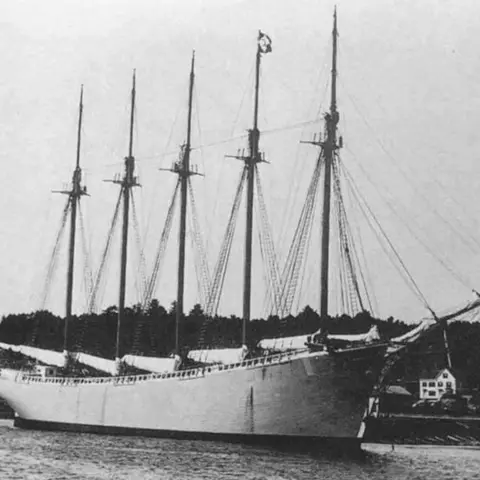
The 5-masted schooner Carroll A. Deering was found mysteriously abandoned in 1921, with no trace of the crew.

 Apple Podcasts
 Spotify
 iHeartRadio
 PocketCasts
 Goodpods
 Amazon Music
 Castbox
 Pandora
 Podchaser
 Youtube Music
 The 5- masted schooner Carroll A. Deering was discovered abandoned on January 31, 1921, hard aground on the treacherous Diamond Shoals off Cape Hatteras. All crew members had vanished without a trace, leaving behind a fully set table in the galley, personal belongings, and signs that the vessel had been recently occupied, but with its lifeboats missing. The ship’s logs and navigational equipment were also gone. Despite investigations by the United States Coast Guard and speculation ranging from piracy to mutiny or even supernatural causes, no definitive explanation was ever found. The fate of the ship's crew remains a mystery.
This episode was written by Madeleine Gassin. Edited and produced by Rich Napolitano. Original theme music is by Sean Sigfried.
Shipwrecks and Sea Dogs is a maritime history podcast about shipwrecks, tragic loss, and incredible accomplishments on the world's oceans and waterways.
Follow Shipwrecks and Sea Dogs
- Subscribe on YouTube
- Follow on BlueSky
- Follow on Threads
- Follow on Instagram
- Follow on Facebook
Learn more about your ad choices. Visit megaphone.fm/adchoices
00:00
Introduction
In December of 1872, the crew of the merchant ship Degratia was sailing along the Portuguese volcanic archipelago of the Azores when they spotted a large vessel drifting.
The mysterious vessel was sailing erratically, hadn't responded to the signals from the Degratia, and had no visible crew on deck. Concerned that the vessel might be in distress or abandoned, the crew of the Degratia decided to board.
Inspecting the ship, they found that there was no crew on board, that it was largely intact and seaworthy, and that its cargo and supplies were still present.
The ship's lifeboats, navigation equipment, and chronometer were all missing, and the last log entry was about ten days before the ship was found.
No trace of the crew was ever found, and the circumstances surrounding their disappearance were never answered. The story of the ghost ship Mary Celeste enthralled the public, and it soon became one of the world's most notorious maritime mysteries.
Little did we know that, only 49 years later, another ghost ship would appear in similar and just as mysterious circumstances on the Diamond Shoals of North Carolina. A shipwreck, missing lifeboats, a missing crew, and no explanation.
The Ghost Ship of the Carol A. Deering, today on Shipwrecks and Sea Dogs. Hello, and welcome to Shipwrecks and Sea Dogs, Tales of Mishaps, Misfortune, and Misadventure.
I'm your host, Rich Napolitano.
2:06
Discovery on Diamond Shoals
On Monday, January 31st, 1921, United States Coast Guardsman CP. Brady held the early morning shift at Cape Hatteras Life Saving Station. The early morning was misty and cold, with strong winter winds blowing the tops off the waves.
The gathering morning light was just enough to see the coast he was keeping watch on. He watched as the cawing seagulls flapped, circled and hung in place, suspended by the wind.
With only an hour and a half left on his watch, he rose from his lookout and went downstairs for a good old cup of morning coffee.
Coming back to his perch, coffee in hand, he looked through his station's telescope, an important tool for keeping watch over the dangerous 12-mile Diamond Shoals that are dreaded and feared by mariners all over the world.
Scanning the shoals, Brady mostly gazed into the thick morning mist, expecting nothing new. Suddenly, a strange shape caught his attention in the growing light. He set his cup down, rubbed his eyes and checked again.
He hadn't seen anything before his coffee break. Rockets, flares and distress signals had been absent through the night. As the wind peeled away the mist, the truth became undeniable.
A large, five-masted schooner, sails raised, was trapped on the Diamond Shoals. Brady had no option but to shout the word every seafarer dreads. Shipwreck.
But to truly understand the danger this ship and its crew now faced, we need to step back and look at where this was all happening. The Diamond Shoals isn't just any stretch of water. It's among the most treacherous in the world.
For thousands of years, North Carolina's barrier islands, widely known as the Outer Banks, have protected the mainland coast and offshore sounds.
As an important part of the region's marine ecosystem, the barrier islands' long stretches of beach, sand dunes, marshes, and woodlands were set aside and were officially established as a part of the Cape Hatteras National Seashore on January 12th,
1953, the United States' first national seashore. This national seashore preserves the portion of the Outer Banks from Bodie Island to Ocracoke Island, covering over 70 miles of coastline and 30,000 acres of beaches.
The environment provides valuable habitats for wildlife, including more than 360 documented bird species, one of the most notable being a wintering area for migrating waterfowl, as well as seals, dolphins, whales, sea turtles, land turtles,
alligators, and other land animals. Located in the Cape Hatteras National Seashore, the Diamond Shoals is a dangerous 12-mile-long sandbar off Cape Hatteras formed by the collision of the Gulf Stream and the Virginia Drift, a branch of the Labrador
current flowing from the Arctic. When these currents collide, they create a strong turbulence that essentially pushes southbound ships into the treacherous sandbar.
It also doesn't help that while most sandbars are relatively stable, the Diamond Shoals constantly shift due to storms and changing currents, making navigation extremely difficult.
Between the current pushing ships towards the sandbar and the sandbar constantly moving, it's no wonder that the Diamond Shoals have been the site of hundreds, if not thousands of shipwrecks, earning it the nickname, the Graveyard of the Atlantic.
And on the morning of January 31, 1921, it was Coast Guardsman CP. Brady who found the graveyard's latest victim. Once Brady raised the alert of a shipwreck, the rest of the Coast Guard made quick work of getting ready for the rescue.
Time was of the essence, and the lifesavers stationed at Cape Hatteras were ready to risk their lives to save those stranded among the shoals. Jacob A.
Miller, the keeper or commander of the Cape Hatteras life-saving station, quickly took charge and directed his men to prepare a surfboat.
Once the surfboat was ready, the crew loaded it onto a boat carriage with a horse leading it across the sand and a half dozen men pushing it from behind.
Together, they hauled the station's powerboat to the south hook of the Cape, but they already encountered a problem. The sea was running pretty high, and they decided to check the north point to see if it would have better launching conditions.
Unfortunately, they found that the sea level was even higher in the north, and they had to return to their original plan of launching at the south point.
They were joined by two other crews from nearby stations, Kinnakeet and Creeds Hill, who were also set to help with the operation, but couldn't launch from their own stations due to the sea conditions.
When the rescue boat was loaded into the water, Keeper Miller picked six rescuers and two bosons to head out toward the wreckage and attempt a rescue.
However, while they had initially launched the rescue boat at 10 o'clock that morning, rough seas made it difficult to get past the breakers, and it wasn't until 1130 that the boat began approaching the wreckage.
When they reached it, they soon faced another problem. Two to three-story high waves were making it impossible to get closer than 500 yards to the ship.
But despite being forced to keep a considerable distance from the ship, the rescuers could see that, with all the sails set, the ship appeared to have been abandoned in a hurry.
They could all see that the schooners' two lifeboats were gone, and the davit falls were hanging over the side. They circled the ship over and over again, looking for any movement or signs of life on board.
But after several attempts to get closer, with no signs of the crew and unable to identify the vessel's name or home port, they had no choice but to head back to shore.
The rescuers reached the shore at 1 10 p.m., and Keeper Miller notified the Coast Guard Seventh District Superintendent and Division Commander of the results of his crew's efforts.
He knew there was nothing they could do until a larger vessel arrived to help them reach the wreckage. The following morning, the US Coast Guard Cutter Seminole, captained by Lieutenant Commander Dench, arrived to assist with the rescue.
On their way there, they passed the ship, mistaking it for a ship underway, and had to turn their ship around and head back to the wreckage. At 10 30 p.m.
that night, Dench sent a telegram to Norfolk, Virginia, the closest major registry and crew signing port, detailing the condition of the schooner and the crew, stating, No trace of crew, schooner stranded about center of outer shoal, apparently not
badly damaged, and all sail set, unable to approach closer than one mile in present sea, as seas are breaking over her at present, but not breaking up. At this point, they didn't even know the ship's name.
All they knew is that the ship seems to have been abandoned in a hurry. Both lifeboats were missing. The crew seemed to have simply vanished, and that, from what they could tell, the ship was in pretty good condition and was still seaworthy.
Two days after the ship was found on the shoals, the wrecking tugboat Rescue, commanded by Captain James Carlson, was dispatched from Norfolk to assist in the rescue.
At the same time, news of the shipwreck and rescue efforts began to break in the media. On the morning of Wednesday, February 2nd, the Ledger Dispatch printed the headline, Ship is abandoned. Crew is missing.
All sails on Schooner are set. Coast Guardsmen still can't get near enough to make out name. The Associated Article asked all the questions the Coast Guard themselves couldn't figure out.
Where is the crew of the strange Schooner wallowing helplessly in the seas off Diamond Shoals? Why was the vessel deserted with all sails set?
A Coast Guard crew that has been frantically trying for two days to reach the strange ship, whose name is still a mystery, are puzzled by the peculiar circumstances under which the vessel was abandoned.
Unfortunately, a continuation of bad weather and rough seas made it impossible to reach the shipwreck for several more days, and investigators were no closer to discovering what had happened to the ship than they were on the day it was first found.
10:05
Ship Inspection History
It wasn't until the morning of February 4th that Captain James Carlson was able to lead the tugboat rescue operation and finally board the ship.
But while investigators hope this milestone would at least shed some light on the circumstances that led to the shipwreck, they were met with even more unanswered questions. On the ship, Captain Carlson was met with an eerie sight.
The crew, their personal belongings, and the ship's navigational equipment were missing, and food was in the middle of being prepared on the stove. Both of the ship's running lights and two red lights in the rigging were lit.
Rescuers found the schooner's steering equipment damaged, the wheel shattered, the binnacle box caved in, and the rudder completely disengaged from the stock, which shields and provides rotational support for the rudder.
A sledgehammer leaned ominously nearby. It appeared the ship was completely without steering ability or any means to navigate.
If this were the case, it might explain why the ship's two lifeboats, the crew's personal belongings, and the ship's navigational equipment would be missing.
Rescuers searched and examined the ship's cabins and below decks, but the only crew members they could find were three half-starved cats. The ship's papers, nautical instruments, chronometer, and the crew's clothing were all missing.
Meanwhile, the ship's doors, signal flags, and other gear were all intact and untouched. Pots of food, including split pea soup, spare ribs, and coffee were all still on the stove in the middle of being prepared.
The crew's beds were unmade, dishes were unwashed, and navigation charts were found in the captain's bathroom.
The discovery of the navigation charts fed the growing theory that something might have happened to the ship's captain before the ship ran aground on the shoals, and that someone, perhaps the first mate, had used the captain's room and kept his
charts in the bathroom. While rescuers investigating the ship were unable to find any obvious evidence of foul play, such as blood, they noted that four days of the ship scouring by waves most likely would have erased all evidence of a fight or
murder. After the search, the Evening Star, a local paper, even speculated that there had been trouble among the crew, a fight perhaps, and mutiny is the latest theory.
Although the ship's search didn't help investigators get any closer to finding out what happened to the ship, luckily they were able to at least identify the ship as the Carol A.
Deering, a large five-masted schooner on its way back from Rio de Janeiro, Brazil, stopping in Barbados. The Deering was built in Bath, Maine in 1919 by the GG Deering Company for commercial use.
It was 255 feet long, 44 feet wide, weighed 1,879 tons, and was designed to carry 3,500 tons of coal. It was the largest ship ever constructed by the GG Deering Company and was one of the last wooden cargo ships that ever built.
The Deering was first launched on April 14th, 1919, and was only around a year old at the time of the shipwreck. It should have been in near perfect condition.
So what could have happened to the Deering for it to shipwreck so close to its final destination? To understand that, investigators took a detailed look at her journey to and from Brazil.
13:26
Ill-Fated Voyage
The Deering's final voyage began July 19th, 1920, when the vessel left from Puerto Rico and arrived in Newport, Virginia to pick up a cargo of coal that was set to be delivered to Rio de Janeiro, Brazil.
At the time, the ship was in good hands, captained by World War I hero, Captain William H. Merritt, with his son, Sewell B. Merritt, as first mate.
Everything seemed to be going according to plan, on August 25th, 1920, when the Carol A. Deering cleared the Virginia Capes and started heading for Rio.
However, not long after, Captain Merritt fell extremely ill, and the ship had to turn back in an emergency to Delaware, where Captain Merritt and his son left the ship. The GG. Deering Company replaced Captain Merritt with Captain Willis B.
Warmel, a 66-year-old retired veteran sea captain and appointed Charles McClellan as first mate.
There's not much information regarding this part of the ship's voyage, but we do know that the Deering's cargo was safely delivered to Rio de Janeiro on September 8th, 1920.
After the successful delivery, Captain Warmel granted his crew leave and met his good friend Captain Goodwin of the SS. Lake Elan.
Warmel complained to his old friend about his crew, saying that they were unruly and that he didn't trust any of them, especially not his first mate, McClellan. The only crew member that he trusted was the ship's engineer, Herbert Bates.
On December 2nd, 1920, the Deering left Brazil and stopped in Barbados for supplies.
Once again, Captain Warmel gave his crew a few days leave and took the opportunity of being at port to write letters to the GG Deering Company, complaining about discipline problems and tensions with members of the crew, particularly involving first
mate McClellan. While in Barbados, he also spoke with another friend, Captain Hugh Norton of the August W. Snow, and complained again about his crew further documenting tensions with them.
Warmel confided in Norton that he was especially having trouble with his first mate, who reportedly was habitually drunk while ashore and mistreated the crew.
The drunken part of Warmel's complaint was proven to be true, at least in Barbados, when McClellan got extremely drunk and complained about his captain, to the captain's friend, Captain Norton.
So, Warmel first complained to Norton about McClellan, and later McClellan complained to Norton about Warmel.
In Drunken Confessions, McClellan complained about Warmel's overbearingness, and that he couldn't even discipline the crew without the captain intervening. He also digressed that he had to do all of the navigation due to Warmel's poor eyesight.
There were obvious tensions between Captain Warmel and First Mate McClellan. And McClellan was even later overheard by Captain Norton, Norton's first mate, and another ship's captain, saying, I'll get the captain before we get back to Norfolk.
I will. During the crew's leave, McClellan apparently got so drunk that he was arrested. He was taken to the local jail on January 9, 1921, where Warmel was contacted about the situation.
Once Captain Warmel heard about this, he went straight to bail McClellan out of jail. Unfortunately for the rest of the crew, McClellan's arrest ended the crew's leave early, and they immediately set sail for Norfolk.
The next time that the Deering and its crew were seen was on January 28th, 1921 off the coast of North Carolina, when the Deering hailed the Cape Lookout light ship.
Captain Jacobson, the light ship's keeper, later reported that a tall man with reddish hair and a foreign accent hailed him from the Deering, speaking through a megaphone.
The ship had apparently lost both of its anchors in a storm off Cape Fear, and asked that the ship's owners, the GG Deering Company, be notified of the situation.
Unfortunately, Jacobson was unable to report the situation because his radio was broken, and he couldn't return to shore with the light ship, abandoning his post.
But the two lost anchors weren't the only strange things about Jacobson's encounter with the Deering.
Jacobson noticed that the man who held the light ship didn't look or act like an officer, which was strange, since an officer would usually be in charge of communication.
Jacobson had noticed that the crew was loitering on the quarter deck, a raised area of a ship's upper deck behind the main mast that serves as the command center and is usually reserved for the captain or officers.
Under normal circumstances, a captain would have certainly reprimanded his crew for milling around in a restricted area, but Jacobson saw no sign of the ship's captain.
The next afternoon, the crew of a different ship noticed the Deering sailing straight towards the infamous Diamond Shoals.
While the crew that spotted the Deering found this strange, they reportedly had not seen anyone on the Deering's deck, and decided not to hail them.
What happened to the Deering and its crew between January 29th, when the Deering was lost, and the 31st, when she was discovered, remains a mystery. The next time she would be spotted was when Coast Guardsman CP.
Brady spotted the shipwreck and initiated the rescue. With the search of the ship coming up empty, attention turned to what could be salvaged from the Ghost Ship.
Salvageable equipment, such as sales, furniture, flags, and a well-stocked medicine cabinet, was removed and sold at public auction. A Bible belonging to Captain Wormel was also removed from the ship and sent to his daughter, Lula Wormel.
Later, the United States revenue cutter, Manning, tried to salvage the Deering and tow it out of the Shoals. But the large ship was stuck hard and was unable to be salvaged.
It's uncertain whether the shipwreck was left on the Shoals to be destroyed by the waves or whether it was initially blown up. And then a larger part of the wreckage that had drifted was dynamited again.
What we do know is that the wreckage, or at least part of it, was deemed a navigational hazard and was blown up with dynamite on March 21st, 1921, to keep the wreckage from posing a threat to other ships.
Later, a portion of Urbao drifted ashore on Ocracoke Island, and wooden timbers from the wreck also washed up on Hatteras Island, which were allegedly used by locals to build houses. Some of the Carol A.
Deering's wreckage is still visible today, as the ships Capstone and Bell are on display at the Graveyard of the Atlantic Museum in Hatteras. While the mysterious circumstances surrounding the Carol A.
Deering shipwreck prompted a basic maritime investigation by the US. Coast Guard, authorities were making no progress and were unable to come up with a concrete explanation for the disappearance of the crew.
But one person refused to give up on finding the truth, and that person was Captain Wormel's daughter, Lula. As soon as she heard about her father's disappearance, Lula refused to believe that the disappearance of the crew was a simple accident.
But the authorities conducted their investigation and thought it was sufficient, even if they never really knew what had happened. Lula took it upon herself not only to investigate the disappearance, but also to campaign for a larger investigation.
Months later, Lula had a hunch that the disappearance of the crew was no accident, and was finally given some credibility when on April 11, 1921, a message in a bottle was found, detailing the events that led to the disappearance of the Carol A.
Deering's crew. Christopher Columbus Gray, a local fisherman in North Carolina, was fishing peacefully when he suddenly found a small object floating in the water.
Wondering what it could be, he got closer and fished it out of the water, realizing that it was an empty bottle. As he picked it up, he realized that something was inside, a handwritten note.
Opening the bottle, the message read, Deering captured by oil-burning boat, something like chaser, taking off everything, handcuffing crew, crew hiding all over ship, no chance to make escape. Finder, please notify headquarters. Deering.
The mystery of what happened to the Carol A. Deering and its crew had been plaguing the public for months, with investigators getting no closer to answers than when the rescuers first boarded the ship.
Finally, Gray had found the answer everyone had been looking for. The Deering had been attacked.
Gray turned the note into the authorities, and the handwriting on it was later identified by Captain Wormel's widow as that of Henry Bates, the ship's engineer. How Mrs. Wormel was familiar with Henry Bates' handwriting is uncertain.
But even the bottle the note was found in was manufactured in Brazil, where the crew was given the longest leave time.
The discovery of the note, as well as the record of a mysterious steamer boat that arrived at Cape Lookout light ship right after the Deering, seemed to support the message's allegations of hostile action towards the crew of the Deering.
Jacobson, the light ship's captain whose radio was broken, recalled that he attempted to hail the mystery steamer so that they could relay the Deering's message that they had lost both of their anchors.
But the steamer didn't respond, and Jacobson was unable to get the name of the ship since it was covered with a canvas.
And while a hostile takeover seemed like a plausible explanation for what happened to the Deering and its crew, especially since the note's handwriting had allegedly been verified by Mrs.
Warmel, some thought that the explanation seemed a bit too convenient, and not everything was adding up. Despite these lingering doubts, the discovery of the message brought the mystery back into the national spotlight.
For Lula Warmel, it was exactly the spark she needed. She wasn't ready to let the investigation fade away, not when there were still so many unanswered questions.
Lula began campaigning even more intensively for an expansion of the investigation, and in May 1921, Lula herself, Captain Merritt, the Deering's former captain who fell ill, and Rev. Dr. Addison Lorimer even visited Washington, DC to meet with US.
Senator Frederick Hale. Together, they convinced Secretary of Commerce Herbert Hoover to initiate a large-scale federal investigation involving five government departments, the US. Navy, Treasury, Commerce, Justice, and State.
Because of her persistence, Lula is credited by many historians as the one who kept the case alive in the press and with the government, especially after the Message in a Bottle appeared.
Thanks to her efforts, she turned the Deering case from a local maritime mystery into an interdepartmental national investigation led by Lawrence Richie, Herbert Hoover's very own assistant.
23:50
Investigation Hoax
When the large-scale investigation was initiated, investigators were especially interested in the Message in a Bottle found by Christopher Columbus Gray in April 1921, since this was really the only lead they had.
The note was forwarded to the departments involved in the investigation, and it received a more detailed analysis.
Unfortunately, investigators reached another dead end when handwriting experts concluded that the note was forged and not written by Henry Bates, as they had previously believed.
In fact, after further questioning from federal agents, Gray confessed to having forged the note himself.
Apparently, after having heard of the mysterious disappearance of the Deering's crew and Cape Hatteras Light Station's involvement, being the station that first spotted the shipwreck, Gray came up with a scheme to help him get publicity while
simultaneously solving the Deering case. He had hoped that the publicity would help him secure a job at Cape Hatteras Light Station, something he had been vying for for quite a while, but was always turned away because there were no open positions.
In the end, his scheme backfired, and it seems he was unable to get the job at the Cape Hatteras Light Station, leaving authorities once again back at Square One with their investigation.
With nowhere else to turn, investigators attempted to chart exactly what happened to the Deering between her being spotted at the Cape Hatteras Light Ship and her running around on the Shoals.
He and several other government investigators spent months reading the log books of Coast Guard light ships that were in the area at the time and tracking down every possible lead.
Investigators, including FBI Agent Thompson, the agent initially signed to examine the note, spent months in Dare County, the closest county to the shipwreck, chasing down leads, interviewing lighthouse and light ship crew, tracking down fishermen
who may have seen the ship, and investigating rumors about the crew reaching shore. Agent Thompson even asked local Coast Guardsmen whether it was possible that the crew had mute need and abandoned the ship before striking the Shoals.
They responded that it was impossible, since the coast was too rough for lifeboat landings, and that any good crew would have known that.
Although authorities were able to confirm that there were hurricanes nearby when the Deering shipwrecked, no other leads panned out, and investigators were faced with dead end after dead end.
With no new leads to go on, no trace of the crew, no ship's logs or the missing navigation equipment, the investigation eventually fizzled out in late 1922, without citing any official finding for the disappearance of the crew in the subsequent
report, and the public accepted mutiny as the unofficial explanation for the Deering crew's disappearance. report, and the public accepted mutiny as the unofficial explanation for the Deering crew's disappearance.
26:29
Theories of Disappearance
To this day, there are five main theories that could explain the disappearance of the crew. The most plausible theory is that the crew abandoned ship due to a particularly strong hurricane.
Hurricanes are not uncommon on the East Coast of the US, and the US government, specifically the Weather Bureau, was adamant that a series of powerful hurricanes was plaguing the Atlantic at the time.
According to this theory, the hurricanes would not only explain the disappearance of the crew, but also other ships' disappearances as well. Specifically, the SS Hewitt, which disappeared under similar circumstances not long after the Deering.
However, if we look closer at the Deering and Hewitt's trajectory, both ships were sailing away from the hurricanes. This would make the hurricane theory less likely. Another possible and highly popular theory is piracy.
This theory was very popular among the public, and Lula Wormel was a strong advocate for it. It was even believed that a group of pirates was responsible for many other maritime disappearances.
Piracy being the cause of the crew's disappearance would be a good explanation. The Deering's wheel was smashed, and meals had been left in the middle of preparing.
This was even more popular when news of the message in a bottle circulated, but when the note was proven a hoax, there is simply no evidence to support the theory of piracy.
On a similar note, some members of the public considered whether Russian or Communist piracy could be to blame. While the Deering Shipwreck occurred before the Cold War, the United States was still in its first wave of the Red Scare.
This began in 1917, triggered by the Russian Revolution and post-war labor strikes, and it continued into the 1920s. This form of mass hysteria driven by intense fear of Communist infiltration led to intense government raids of Russian organizations.
In a raid of the headquarters of the United Russian Workers Party, officers allegedly found papers that called on members to seize American ships as part of a Bolshevik plot.
US government officials who took a hard stance against Communism were very supportive of this theory.
But while the papers seized in the raid called for American ships to be seized, there is no evidence to prove that one of those ships was the Carol A. Deering. Another possibility was that rum runners were to blame.
The disappearance of the Deering occurred during the prohibition era in the United States, a nationwide constitutional ban on the production, importation, transportation and sale of alcoholic beverages between 1920 and 1933.
Because the production and transportation of alcohol was illegal during prohibition, rum runners played the critical role of smuggling large amounts of foreign alcohol into the US via ships.
Rum runners mainly operated along the Atlantic Coast and from the Bahamas, both locations that were part of the Deering's route back to Virginia.
This led to speculation that liquor smugglers working out of the Bahamas wanted to steal the Deering and use her to run rum.
Since the Deering was a very large ship, it was thought that smugglers might want her in order to transport large amounts of liquor all at once. But rum runners typically didn't choose such large and conspicuous ships.
There was also a rumor that the Deering was carrying a million dollars worth of liquor in her cargo.
Since her cargo hold would have been empty after her delivery in Brazil, it is possible that the crew was attempting to smuggle a million dollars worth of liquor into the US. But the supposed liquor was never found during the investigation.
While this was never proven, it could have further incentivized the rum runners to target her or members of the crew could have been working with the rum runners.
The last theory is often considered the unofficial explanation for the abandonment of the Carol A. Deering, mutiny.
The conflict between Captain Wormel and his first mate were well-documented, with several reports having been made throughout the Deering's journey, and suggested that there may have been trouble between Wormel and the crew.
Captain Jacobson at Cape Hatteras lookout remarked that the Deering was a bit off. He recalled that the man who hailed the light ship was definitely not Captain Wormel, and did not seem like an officer.
Senator Frederick Hale, who was instrumental in convincing Herbert Hoover to launch a nationwide investigation, believed that what happened to the Deering was a clear case of mutiny, that ultimately led to the crew's disappearance.
While the crew's discontent with Captain Wormel could have been the root cause of such mutiny, there was still no concrete evidence that mutiny occurred, or that it led to the crew's disappearance.
There are also some that believe a paranormal or supernatural event is to blame for everything.
The most popular of these explanations is the Bermuda Triangle, an urban legend focused on a loosely defined region in the western North Atlantic Ocean, where numerous aircrafts and ships are said to have disappeared under mysterious circumstances.
31:18
Enduring Mystery
Over a hundred years later, we still continue to be fascinated by this story, and speculation about what happened remains strong.
With the passing of time, we have some emotional distance from the events, and we reexamine the story through a more analytical lens.
It is now largely believed that the Deering's crew might have simply abandoned ship after the Deering was grounded on the Diamond Shoals, and that the crew was unfortunately unable to make it to shore in the rough conditions, and were swept out to
sea. Sadly, to this day, there is no official explanation for what happened to the Carol A. Deering or its crew, and it is unlikely that we will ever have one. The Carol A.
Deering Ghost Ship is considered one of history's greatest maritime mysteries. That's going to do it for the Ghost Ship of the Carol A. Deering.
Thank you so much for listening. This episode was written by Madeleine Gassin, and edited and produced by me, Rich Napolitano. Original theme music is by Sean Sigfried.
Last but not least, please be sure to rate and review Shipwrecks and Sea Dogs on Spotify, Apple Podcasts, or wherever you listen to podcasts. Please join me again next time. And as always, don't forget to wear your life jackets.


