Lost Franklin Expedition w/NEW UPDATES
129 men vanished in the Canadian Arctic, 1845-1848.

 Apple Podcasts
 Spotify
 iHeartRadio
 PocketCasts
 Goodpods
 Amazon Music
 Castbox
 Pandora
 Podchaser
 Youtube Music
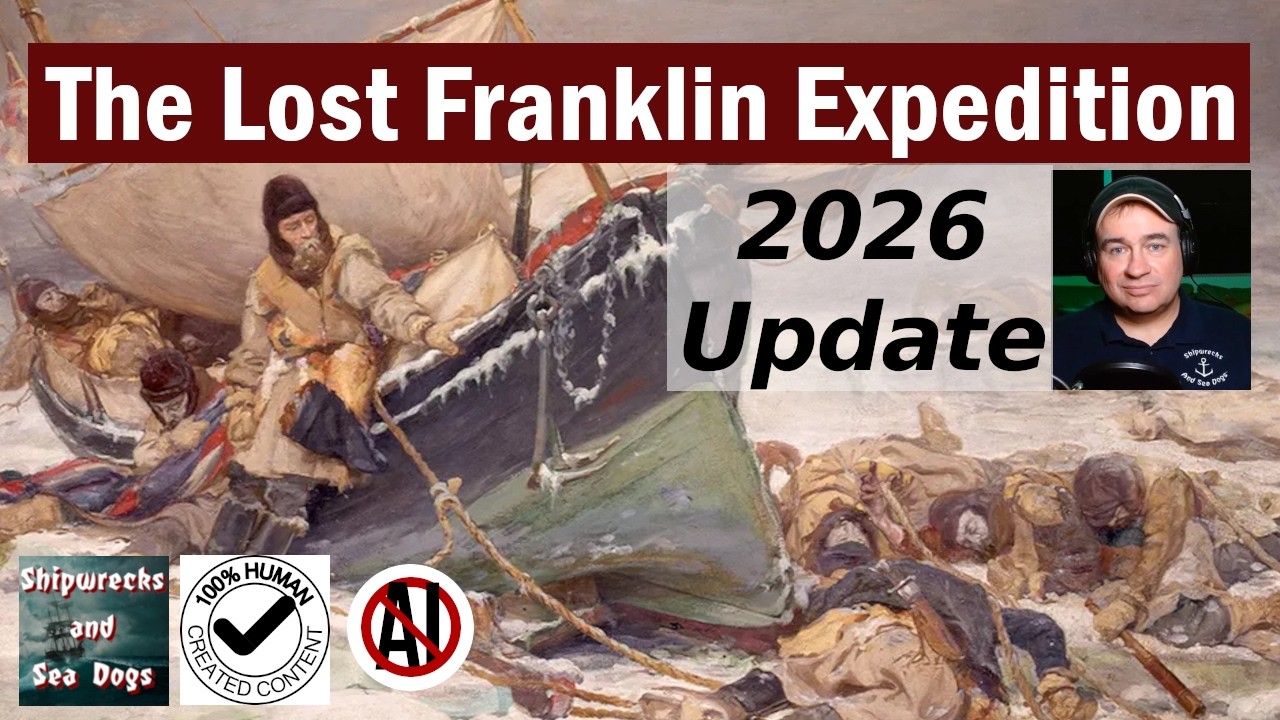
 This replay of episode 35 includes new updates! A 2026 research study has positively identified remains of four men from the Franklin Expedition using DNA analysis. Also, updates about what has been found at the wrecks of HMS Terror and HMS Erebus.
The Franklin Expedition of 1845 was a British voyage led by Sir John Franklin in an attempt to navigate the Northwest Passage, a coveted sea route through the Arctic. Comprising two ships, the HMS Erebus and HMS Terror, the expedition aimed to explore uncharted territories but tragically ended in disaster. The ships became trapped in ice off King William Island, and all the crew members perished. Despite numerous search missions, the fate of the expedition remained a mystery for over 150 years until the wrecks of the Erebus and Terror were discovered in 2014 and 2016 respectively, shedding light on the hardships faced by the crew, including exposure, starvation, and lead poisoning from poorly preserved food cans, contributing to their demise.
This episode was written, edited, and produced by Rich Napolitano. Original theme music is by Sean Sigfried.
**No AI was used during the production of this episode.**
For ad-free listening, access to exclusive bonus episodes, and free perks, please subscribe to the Officer's Club!
Love the podcast? Show your support at BuyMeACoffee.com/shipwreckspod.
Please leave a rating and review on Apple Podcasts, Spotify, Podchaser, or wherever you listen to podcasts.
Shipwrecks and Sea Dogs tee shirts, hats, and other items are available at shop.shipwrecksandseadogs.com.
Shipwrecks and Sea Dogs is a maritime history podcast about shipwrecks, tragic loss, and incredible accomplishments on the world's oceans and waterways.
Follow Shipwrecks and Sea Dogs
- Subscribe on YouTube
- Follow on BlueSky
- Follow on Threads
- Follow on Instagram
- Follow on Facebook
Learn more about your ad choices. Visit megaphone.fm/adchoices
00:00
Introduction
Hello and welcome to Shipwrecks and Sea Dogs, Tales of Mishaps, Misfortune and Misadventure. I'm your host Rich Napolitano. The Franklin Expedition of 1845 has been one of the most intriguing historical events of all time.
Historians have been debating and theorizing for over 150 years about the timeline of the events and what killed the 129 men on board HMS Terror and HMS Erebus. No log books from either ship have ever been found.
And what little we do know comes from just a couple of documents, human remains, artifacts, and testimony from the native people of Nunavut. In December of 2023, I published episode 35 of Shipwrecks and Sea Dogs about the Lost Franklin Expedition.
Since then, new evidence has been revealed, giving us more clues about the fate of the officers and crew.
A study published in the Polar Record on May 7th, 2026, just a week prior to this recording, has finally resolved one of the most enduring puzzles surrounding the doomed expedition.
The identity of a sailor whose skeleton was discovered at Gladman Point on King William Island in 1859 by Sir Francis Leopold MacClintock. Efforts to identify this sailor had been complicated by contradictory evidence.
Documents found with the body, including a seaman certificate and diary, known as the Peglar Papers, pointed to Harry Peglar, a petty officer aboard HMS Terror. But the clothing told a different story.
Fragments of a double-breasted waistcoat and a black silk neckerchief was a style used only by stewards or officer servants, not by sailors of Peglar's rank. This contradiction fueled more than a century and a half of debate.
The prevailing view among researchers had been that the skeleton belonged not to Harry Peglar, but to one of the expedition stewards, perhaps a friend who had been carrying Peglar's documents.
The two most frequently proposed candidates were Thomas Armitage and William Gibson, both stewards on HMS Terror, who had previously served alongside Peglar.
Researchers at the University of Waterloo and Lakehead University of Ontario, Canada, have finally solved this mystery.
Following this replay of episode 35, the Lost Franklin Expedition, I will tell you about this recent research, how the identity of four men from the Franklin Expedition have been confirmed, and updates about the excavation of the wrecks of HMS Terror
and HMS Erebus. It is May of 1847. The crews of the HMS Erebus and HMS Terror have been stuck in the ice of Victoria Strait in Northern Canada since September of 1846.
The expedition, led by Captain Sir John Franklin, has been in search of the elusive Northwest Passage to the Pacific Ocean. But winter has come early and the two ships are trapped, wedged in the thick pack ice of the Canadian Arctic.
The uncomfortable conditions aboard sailing ships were made even worse throughout the winter. Hungry, freezing, sick and miserable, the men are desperate.
Franklin dispatches Lieutenant Graham Gore, first mate Charles Frederick DeVoe, and six sailors to explore the west side of King William Island.
Gore is instructed to leave pre-written notes in stone cairns along the way, hoping the notes would be found and help would be sent.
Lieutenant Gore comes across a stone cairn built by a previous expedition at what would later be called Victory Point. He leaves one of the pre-drafted notes inside.
The scouting party continues south for several miles along the coast before stopping to build another cairn. Gore leaves a second note inside, identical to the first.
Seeing no people, no food, and no resources of any kind, the men trek back through the ice and snow and return to the relative safety of their ships.
The notes they left would indeed be found, although far too late to change the fate of the doomed expedition. The Lost Franklin Expedition, today on Shipwrecks and Sea Dogs.
Welcome to Shipwrecks and Sea Dogs, Tales of Mishaps, Misfortune and Misadventure. I'm your host, Rich Napolitano. Thanks for joining me once again.
Much has been written of the Franklin Expedition, and even more has been speculated. The disappearance of the ships and its men captured the imaginations of those back in England, caused great distress and stirred feelings of uneasiness.
It's a fascinating bit of history about human desire for exploration, the risks we are willing to take for it, and ultimately the human will to survive. I'm excited to finally bring you this story of the 1845 Franklin Expedition, so let's jump in.
The HMS Terror was built in Topsham in Devon, England, by the Royal Navy, and was launched in 1813.
Originally designed as a bomb vessel, the Terror was not fitted with cannon, but with mortars, in order to fire high trajectory shells over long distances at enemy positions on land.
For this reason, bomb vessels had very strong and sturdy hulls to withstand the recoil of the mortars. The Terror participated in the War of 1812 between the United Kingdom and the United States.
For the UK, this was another front of the Napoleonic Wars.
The Terror saw action at the Battle of Baltimore, and the assault on Fort McHenry, the battle which inspired Francis Scott Key to write the Star-Spangled Banner, which later became the national anthem of the United States.
In 1815, the Treaty of Ghent was signed, ending the conflict and the Terror was laid up until 1828, before being redeployed in the Mediterranean for several years.
The Terror was then refitted as a polar exploration vessel, as her sturdy hull was perfectly suited to withstand breaking through the ice. In 1836, the Terror was assigned to an Arctic expedition to explore Canada's Hudson Bay.
Under the command of Captain George Back, the ship became stuck in the ice for 10 months, and sustained significant damage in the frozen strait at the northern tip of Hudson Bay.
At one point, the ship was pushed 12 meters up a slope by the encroaching ice, and was nearly sunk by an iceberg. In the spring of 1837, she was able to break free and begin her journey back to England.
But the Terror was badly damaged, and just barely made it to County Donegal, Ireland, where she was beached.
In 1839, after major refitting and extensive repairs, the Terror was assigned to the Ross Antarctic Expedition, and was paired with the HMS Erebus for the first time.
The HMS Erebus was built in Pembroke Dockyard, Wales, and launched in 1826 by the Royal Navy. Like the Terror, it was built as a bomb ship.
The ship's name comes from the deity Erebus in Greek and Roman mythology, being the personification of darkness and shadow.
It served two years on the Mediterranean before being refitted as a polar expedition ship in 1839, when it joined the Terror for an Antarctic expedition under the command of Sir James Clark Ross.
From this point on, the fates of the two ships were linked. The Erebus and Terror departed the Chatham Dockyard in Kent in September of 1839, bound for Van Diemen's Land, or modern-day Tasmania.
The ships arrived in Tasmania in August of 1840, where they began preparing for their Antarctic expedition. On the 21st of November 1840, they departed for Antarctica with the stated mission of conducting magnetic experiments around the South Pole.
They reached Antarctica in January of 1841, discovering what would be named the Ross Sea and Victoria Land. Ross also discovered an island which they named Ross Island, and its two volcanoes, Mount Terror and Mount Erebus, were named after the ships.
McMurdo Sound was named after Archibald McMurdo, the Senior Lieutenant of the Terror. This first expedition also found what Ross called the Great Ice Barrier, now known as the Ross Ice Shelf and the Trans-Antarctic Mountains.
The expedition wintered in Tasmania and returned again later in 1841. Over the next two summers, the expedition charted much of the Antarctic coastline, conducted magnetism experiments, and collected specimens of flora and fauna.
The Terror and Erebus returned to England on the 4th of September 1843, after an extremely successful expedition. Exploration of the Arctic was of particular interest, but not solely for scientific purposes.
Explorers had been searching for the fabled Northwest Passage for centuries, in order to find a faster trade route to Asia.
With the Panama Canal still 70 years in the future, the Second Secretary of the Admiralty, Sir John Barrow, lobbied the Royal Navy to send an expedition to search for such a passage to the Pacific.
Barrow was 82 years old, and had held his post for 41 years. Much progress had already been made charting the North American polar regions, and he believed this passage would soon be found.
The Royal Navy agreed and commissioned the HMS Terror and HMS Erebus with the goal of finding and mapping a navigable Northwest Passage through Canada, from the Atlantic Ocean to the Pacific Ocean.
Barrow's first choice to command the expedition was William Edward Perry. He was an experienced mariner, discovering Perry Channel through the central section of the Canadian Arctic while searching for the Northwest Passage in 1819 to 1820.
But he had had enough of Arctic exploration and therefore declined. Barrow's second choice was James Clark Ross, who led the successful expedition to Antarctica, and was the nephew of fame navigator Sir John Ross.
He too declined, having promised his wife that his days of polar exploration were over. Barrow's third choice, James Fitzjames, was rejected by the Admiralty due to his young age.
George Back was rejected for being too argumentative, and Francis Crozier was found unsuitable, allegedly due to his Irish birth, Presbyterian religion, and for being a commoner.
Barrow and the Admiralty finally decided on 59-year-old Sir John Franklin. This was a surprising choice. Franklin indeed had experience, and was well respected, but at 59 years old, he was not a young man.
Franklin was also a bit overweight, older than all the other candidates, and had not voyaged to the polar regions in 27 years.
But Franklin had enough friends in the Admiralty to push him through, and he was appointed as commander of the 1845 expedition. Sir John Franklin had already had a long and storied career by this time.
Born in Spillsby in Lincolnshire, he entered the Royal Navy in 1800 at age 14, and showed a keen interest in exploration, surveying and science.
After two years exploring the coast of Australia with his uncle Matthew Flinders, Franklin served under Admiral Horatio Nelson during the battles of Copenhagen and Trafalgar during the Napoleonic Wars.
He later served as a lieutenant on HMS Bedford, and was wounded during the Battle of New Orleans in 1815. Following up his war service, Franklin turned his interest to exploration.
In 1818, he commanded the refitted whaling ship Trent on an unsuccessful expedition to find a passage through the icy waters of Norway. A year later, Franklin was chosen to explore the Arctic coastlines of Canada.
During Franklin's first Arctic expedition from 1819 to 1822, he was tasked with mapping the latitudes and longitudes of North America's coast, as well as taking scientific measurements and observations.
But harsh conditions and lack of proper supplies took their toll. The men struggled with starvation and sickness, resorting to scraping lichens off rocks and eating their leather boots.
After wintering at Fort Enterprise, the men struck out for the mouth of the Coppermine River, where conditions were worse and supplies thin.
Ship's surgeon John Richardson made it back to the relative safety of Fort Enterprise and reported two of the men had engaged in cannibalism. Richardson also admitted to killing the men who committed these acts.
In total, 11 of Franklin's 19 men perished during the voyage, and only 350 miles of coastline were charted. It was an undeniable failure. Despite the struggles of the expedition, Franklin returned to England a hero.
He described the ordeal of his expedition in his, Narrative of a Journey to the Shores of the Polar Sea in the years 1819, 20, 21, and 22, which he published upon his return.
His narrative was eagerly devoured by the public in an age when the chronicles of a gentleman's adventures were highly sought after. Franklin was then appointed to a second Overland Arctic Expedition from 1825 to 1828.
Franklin did not make the same mistakes and took sufficient supplies and personnel. Franklin wrote of the comparison between the two voyages.
It was impossible not to be struck with the difference between our present complete state of equipment and that on which we had embarked on our former disastrous voyage.
Instead of a frail bark canoe and a scanty supply of food, we were now about to commence the sea voyage in excellent boats stored with three months provision.
Franklin traveled about 14,000 miles and mapped roughly half of the continent's northern shores. All of the information gathered by Franklin and his men offered more clues for finding the Northwest Passage.
In 1828, Franklin again published a narrative of his expedition. Narrative of a second expedition to the shores of the Polar Sea, adding to his fame. Franklin was promoted to captain and knighted by King George IV.
He went on to serve as Lieutenant Governor of Van Diemen's Land from 1836 to 1843. After returning to England, Franklin made it known that he wished to receive another command. And he soon received it.
Following the Ross expedition to Antarctica, the HMS Erebus and Terror were again refitted, upgraded, repaired and reinforced. 20 feet of iron siding was added for and aft to protect the ships from the Arctic ice.
They were also given cross-planking to help absorb impacts from any direction. The ships were also the first ever in the Royal Navy to be fitted with steam-powered engines and a screw propeller, allowing them to reach speeds of up to 7.5 km per hour.
This was accomplished by installing railway locomotives from the London and Greenwich Railway in each ship to power the screw propellers. Having originally been bomb ships, storage space below decks was plentiful.
In total, the ships carried 24 tons of meat, 35 tons of flour, 2 tons of tobacco, 8,000 tins of meat, soup, and vegetables, 7,000 liters of liquor, 1100 pounds of tinned pemmican, 9,000 pounds of lemon juice, and 200 pounds of pepper.
Livestock of cattle, sheep, pigs, and hens were on board to be eaten during the early stages of the voyage. The Erebus also had three pets, a monkey which Lady Franklin gifted to the men, a dog named Neptune, and a cat for killing rats.
The ships also carried scientific instruments, photography equipment, and luxury items such as musical instruments and thousands of books.
An innovative internal heating system was installed in both ships using a series of ducts from the steam engines. Both ships received another impressive upgrade, a desalination system to produce fresh water from salt water.
The Terror and Erebus were fully upgraded, modern and sturdy ships with enough supplies to last three years, and even longer if supplies were stretched. Under the command of the highly respected Sir John Franklin, the expedition was ready to launch.
16:42
Voyage Begins
The Terror and Erebus departed from Greenhithe, England in Kent on May 19, 1845 with a crew of 134. Franklin commanded the expedition from the Erebus with James Fitzjames serving as the ship's captain. Francis Crozier captained the HMS Terror.
The ships first sailed to the Orkney Islands for a brief stop for supplies before heading west for Greenland, escorted by HMS Rattler and accompanied by the supply ship, Barretto Jr.
On July 4, 1845, the ships arrived at Whalefish Islands at Disco Bay on the west coast of Greenland where they anchored.
Additional provisions were then loaded from the supply ship, and on July 12, crew members mailed their last letters home before a long and uncertain journey. When the ships were completely resupplied, the expedition was ready to set out.
Already, just two months into the expedition, five of the crew had become gravely ill and were sent home on the HMS Rattler and Baretto Jr., leaving a total of 129 crew for the expedition.
On the 29th of July, 1845, the Terror and Erebus were spotted by the whaling ships Enterprise and Prince of Wales in Baffin Bay off the west coast of Greenland. This was the last known sighting of the Franklin expedition.
In 1847, two years had passed since the Franklin Expedition set out, and no thought or worry was given about their fate. An expedition such as this would easily be two to three years, so it was not out of the ordinary to have heard no news.
But Lady Jane Franklin, Sir John's wife, as well as members of Parliament and other influential people, began to push for the Admiralty to send search parties. By spring of 1848, the first of three search expeditions departed England.
Captain Henry Kellett was sent to the western entrance to the Northwest Passage, with Sir James Ross and Lieutenant Robert McClure to enter from the east. Dr.
John Ray and Sir John Richardson were to trudge overland starting at the mouth of the Mackenzie River. Though much effort was put forth, these searches provided no results.
By 1850, there was growing pressure from the public and constant urging from Lady Franklin to do more to find the lost men.
In response, the Admiralty offered a reward of 20,000 pounds for information leading to their discovery, prompting private expeditions to join the search.
Between 1849 and 1859, 32 separate expeditions were sent out to search for the Terror, Erebus and their crews.
On the 23rd of August of 1850, the first real clues were discovered when Captain Erasmus Omeny of the HMS Assistance discovered remnants of Franklin's camp at Cape Riley on the southeast shores of Devon Island.
Omeny wrote, I had the satisfaction of meeting with the first traces of Sir John Franklin's expedition, consisting of fragments of naval stores, ragged portions of clothing, preserved meat tins, etc., and the spot bore the appearance of an
encampment. While this was helpful evidence, it left no clue of what happened to the men or where they went. Omeny pushed on with Captain Horatio Austin Thomas, and later that day spotted a cairn high up on a cliff on Beachy Island.
This small island is on the southwestern tip of the much larger Devon Island. The cairn was disassembled, hoping to find an ode inside, but nothing was found.
As word spread of the evidence found at Cape Riley, and of the cairn on Beachy Island, many more ships approached, and large parties of men disembarked.
Commander of the HMS Pioneer, Sherrard Osborne, wrote of this, A boat full of officers and men proceeded on shore. On landing, some relics of European visitors were found.
Captain William Penny of the HMS Lady Franklin thoroughly searched the area, and discovered more traces of Franklin's expedition at Cape Spencer on Devon Island, including a small stone hut, food tins, torn mittens, and scraps of a newspaper dated
September of 1844. On August 27, an excited sailor approached Captain Penny, shouting, Graves! Captain Penny, graves! Penny hurried to the site, followed by his ship's surgeon, Dr.
Elisha Kent Kane. There they saw three tombstones, lined up next to each other. Two of the graves were covered with a limestone slab.
Each tombstone included an inscription. Sacred to the memory of William Brain, RM., HMS Erebus, died April 3rd, 1846, aged 32 years. Choose ye this day whom ye will serve.
Joshua chapter 24, verse 15. The next read, sacred to the memory of John Hartnell, AB of HMS Erebus, died January 4th, 1846, aged 25 years. Which said, Thus saith the Lord of Hosts, consider your ways.
The third grave contained the first man to die, sacred to the memory of John Torrington, who departed this life January 1, AD., 1846, on board of his Majesty's ship Terror, aged 20 years.
The searchers were now confident that they had found the site of Franklin's 1845-1846 winter encampment.
As the area continued to be searched, additional artifacts were found, including an armorer's forge, remains of tents, a storehouse, and a deceased polar bear that had been shot with a rifle, the same type as had been issued to Franklin's men.
Another large cairn was found on Beachy Island, made of discarded food tins, but still no note of any kind was found inside. But the graves of the three men left the searchers wondering how these men died so soon into the expedition.
Captain Omeny speculated what could have caused such death in such a short amount of time.
In a report to the British government in 1852, he wrote, We know that three of their men, young men, died the first year, from which we may infer they were not enjoying perfect health. It is supposed their preserved meats were of an inferior quality.
In fact, the supplier of the tinned foods, Stephen Goldner, had problems with the quality of his food with later expeditions.
And at the time of the Franklin Expedition, Commander James Fitz James expressed concern about purchasing from an unknown supplier simply because he offered the lowest prices. Another surgeon with Penny's Expedition, Dr.
Peter Sutherland, wished to perform autopsies on the three men. But this was not received well by other officers, and the idea was abandoned. The search expeditions then settled into their bitter cold winter camp and the frozen wasteland themselves.
In the spring of 1851, sledging parties were sent out to nearby islands, including Cornwallis Island, Prince of Wales Island, and Devon Island, but no further evidence was found.
Fearing another arctic winter, the Northern Search parties returned to England.
Over the next several years, many more expeditions were sent to search for the Lost Expedition, both by the Admiralty, American interests, and through private funding by Lady Franklin.
Coastlines were charted, islands discovered, and the final stretch of the Overland Northwest Passage was found by Captain Robert McClure. But nothing was discovered regarding the Franklin Expedition.
24:15
Inuit Accounts McClintockʼs Search
In March of 1854, the Admiralty officially declared Sir John Franklin and the crews of the HMS Terror and Erebus as deceased. But this did nothing to quell the fervor to find out the fate of the men and of the ships. In 1854, Dr.
John Ray, a Scottish explorer, fur-trapper and surgeon received information from a local Inuit tribe near King William Island while he was exploring Boothia.
This location is 900 kilometers or over 500 miles from Beachy Island where Franklin spent the winter of 1845 to 1846. The Inuit people reported the two ships were crushed in the ice and many died of starvation.
The Inuit also reported seeing some of the white men dragging sledges south down King William Island towards Backfish River.
The Inuit discovered mutilated corpses and bones with cut marks on them in pots, indicating some of the men may have resorted to cannibalism.
They also possessed European artifacts such as monogrammed silverware belonging to Sir John Franklin, Francis Crozier and James Fitzjames, as well as Sir John Franklin's Hanoverian Order of Merit.
Ray was able to purchase some of these artifacts and bring them back to London. John Ray returned to England to report his news and Lady Franklin, along with Charles Dickens, began a smear campaign against Dr.
Ray, not believing that the distinguished Sir John Franklin and other Englishmen would resort to cannibalism. Lady Franklin even refused to pay Dr. Ray for his efforts.
As Ray's information was second hand from the Inuit people, it was not trusted and most did not believe any of it to be true.
The Hudson Bay Company was asked to follow up on Ray's information and Chief Factor James Anderson discovered a few more artifacts from the Franklin Expedition, but did not find anything conclusive. Dr.
Ray was ultimately awarded 8,000 pounds in reward money and his crew split another 2,000 pounds. With the outbreak of the Crimean War in 1853, much attention was diverted to the support of the war effort.
Interest in searching for the Franklin Expedition waned, but it did not disappear. Lady Franklin continued to push for the British government to perform one last search, but her efforts were unsuccessful.
Instead, she took it upon herself to fund another expedition. Through public donations and a donation of supplies from the Admiralty, she was able to purchase the yacht called the Fox and hired Captain Francis Leopold McClintock.
He was a Royal Navy officer and a veteran of three prior expeditions to search for Franklin. On July 1st, 1857, McClintock set off on board the Fox from Aberdeen, Scotland, with second-in-command Lieutenant William Robert Hobson.
McClintock immediately experienced problems and was forced to spend the winter of 1857 to 1858 stuck in Baffin Bay. By spring, he was able to continue west into Lancaster Sound, reaching Beachy Island in August of 1858.
There, he erected a monument at the request of Lady Franklin.
The inscription read, To the memory of Franklin, Crozier, Fitzjames, and all their gallant brother officers and faithful companions who have suffered and perished in the cause of science and the service of their country, this tablet is erected near
the spot where they passed their first arctic winter, and whence they issued forth to conquer difficulties or to die. After stopping at Beechey Island, McClintock headed south, and by September of 1858 had reached the Bellot Strait, and set up his
second winter camp on the Boothia Peninsula. In April of 1859, the men set out overland with sledges, splitting up into three parties.
McClintock would head south down the Boothia Peninsula, and then the eastern shores of King William Island, while Hobson was to head to the west and down the west coast of King William Island, and Alan Young took a search party northwest across the
ice to Prince of Wales Island. McClintock came upon an Inuit village on the eastern side of King William Island, and they told him of white men dragging a sledge across the snow on the other side of the island, and then dropping dead.
They also had artifacts belonging to the Franklin Expedition, which McClintock traded for. Continuing south, McClintock reached the North American mainland, going as far as Montreal Island, at the entrance to the Baxfish River.
Here he found a preserved meat tin, an iron hoop, and other scraps of the Franklin Expedition. Turning back north, he crossed Simpson Strait and reached the southern shores of King William Island.
Heading west along the southern shores, McClintock's team made a disturbing but relevant discovery, a human skeleton wearing a steward's uniform. Next to the skeleton was a tattered notebook, a clothes brush, and a hair comb.
McClintock wrote of this discovery, This poor man seems to have selected the bare ridge top as a forwarding the least tiresome walking and to have fallen upon his face in the position in which we found him.
It is probably that, hungry and exhausted, he suffered himself to fall asleep when in this position, his last moments were undisturbed by suffering. The notebook belonged to a man named Harry Pegler, who was a petty officer on the HMS Terror.
Most of the messages in the notebook were of no significance, and others were indecipherable. However, a badly spelled, broken, and partial entry read, O Death, where is thy sting? The grave at Comfort Cove.
For who has any doubt how? The dire sad. It is impossible to determine if the skeleton was that of Harry Pegler, or if this was another man who took up writing in a notebook after Pegler died elsewhere.
Because the skeleton was wearing a steward's uniform, it is more likely that the body belonged to Thomas Armitage, a gun room steward on HMS Terror, and a shipmate of Pegler's.
30:18
Victory Point Note
While McClintock was searching to the east and south, Lieutenant William Hobson made probably the most significant discovery regarding the Franklin Expedition.
Starting at Cape Felix, at the extreme northwest of King William Island, Hobson and his men trekked south down the western shore. At a location known as Victory Point, a stone cairn was found, and this time, they found a note inside.
The note was a standard Admiralty form with space for a written message and a pre-printed request to report the finding of the document to the Admiralty in London.
The handwritten message was dated 28th May, 1847 and stated the following, HMS ships Erebus and Terror wintered in the ice in latitude 70 degrees, five minutes north, longitude 98 degrees, 23 minutes west.
Having wintered in 1846 to 1847 at Beachy Island in latitude 74 degrees, 43 minutes, 28 seconds, longitude 91 degrees, 39 minutes, 15 seconds west.
After having ascended Wellington channel to latitude 77 degrees and returned by the west side of Cornwallis Island. Sir John Franklin commanding the expedition. All well.
Party consisting of two officers and six men left the ships on Monday 24th May, 1847. Signed GM Gore Lieutenant Charles F. This was conclusive proof the Erebus and Terror survived the winter and ventured further south.
Curiously, the note left by Gore and DeVoe states that they spent the winter in 1846 to 1847 at Beachy Island, but this was an error.
The evidence found on Devon Island and Beachy Island already indicated that Franklin had wintered there between 1845 and 1846. This was an error perhaps due to the cold, hunger and exposure.
But written around the margins was scrawled another note, written much later than the first. The note reads, 25th April 1848.
HMS ships Terror and Erebus were deserted on the 22nd April, five leagues north-northwest of this, having been beset since 12th September 1846. The officers and crews consisting of 105 souls under the command of Captain FRM.
Crozier landed here, in latitude 69 degrees 37 minutes 42 seconds, longitude 98 degrees 41 minutes.
This paper was found by Lieutenant Irving under the cairn supposed to have been built by Sir James Ross in 1831, four miles to the northward, where it had been deposited by the late Commander Gore in May 1847.
Sir James Ross's pillar has not however been found, and the paper has been transferred to this position, which is that in which Sir J. Ross's pillar was erected.
Sir John Franklin died on the 11th of June 1847, and the total loss by deaths in the expedition has been to this date nine officers and 15 men. FRM Crozier, Captain and Senior Officer, and starred on tomorrow 26th for Back's Fish River.
James Fitzjames, Captain HMS Erebus. This note, found in a cairn at Victory Point on King William Island in 1859, over a decade after it was left there, provided evidence that Sir John Franklin and other men had died.
It also confirmed that Captains Fitzjames and Crozier had survived, at least initially, along with over 100 of the crew.
McClintock later wrote after visiting the site, Around the cairn a vast quantity of clothing and stores of all sorts laid strewed about, as if at this spot every article was thrown away which could possibly be dispensed with, such as pickaxes,
shovels, boats, cooking stoves, ironwork, rope, blocks, canvas, instruments, oars and a medicine chest. The route of the Franklin Expedition was now coming into focus.
Franklin circled Cornwallis Island to the west of Devon Island, before wintering on Beachy Island. The ships then continued south into Victoria Strait, where they became trapped in the ice in September of 1846.
Most likely out of desperation, Lieutenant Gore led a scouting party, depositing these standard admiralty forms with their first note and cairns along the way.
Gore and his men trekked through the ice and snow another eight miles and left another note at what is now called Gore Point before returning to the ships.
A year later, in April 1848, Fitzjames and Crozier abandoned the ships in the ice and led their men to King William Island. When they found Gore's note at Victory Point, they added their second message.
The ships had spent almost two years frozen in the ice in Victoria Strait. The Victory Point note provides the only firsthand evidence of the progress of the Franklin Expedition.
As the note indicates, the men were heading for Baxfish River to the south. It can only be speculated, but it is reasonable to expect that they believed more food and supplies could be found to the south and perhaps even rescue.
After finding the Victory Point note, Hobson continued south and came across a lifeboat from one of the ships. Inside, he found two skeletons and many artifacts. One of the skeletons had evidence of being mauled by large animals, possibly wolves.
McClintock described the other skeleton as being untouched and wrapped in warm clothing and furs. Two loaded, double-barreled guns were found nearby, indicating the men were protecting themselves against some unknown danger.
The boat had been prepared for river travel and included a vast amount of goods that McClintock described as a mere accumulation of dead weight, of little use, and very likely to break down the strength of the sledge crews.
The artifacts on the boat were carefully logged and included boots, silk handkerchiefs, scented soap, sponges, slippers, toothbrushes, and hairbrushes. A number of books were also found, including the Bible and the Vicar of Wakefield.
The only food found on board was tea and chocolate. The boat was found pointed in the opposite direction from Baxfish River, which was where the men indicated they were heading in the Victory Point Note.
This led McClintock to conclude that perhaps these men broke off from the main group and attempted to return to the ships. McClintock named this area Cape Crozier, but has since become known as the boat place by historians.
37:06
Later Discoveries
By June of 1859, McClintock had returned to the Fox, followed shortly by William Hobson, who was very weak and suffering from his ordeal.
Alan Young returned on the 29th of June, also in very bad health, having mapped Peel Sound, but finding no traces of the Franklin Expedition.
McClintock set sail home for England in July of 1859, taking with him the news of the significant discoveries made by his team.
The discovery of the Victory Point Note, the human remains, and the boat place earned McClintock and his men fame and brought closure to Lady Franklin.
McClintock was knighted and elected a Fellow of the Royal Society in 1865, and all members of the crew were awarded the Arctic Medal.
American explorer Charles Francis Hall lived with the Inuit at Frobisher Bay on Baffin Island, and he launched two expeditions to King William Island in the 1860s.
There he found evidence of graves, campsites, and other relics along the southern coast. In 1869, an Inuit led him to a shallow grave containing a well-preserved body and fragments of clothing.
The remains were returned to England, where they were examined by biologist Thomas Henry Huxley, and determined to be Second Lieutenant of the Erebus, Henry Thomas Dundas Lévesque.
The remains were interred under the Franklin Memorial at Greenwich Old Naval College in London. But a re-examination in 2009 determined the remains most likely belonged to Harry Goodsir, Assistant Surgeon of the Erebus.
Charles Francis Hall collected hundreds of pages of testimony from the Inuit, who claimed they visited the ships, and saw the men trekking overland and dying. Hall later was skeptical of much of the Inuit testimony.
In 1881, an expedition by United States Army Lieutenant Frederick Schwatka led to the discovery of the remains of John Irving, third lieutenant of the HMS Erebus.
With the help of local Inuit, Irving's remains were found, along with personal items that helped positively identify Irving. His remains were returned to Scotland, and buried at Dean Cemetery in Edinburgh.
Of the crew of the Franklin Expedition, only the bodies of John Irving and Harry Goodsir have ever been recovered and returned to their homeland. For over a hundred years, no official searches had been done for the ships. In 1981, Dr.
Owen Beatty, a forensic anthropologist, and his team from the 1845 Franklin Expedition Forensic Anthropology Project, went back to the area to investigate.
Having a good idea of where to look, the team found the artifacts and three graves on Beachy Island. After receiving permission to exhum the bodies, Beatty and his team carefully excavated the frozen tombs.
The remains were remarkably well preserved, and Beatty was able to extract frozen tissue, hair, and bone samples, and have them analyzed using modern technology.
The results confirmed extremely high levels of lead in the samples, as much as 20 times higher than what would be found in humans today.
Beatty's examination of the food tins also revealed faulty manufacturing, with some of the tins not being properly sealed at its edges. Beatty also found skeletal remains on the southern shores of King William Island.
After careful examination, he determined cut marks on some of the bones made by a knife or other sharp object. This isn't conclusive evidence of cannibalism, but it is an additional clue to consider.
In 1992, the Canadian government declared the Erebus and Terror as national historic sites, even though the ships had not been found yet at that time.
Finally, in 2014, expeditions led by Parks Canada found the wreck of the Erebus in just 11 meters of water off the coast of the Adelaide Peninsula.
In 2016, the Terror was found 45 miles to the north in what is now called Terror Bay off the coast of King William Island. Both of the ships are now in what is Nunavut territory of north central Canada.
Many artifacts were found, including all varieties of personal items, supplies, dishes, and musical instruments. Some still had their contents inside, such as a ceramic jar of prepared mustard.
Unfortunately, no personal diaries or log books were found, which might help explain what happened to the crew. But Parks Canada continues to maintain the wreck sites as they carefully plan future excavations.
In 2017, the British government gave partial ownership of both ships to Parks Canada in exchange for a share of the artifacts found at the sites.
The Canadian government subsequently gave partial ownership to the Inuit people, recognizing their contributions to finding the sites.
Despite the failed expedition, Sir John Franklin mapped more of the Canadian coast during his career than any explorer except George Vancouver.
The Lost Franklin Expedition and the fate of its 129 crew are still a source of fascination and mystery today.
42:12
Modern Identifications Wreck Excavations
As promised, I have a pretty exciting update about the Franklin Expedition.
In 2021, researchers from the University of Waterloo and Lakehead University's Paleo DNA Laboratory conducted comparative DNA analyses on skeletal remains found on King William Island, presumed to be members of the Franklin Expedition.
The analyses compared DNA extracted from the remains with known descendants of the crewmen. The team identified DNA from a skull as the remains of John Gregory, an engineer aboard HMS Erebus.
In 2024, DNA within a molar from a jawbone was compared with samples provided by 25 living descendants of the expedition's crew. The results produced one exact match, the second cousin five times removed of Captain James Fitzjames.
The jawbone mentioned in the previous episode had evidence of cut marks from a knife, indicating the possibility and probability of cannibalism.
This is significant as it proves that Fitzjames died while others were still alive, and that the men were in such a dire state that they might cannibalize a senior officer.
Douglas Stanton of the University of Waterloo and co-author of the study, remarked, neither rank nor status was the governing principle in the final desperate days of the expedition as they strove to save themselves.
The research team has once again made an incredible discovery, made public in a paper released on May 6, 2026.
Remains from the skeleton found by Sir Francis Leopold McClintock at Gladman Point in 1859, along with the Peglar papers, have also now been analyzed.
As mentioned, it has long been thought the remains belonged to one of eight stewards, despite Peglar's diary and personal items being found with the skeleton. The skeletal samples themselves presented challenges.
Bone and tooth samples were acquired through excavations at the site between 2019 and 2023. Analysis of the bones from the left foot and two fingers from the right hand, yielded a DNA profile consistent with a male of European ancestry.
Comparison of this DNA profile with those of descendants of the stewards yielded no matches.
However, when mitochondrial DNA from the skeleton was compared with a presumed descendant of Harry Peglar, it yielded a match with a genetic distance of zero, meaning an exact match.
The descendant donor traced their ancestry to Mary Ann Peglar, one of Harry's older sisters, born in 1803 in Westminster with unbroken mitochondrial DNA inheritance through five generations.
This DNA match confirmed that the skeleton found in 1859 with Peglar's diary, certificate, and personal items were definitively Harry Peglar and not Thomas Armatage, William Gibson, or any other steward. But solving one mystery has opened another.
Peglar joined HMS Terror in 1845 as Captain of the Four Top, a petty officer role in charge of the crew manning the foremast and its sails and rigging. Yet he was found dressed in the uniform of a steward, which confused his identity.
Researchers believe it was improbable that Peglar wore a steward's uniform simply due to a shortage of clothing, given that a large heap of warm garments had been discarded at the camp near Victory Point, and another vast quantity further south at
Erebus Bay. A more likely explanation is that Peglar had been disrated or demoted at some point between 1845 and 1848. Though the exact circumstances remain unknown.
His previous service record does include instances of misconduct, including being disrated to ordinary seaman and given two dozen lashes for drunkenness and mutinous conduct in 1833.
The positive identification of Peglar has solved a 167-year-old mystery. He is the only sailor from HMS Terror whose remains have been conclusively identified thus far.
The only one from the Simpson Strait region at the southern end of King William Island, and the only one thought to have died alone, 200 kilometers from where he stepped ashore near Victory Point in late April 1848.
The research team identified three additional sailors from HMS Erebus. Their skeletons were found 130 kilometers to the west of Peglar's remains.
Using the same DNA analysis techniques used to identify Harry Peglar, the researchers identified William Orrin, David Young, and John Bridgens. Additional discoveries have been uncovered regarding the wrecks of HMS Erebus and HMS Terror.
In 2023, the underwater archaeology team of Parks Canada conducted 68 dives over a 12-day period at HMS Erebus, and carefully excavated artifacts from the vessel.
In what is believed to be the cabin belonging to 2nd Lieutenant Henry Dundas-Lévaconte, marine archaeologists found items related to navigation, science, and leisure, including a parallel rule, an intact thermometer, a leather book cover, and a
fishing rod with a brass reel. Other items including a leather shoe, storage jars, and a sealed pharmaceutical bottle, were recovered from an area thought to be the captain's steward's pantry.
A seaman's chest in the forecastle on the lower deck was also discovered.
Various personal items were found within, including a lens from a pair of glasses, map-making tools, coins, a pistol, medicine bottles, a leather shoe, shoulder epaulettes, and a group of fossils.
Scientists from the Geological Survey of Canada are helping to identify the fossils, which may give clues about the route the ships once traveled.
More dives were made on Erebus in 2024, and divers recovered additional artifacts from the seaman's chest, including a soldering iron, clothing, a medicinal bottle, two pistols out of more than 20 observed in the chest, and rolls of straight edge
shaving razors. Spare propellers and an ice anchor were also documented in the debris field, the first of any anchors found from either Erebus or Terror. The Parks Canada team then returned to HMS Terror for the first time since 2019.
Archaeologists conducted a site assessment, including a photographic coverage of the upper deck using hundreds of high definition photos. This data will be used to complete a detailed site plan and generate a 3D model of the wreck.
Following more than a decade of active exploration of the Terror and Erebus, in 2025 Parks Canada transitioned from active archaeological research to a regular monitoring program, co-developed with Inuit partners.
A new exhibition at the Natalic Heritage Center also opened in 2025, bringing the story of the Franklin Expedition closer to the Inuit communities, whose knowledge was invaluable to finding the once lost ships.
There is still much we do not know about the Franklin Expedition. What killed Sir John Franklin? How significant was lead poisoning in the deaths of the crew?
Was tuberculosis rampant? Scurvy? Did they starve to death or die of exposure?
And how prevalent was cannibalism? Both ships were found much farther south from where they were abandoned. Did they drift on their own, or did some of the men manage to return to the ships, possibly in 1849 or 1850, and sail them south?
We simply do not know. But as more evidence continues to be found, we gain valuable clues towards solving the puzzle of the doomed Franklin Expedition. Shipwrecks and Sea Dogs is written, edited and produced by me, Rich Napolitano.
Original theme music is by Sean Siegfried. You can find transcripts, show notes, and show merchandise at shipwrecksandseedogs.com.
If you enjoy Shipwrecks and Sea Dogs, you can do me a huge favor by leaving a five-star review on Apple Podcasts, Spotify, or wherever you listen to podcasts. Please join me again next time. But until then, don't forget to wear your life jackets.


