The Sinking and Discovery of the USCGC Tampa
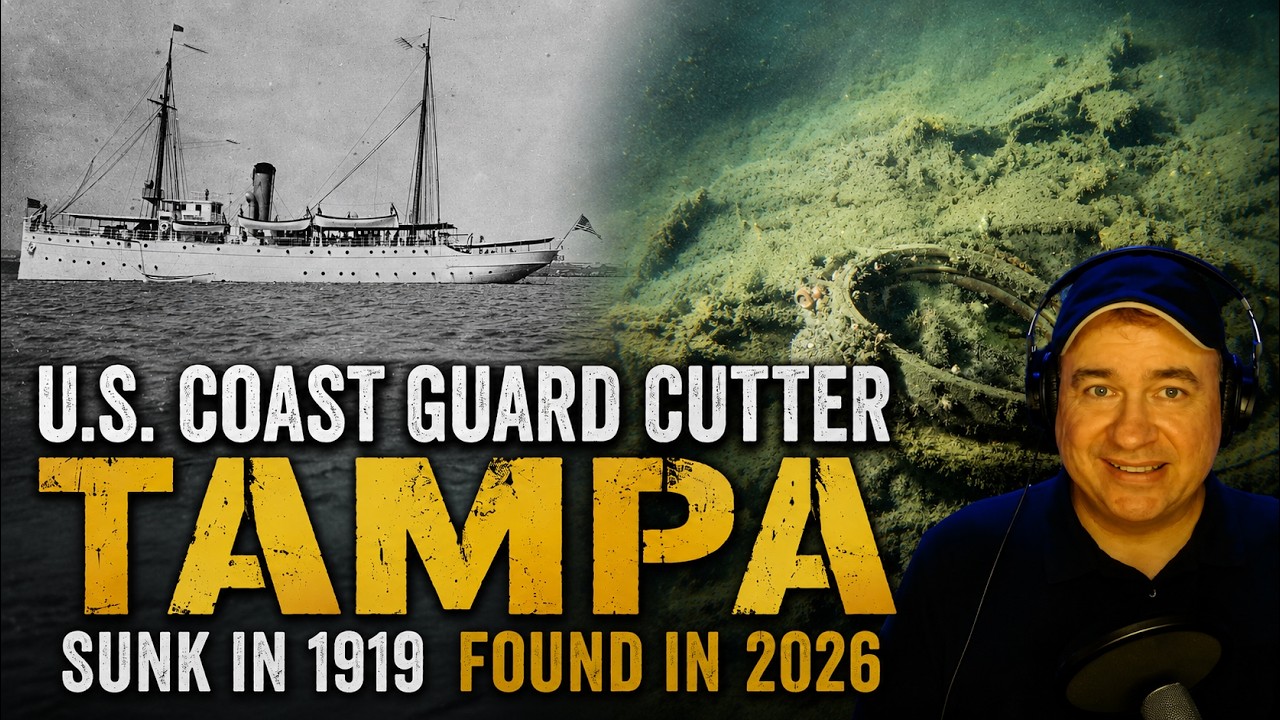
The USCGC Tampa was sunk by a German U-Boat in 1918 and found over 100 years later.

 Apple Podcasts
 Spotify
 iHeartRadio
 PocketCasts
 Goodpods
 Amazon Music
 Castbox
 Pandora
 Podchaser
 Youtube Music
 The Sinking and Discovery of the USCGC Tampa On September 26, 1918, the U.S. Coast Guard Cutter Tampa vanished into the Bristol Channel after a German U-boat torpedo struck her hull, killing all 131 sailors and personnel aboard in what remains the largest single loss of American life in combat during World War I. For over a century, the ship's final resting place stayed a mystery until April 2026, when a British volunteer dive team called Gasperados located her wreckage roughly 50 miles off Newquay, Cornwall, more than 300 feet beneath the Atlantic.
In this video, we cover the full story of the Tampa: her origins as the Revenue Cutter Miami in 1912, her service on international ice patrols, her wartime role escorting convoys through U-boat-infested waters, the night she was lost, and the painstaking three-year search that finally solved one of the Coast Guard's oldest mysteries.
🔹 The Tampa's early years and transformation into a Coast Guard cutter
🔹 Her WWI convoy escort missions across the Atlantic
🔹 The attack by German submarine UB-91
🔹 How the Gasperados dive team and Coast Guard historians identified the wreck
🔹 What the discovery means for the families of the lost crew
Guests in this episode are:
🔹 Dr. Bill Thiessen, Historian for the USCG Atlantic Area
🔹 Dom Robinson, Gasperados Dive Team
🔹 Gary Thomas, CDR Gary M. Thomas, USCG (Ret.)
👉 Dom Robinson's YouTube Channel: @DeepWreckDiver
👉 Gasperados Dive Team: https://www.facebook.com/p/Gasperados-Dive-Team-61579320759276/
👉 US Coast Guard History: https://www.history.uscg.mil/home/history-program/
👉 Foundation for Coast Guard History: https://fcgh.org/
#USCGCTampa #CoastGuardHistory #WWIShipwreck #NavalHistory #Shipwreck #WorldWarI #MaritimeHistory #Cornwall #UBoat #podcast #history
**🎧 LISTEN AD-FREE + BONUS EPISODES**
👉Shipwrecks and Sea Dogs is part of the Into History podcast channel. Subscribe here: https://www.intohistory.com/shipwreckspod
👉Get exclusive bonus episodes and merch on Patreon: https://www.shipwrecksandseadogs.com/patreon
👉Subscribe on Apple Podcasts: https://www.shipwrecksandseadogs.com/apple
👉Shipwrecks and Sea Dogs Merchandise is available! https://shop.shipwrecksandseadogs.com
👉You can support the podcast with a donation of any amount at: https://www.buymeacoffee.com/shipwreckspod
** No AI was used to create this episode.
Written, edited, and produced by Rich Napolitano.
Original theme music by Sean Sigfried. https://www.seansigfried.com
Tampaʼs Early Service
Hello, and welcome to Shipwrecks and Sea Dogs, Tales of Mishaps, Misfortune and Misadventure. I'm your host, Rich Napolitano. Today, I'm very happy to have with me the historian for the United States Coast Guard Atlantic Area, Dr.
Bill Thiessen, and member of the Gasperados Dive Team, Mr. Dom Robinson, to talk about the history of the US. Coast Guard cutter, Tampa, its sinking and subsequent discovery.
Gentlemen, thank you so much for joining me today.
Thank you.
The history of the Tampa goes back to even before the merging of the US life-saving service and the revenue cutter service into what is now the modern US. Coast Guard.
Starting with its construction, what is the history of those early years of the Tampa's service?
So the Tampa was built, it's a 190-foot cutter, and it was built to do high-seas missions for the revenue cutter service. Obviously, it was built in 1912, and that was predating the loss of RMS Titanic.
So once the revenue cutter service adopted what they call the International Ice Patrol in 1913, she was responsible for steaming north from the East Coast to identify, locate, and transmit the location of icebergs for international and commercial
shipping going through the North Atlantic to ensure no other vessels would sink as a result of hitting an iceberg. That was one of her main duties. Another one was derelict destruction.
Back in the days prior to World War I, a lot of derelicts would be set afloat in commercial shipping lanes. And these would be oftentimes wooden tall ships that crews had abandoned or they had been set afire or whatever.
They were floating around and being a hazard navigation. So Tampa would often go out to destroy these floating wrecks, as well as to rescue and search and rescue cases. This is all prior to World War I.
And it was originally built as the Miami.
So why was it renamed to Tampa?
So yeah, back in the Revenue Cutters Service days, a lot of these vessels were named for tribes, Native American tribes like the Miami.
And actually she wound up serving so much in Florida and often was at the Gasparilla Festival in Tampa that in 1916 they decided to rename her Tampa in honor of the Port of Tampa, where she so often found herself doing assignments and missions for
I'm actually from the Tampa area, lived here almost my whole life.
And I was interested, it was really interesting to see that connection to the Gasparilla Festival because we still have the Gasparilla Festival every year.
That's right.
Late January into early February, the flagship, Jose Gasparilla II, comes down the Hillsborough River with the whole fleet of other ships. It's a pretty interesting connection there to the Coast Guard Cutter.
Actually, the Tampa carried quite a few crew members from Tampa and from Key West that had been listed off the dumpster.
3:36
World War I Sinking
When the US entered World War I in 1917, how did this impact the US.
Navy and the still relatively new US. Coast Guard?
The impact for the Coast Guard was that it was really the first time that she had served as a military agency. Prior to 1915, the service was not considered military, was considered civilian still with uniforms on.
This was a baptism of fire for the Coast Guard because it was the first time that the service would be a branch of the US military. Furthermore, it was in the first time that they would serve in the European theater in wartime.
So the cutters that were assigned to the European theater as well as Coast Guard personnel was really the first time in their history that they would serve as a branch of the Navy in a war zone in the European theater.
September 17, 1918, the Tampa set off on its final fateful voyage. Can you walk us through the events that led up to its sinking?
Right. So it was common for this cutter as well as several other Coast Guard cutters to serve convoy duty between Gibraltar and the UK. And so steaming north with her convoy doing escort duty, she was bound north for the UK over several days.
And about the time she got into UK territorial waters, she had to re-coal because she was running low on fuel.
And so she separated from the rest of the convoy steaming independently for Milford Haven, where she was to refuel and re-provision to prepare to steam back south to escort another convoy.
So at the time she was torpedoed, she was actually steaming independently and not with the convoy.
And it was the German U-boat U-91 that found the Tampa and torpedoed her and sunk her on that fateful day. What was the response from the public like about the loss of the Tampa and so many, not only American but British servicemen as well?
It was a shock and it was a sudden kind of trauma, you might say, because it was all hands were lost. The loss was very sudden and there was very little that was left to represent the cutter after she sank.
So there was a debris field on the surface, two bodies washed ashore in whales. But other than that, it was a complete loss of over 100 lives. Obviously, it was Coast Guard.
There were some Navy personnel as well as some Royal Navy personnel that were all lost. So it was a grave event that was grieved by people from the UK as well as the United States.
7:10
Search Discovery
So fast forward 100 years or so.
How did the search for the Tampa begin?
Okay. So there were actually some other efforts to try to locate Tampa about five years ago. One of the underwater archaeologists named Jim Delgado, along with some other divers from the UK.
I think there might have been, I forget how many there were involved. There was a lot of documentation and a wreck site was found. It was not the Tampa.
So the efforts were underway about five years ago, but nothing was successful and there was no indication as to actually where the wreck site might be. Then Dom, you can take it from there.
Our involvement really started with this. On the back of finding the Jacob Jones, we went to the cemetery. There's World War I maritime American Cemetery, south of London.
We got invited up there for the UK Remembrance Day, which is the 11th of November. When we were there, we became aware of the Tampa. It was like, maybe we should go and look for this.
Really, the Gasperados team is based around two people, Steve and Barbara Mortimer. They started doing the research, started looking at targets. Then we just started going out and diving these targets.
I know they've been in touch with Bill and Jim Delgado that's already been mentioned. I think they were communicating over, trying to interpret the historical data. What did the submarine say about the sinking?
What did the other ships in the convoy say about the sinking? Then trying to use information about tides and also the information provided by the UK Hydrographic Office, which shows objects on the seabed.
Then it was a case of just going out to dive them. I say just going out to dive them. These things are 45 or 50 miles offshore, which is a long way.
They're around about 90 to 100 meters deep. So that is a really significant undertaking. There's only a certain number of days per year you can get out there.
Obviously, everyone's got jobs and lives and all those kind of things. So we would probably do about three, four, maybe five targets a year, which is why it took us three years to find it.
What kind of preparation do you have to do for such a challenging project like this to search for a wreck?
I think you need some really dedicated people. I don't necessarily include myself in that list. I was the person who just turned up to do the dives.
It was the Mortimer's really who were doing all the hard lifting on this.
Because there was multiple trips to the archives, obviously the German records are in German, but they're in World War I era German, which is quite different to what is spoken now.
It's military World War I era German, so you need people who can interpret that. Also, you need people who understand the tides. We heard about the debris field.
We heard about the people who washed ashore. You need to be able to interpret the information in the British and American archives, et cetera, et cetera. So that's the bit of the iceberg you don't see.
The tip of the iceberg is people like myself just turning up for the glory and going diving. And one of the things actually is that along the way, we found a whole load of other stories, which we didn't intend to in the least, but they were there.
So you just go down on these wrecks that people would not normally dive because Tampa was quite small. And people normally, if they're going that far out, you want to dive a big wreck.
You want to dive a liner or a large merchant ship or a big warship. You don't want to go out and dive a little small thing. And what we ended up finding was a load of fishing boats.
We found a landing craft tank from the Second World War. We found a sailing ship, you know, all these sorts of things, some of which we never identified, some of which we think we did.
So it was kind of a really interesting process, but also really frustrating at the same time. And the dive that we found the Tampa on was the last dive we were going to do. We were going to give up at that point.
So it's kind of classic movie type stuff where, you know, all hope is lost and you're just going out there for one last throw of the dice and obviously that turned into it.
And what was that like when you finally did get to go down and achieve your glory and find the ship? What was that when you actually found it? What did you find on there?
What did you see?
I was the first person down, which is a really nice thing. And got down there. You can see the one of the things we get very good at is trying to identify wrecks really quickly and you recognize certain things.
So, when you land on a Collier, it's coal everywhere, so you get really used to it. When you dive on a modern ship, you see electronics and wiring and all those kind of things.
When you dive on a cheap ship, you can tell by the portholes and the bridge gear and all those things. When we landed on Tampa, it was instantly apparent that this was a high status ship.
All the bridge gear, all the portholes, all the engine gear, all that kind of stuff. This was a well-made ship. Now, we also found some of the things that we were expecting on the Tampa.
So we found ammunition really quickly. We found the plates, some of which showed an American link. So they had New Jersey and New York written on them, which was quite rare.
But we didn't find a gun. We were expecting the massive bell that you can see in the photos. We didn't find that either.
So if I'm honest, I was not 100% certain while I was down there. It wasn't until I was coming up and I was processing it all.
And I was like, actually, there's so much down here that kind of, that lines up, even though there isn't a smoking gun, you know, one definite thing. This has to be it. And of course, we went back and dived it again.
And, you know, when we dived it again, it just, it was super apparent that it was the Tampa. And that feeling of discovery, knowing that we found something that is so significant to the Coast Guard, because we all knew the history.
We'd seen the stained glass windows. We'd seen the post named after the Tampa. I'd been to the memorial in Hampshire.
You know, I'd seen the stuff online, all that kind of stuff. So I knew it was really important what we'd found. And that's really nice, because all of a sudden you close these stories down and you start to get feedback from people.
And it's like, my granddad was on there. My great uncle was on there. You know, those kinds of stories start to come out.
And that is just really, really nice.
And did you ever find any kind of definitive item that proved that it was the Tampa?
We may well have found stuff. We just didn't bring it up. So for me, the ship's helm is down there.
And it's a beautiful, beautiful thing. I'm almost certain that on the top of there will be the maker's details and a serial number. I guarantee pretty much if we brought that up, it would link straight to the Tampa.
Ditto, the binnacle is down there, probably the same. The telegraph, less likely, but also possible. Maybe we could have bring up some of the ammunition.
That might indicate where it was made. The fire extinguishers, you know, they've got brass plates on them. Chances are there would be another American link there.
Whether any of them would say Tampa or Miami, I don't know for certain. But if it was me, I would bring up the artifacts. They would identify it.
And then for me, those artifacts should be somewhere back in America. I'm not sure if there's a Coast Guard museum, but you know, that's where those artifacts should be to allow people to know the story.
And so, Bill, what are your thoughts about that? Could artifacts from the Tampa be brought up or placed in a museum?
So, the tricky part is the fact that a wreck site that's associated with World War I that could have had a lot of loss of life is considered a war grave. So, there's a lot more rules and regulations associated with how that's handled.
And so, you know, just like Dom said, the way to definitively identify it is to bring up something that says Miami or Tampa on it, because those were the names the ship had, or even maker's marks on some of the artifacts that would trace it back to
the United States. So, that's kind of where we're at right now. I think the next step is going to be to send down some sort of either a team or technology that can go ahead and confirm that identity.
There are some efforts underway to try to send some of that technology down there that can do that.
I mean, just to pick up on one point there, if you don't mind, Bill. The USS Jacob Jones, which we did definitively identify because we saw the bell and it had USS Jacob Jones written on it and we took a photo of it.
Yeah, that bell is currently in America. The Royal Navy lifted it, gave it back to the US Navy, and it's been conserved somewhere in America. So for me, I think the argument has already happened.
Yeah, and that would be the ideal situation.
In fact, I think there is another bell that was on the forward part of the vessel that might be a possibility. But there's a lot of material in that wreck site that could be corroborative.
In fact, just like Dom said, there is a National Coast Guard Museum that's being built as we speak.
And if indeed there was a chance to bring something up off the wreck site, that would obviously be the ideal place to put it on display for people to recognize the sacrifices of those crew members from the Tampa.
I spent a long time looking for the bell down there, by the way. And my view, such as it is, is that the Tampa hit the seabed, going down semi-vertically, and so all the front is compressed together.
And things like the gun and the bridge have kind of come forward. And my understanding is the bell was on the forward mast, and I think that's buried. So that's why I don't think we could find a bell.
What is the overall condition of the vessel today?
Well, I mean, it's been underwater for 100-odd years in an area that is very difficult for Shipwrecks.
So it's effectively exposed to the full force of the Atlantic, prevailing, everything is westerly. So it's been battered for 100 years. It's had 100 years of corrosion.
It was obviously torpedoed. It hit the seabed. So it's pretty smashed up.
The back, the stern is completely gone. We had a good look for it. In fact, I've seen some multi-beam imagery of the site, and there's no sign of a bit of the stern nearby or whatever.
So I think it was blown apart completely. Maybe the depth charges or whatever went up on it. So it's heavily degraded.
It will continue to collapse. And it's covered in fishing nets because of course, that is a really active area for British fishermen, Irish fishermen, French.
In fact, two of the vessels that we found were French fishing vessels, et cetera, et cetera. They get trawled, all those kinds of things. So these people imagine that wreck sites kind of look exactly as they were when they sunk.
These things are very dynamic. They're collapsing. And at some point, there will be very, very little left of them, which is why I'm a big fan of getting stuff from the seabed, bringing it up, sticking it in museums.
And then it's there to be seen by far more people than just me and a couple of my mates. And that story, that the memory doesn't get forgotten. In fact, people can not quite touch it, but certainly see something tangible about it.
That's always an interesting dichotomy when we talk about wreck diving and that there are so many things that we could do to remember what happened, remember the event, remember the people that were on board and all of the circumstances surrounding
that. It's just, it gets complicated when it's especially a war grave. So, you know, there's things to balance there. In terms of just respecting the dead, I suppose.
I can tell you any number of shipwrecks on which large numbers of people have died that have had lots of stuff taken off them.
Oh, I'm sure.
People who knew the people who died on these wrecks tended to be a lot less worried about this kind of thing than we seem to be today.
22:22
Tampaʼs Enduring Legacy
Bill, how is the legacy of the Tampa remembered today?
Well, there's monuments to the dead in our country as well.
There's a very large monument to the lost members of the crew and World War I losses at Arlington National Cemetery. Oftentimes, there are special Coast Guard ceremonies that take place there, wreath laying, for example.
So it was pretty much an open question, perhaps an open wound for many, many years.
And in fact, a lot of the families have come forward to and reached out to the Coast Guard, some because we're still trying to honor with the lost crew with Purple Heart medals.
And we've been able to locate perhaps 50 percent of the families so far to do that.
One of the great things about a podcast like this is it can spread the word and sometimes we'll get some of the families to reach back once they hear about this event taking place. And so it's still remembered.
It's still considered one of the great losses in Coast Guard history. And I will say too that our service is famous for going out, rescuing other people and going in harm's way off and losing our own lives just to save the lives of total strangers.
And so for a dive team like the Gasperados to really do us the favor and return, and to locate people that we've lost is very emotional and moving for not just the Coast Guard and its personnel, but also Americans in general. And we're very grateful.
Bill, if somebody wanted to learn more about the history of the Tampa, or perhaps get in touch because they're a family member of one of the victims, what could they do? Where can they go to find more information about that?
Well, there's a great deal of Tampa information on the Coast Guard Historian's website. And it's easy just to do keywords in a Google search for Coast Guard Historian's website. And there you'll find the information for Tampa.
There's also contact information for our office. And we have one staffer who's actually dedicated to reaching out to Tampa families. And so if someone were interested in finding out more, they can go to the website.
And if they're interested in trying to see if their relatives might have been on board the Tampa, or if they know that they have lost loved ones that are on board the Tampa, they can certainly reach out with our email link or phone numbers that are
on that website. And we can take care of them.
And I'll make sure to put that website in the show notes of this episode.
Sure. Thank you.
And Dom, where can everybody see more about your work as a diver and your dive team?
Yeah. I mean, I publish a lot of my videos on my YouTube channel, Deepwreck Diver. I hope everybody will go and have a look at it.
But you can see not just the dive where we identified the Tampa, but also a number of the other dives that we did whilst we were searching for that.
And I've mentioned some of those already, the various fishing vessels and the LCTs and all those kind of things, pretty much all of which had loss of life on.
And so there have been things there where we've, you know, like there's a French fishing vessel, for instance, where two guys died on it in the early 1970s. And I guess their loved ones never knew where that was.
They now know where it is, which is quite nice to them in the same way that it's absolutely fantastic that all the people associated with the Tampa know exactly where that is.
And, you know, where their loved ones, you know, I guess last known position is.
And again, I'll make sure to include that link to your YouTube channel in the show notes at Deepwreck Diver.
I think I'd like to add that I don't think anybody except for people like the Gasperados can know truly how much time, effort, investment of resources and just emotional investment there is in doing dives like the ones that they did to locate the
Shrek site. The tides, you have to worry about the tides. You have to worry about the sea state. You have to worry about the weather.
You have to worry about the visibility down the seafloor. Is there algae down there? And you also have to take time off from your jobs.
And diving 90 feet, I'm sorry, 90 meters over 300 feet in the water is not exactly a walk in the park.
So I think we really need to recognize and applaud the Gasperados for all the three years of this exploration, trying to find this wreck site is really tremendous. In some ways it was a needle in a haystack and they found it anyway.
So I think hats off to the Gasperados for all the heavy lifting and all the hard work they did on this project.
28:15
Diving Exploration Motivation
I mean, that's a really kind thing to say, Bill.
Thank you very much. I do know that Stephen Barbes, who are the absolute mainstays, they are our leaders, they're the people who led this project.
I know they really appreciated the kind of support that they got from yourself and other people within the US Coast Guard.
Because it makes such a difference having that additional information, having pictures and drawings and just the information about the sinking, just to kind of guide you as to what to expect when you get down there.
I guess the other thing to probably mention is that a couple of people were actually hurt while we looked for the Tampa. So we did have a couple of people get decompression sickness. There is an element of risk associated with what we do.
On the flip side though, there aren't many places that you can go exploring anymore. There's no more continents discovered, there's no more mountains that haven't been climbed or anything like that.
About the one place in the world that you can still go and do genuine exploration is at the bottom of the sea.
And that's the kind of thing that motivates me in particular, is just to move on from the humdrum of daily life and go out there and do something that I personally find genuinely exciting, despite all the other stuff, all the amount of time and
effort and cost and all those things. And then when you get a moment like this, when you find it and you close it and you achieve your goal, it's a wonderful experience. And it will be one of the highlights of my life. I'm absolutely certain of that.
It's really fantastic.
I know it takes a lot of dedication, really takes a very special kind of person and a specific set of skills to do what you do. So much appreciated.
And probably some insanity as well.
Joining us now is Commander Gary M. Thomas, US. Coast Guard Retired, and Executive Director of the Foundation of Coast Guard History, with his thoughts about the discovery of the US.
Coast Guard Cutter, Tampa.
One of the important things is, as we look at America's 250th birthday coming up here, no slight to you Brits who did such a good job on this, is that the Revenue Cutter Service, the predecessor service, has been around since 1790, and that's what
the Coast Guard is today. But people don't think about the Coast Guard as being overseas in a combat situation, leading to the largest maritime loss during World War II for the US. Naval Forces.
And it's important for people to realize that even today, our forces are in combat positions, and it's one small part of the Coast Guard history.
But it's an important one, and it's one that we often give up lives, and it's important that America remembers that on our 250th.
Yeah, and actually, on that point, I think it's important that we in the UK, for all that's going on in the world at the moment, you know, it's important that we remember at two really significant points in our history, you guys had our back.
And the fact that your guys died in the middle of the Bristol Channel, defending convoys that were keeping our country alive, is something that none of us should forget.
And certainly, you know, I serve alongside American forces in Afghanistan, in Iraq, in Bosnia, and those the things that bring us together are far greater than the things that divide us. And we should remember that as well.
Shipwrecks and Sea Dogs is written, edited, and produced by me, Rich Napolitano. Original theme music is by Sean Sigfried. You can find transcripts, show notes, and show merchandise at shipwrecksandseadogs.com.
If you enjoy Shipwrecks and Sea Dogs, you can do me a huge favor by leaving a five-star review on Apple Podcasts, Spotify, or wherever you listen to podcasts. Please join me again next time. But until then, don't forget to wear your life jackets.


