The Doolitte Raid and Unit 731 w/Jenny Chan
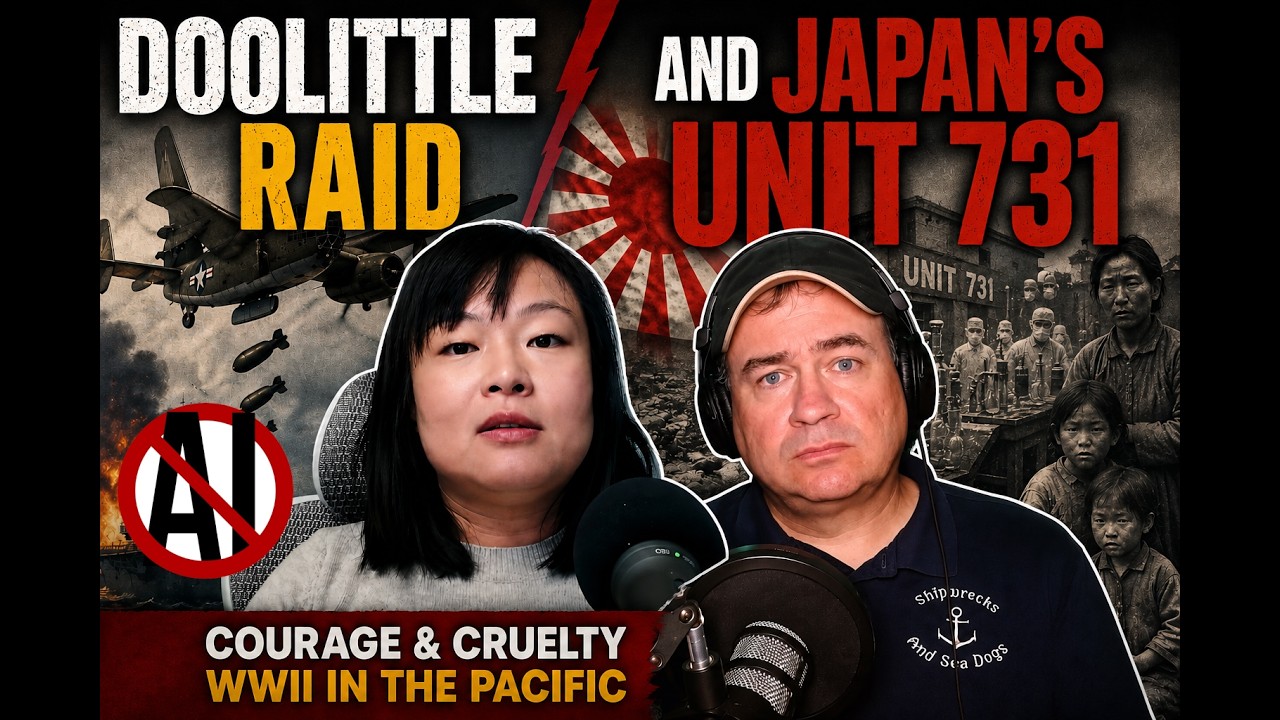
The Doolittle Raid sparked massive retaliation against the Chinese people, with Unit 731 responsible for many atrocities.

 Apple Podcasts
 Spotify
 iHeartRadio
 PocketCasts
 Goodpods
 Amazon Music
 Castbox
 Pandora
 Podchaser
 Youtube Music
 In April 1942, sixteen American B-25 bombers lifted off from the deck of USS Hornet and struck the Japanese home islands in a raid that stunned the Empire of Japan. But for the Chinese people of Zhejiang and Jiangxi provinces, the Doolittle Raid triggered a catastrophe. In this episode of Shipwrecks and Sea Dogs, host Rich Napolitano examines the brutal Japanese military campaign that followed during a campaign of deliberate terror against civilian populations who had aided the American airmen. What unfolded was one of the most horrifying chapters of World War II in the Pacific: a systematic campaign of slaughter, rape, and the deliberate weaponization of disease against an unarmed population.
At the center of that horror was Unit 731, the Imperial Japanese Army's covert biological and chemical warfare research program. Operating under the cover of a public health unit, Unit 731 conducted lethal human experimentation on prisoners of war and civilians, developing plague, cholera, and typhoid as battlefield weapons. These weapons were deployed against Chinese towns and villages during the reprisal campaign.
Guest Jenny Chan of Pacific Atrocities education examines the documented record of these atrocities, the scale of the death toll, and the deeply troubling postwar decision by American authorities to grant Unit 731 scientists immunity from prosecution in exchange for their research data.
For ad-free listening, access to exclusive bonus episodes, and free perks, please subscribe to the Officer's Club!
This episode was written, edited, and produced by Rich Napolitano. Original theme music is by Sean Sigfried.
**No AI was used during the production of this episode.**
Please leave a rating and review on Apple Podcasts, Spotify, Podchaser, or wherever you listen to podcasts.
Shipwrecks and Sea Dogs tee shirts, hats, and other items are available at shop.shipwrecksandseadogs.com.
Shipwrecks and Sea Dogs is a maritime history podcast about shipwrecks, tragic loss, and incredible accomplishments on the world's oceans and waterways.
Follow Shipwrecks and Sea Dogs
- Subscribe on YouTube
- Follow on BlueSky
- Follow on Threads
- Follow on Instagram
- Follow on Facebook
Learn more about your ad choices. Visit megaphone.fm/adchoices
Hello, and welcome to Shipwrecks and Sea Dogs, Tales of Mishaps, Misfortune and Misadventure. Today, I have Jenny Chan back for part two of a really great discussion we're having about Pacific Atrocities during the Second World War.
Jenny, thanks so much for being here again. It's great to talk to you.
Thank you so much for having me again.
There's so much to talk about, that's why you're back.
We had a bunch of things we talked about last time, the hell ships and the torturous conditions aboard those, and we're going to expand a little bit further out into some of the things that were going on during the Pacific War, specifically between
the Empire of Japan and China, and some of the atrocities, as your organization has called Pacific Atrocities, education, that occurred then. One thing that we didn't talk about last time is the Doolittle raid, and of course that's a pretty famous
event from World War II, and a lot of people know the story, but we'll talk about that, and then we can get into some of the details. But Jenny, tell us about the Doolittle raid. What was it?
Yeah, the Doolittle raid basically happened after Pearl Harbor, and it basically was FDR's way of showing the public that they can get back at Japan, and they were bombing Japan in the cities and whatnot.
And what people don't know, don't realize about the Doolittle raid is its connection to Unit 731, and that's what I want to focus on today, and also talk about even 10 years before Pearl Harbor and Japan's empire involvement with Unit 731, and also
Okay.
So yeah, I mean, I think a lot of people know the story of the Doolittle raid. They launched bombers off the aircraft carriers, and they had to shed all the weight, and it was really difficult to do, and they barely made it.
But the bombers were able to actually drop some bombs on mainland Japan. But what is the connection to...
2:02
Unit 731 Atrocities
Well, first of all, what is Unit 731? And then we can get into what the connection is to the Doolittle raid.
So Unit 731 was started with Ishishiro, and he was basically prominent scientist, rising star in Japan. And he was very involved in biological weapons and its development.
And also he was very interested in germ warfare because he read the Geneva Convention and thought, well, if they're writing laws about germs, then there must be something to it that would be useful for the Empire of Japan to expand.
And so he started doing research, and he realized that he had learned that due to unsanitary water from Russo-Japanese War, and a lot of Japanese soldiers had died that way, that it would be, Japan should be interested in also developing a water
filter system. And so they actually did that, well, he did that, and he developed this water filter, and he decided to pee in it and then drink it in front of the Emperor.
So he peed in it, filtered it, drank it in front of the Emperor, and the Emperor was very impressed with what he saw. So the Emperor gave him a bunch of money to start his lab.
And at first, he started it in Tokyo, but he realized that if he starts a lab in Japan itself, it might be just too out there and people will find out very shortly about he's doing biological weapons and also doing maybe human experimentation.
So he decided to actually farm it out, and actually not farm it out, but actually because Japan had invaded Manchuria in 1931, and by 1932, they basically took control of it.
And so he thought, well, if Japan has a huge part of Manchuria and it's such a remote location, maybe that'll be a great area where I can have my experimentation lab, like a biological experimentation lab.
So he took a road trip and took a look at how Manchuria was going to work out for this biological weapons lab and whatnot. And he thought, well, this is a great area to do it. So he started out a lab.
At first, he started it in a soy sauce factory. But then his prisoners got out. He thought, well, maybe a soy sauce factory is not big enough for my ambition.
So he started it. He started doing something else. He took over this Ping Fong village and basically evicted all of the villagers.
And then he built, because his first attempt in Manchuria was found out, so he actually had assigned his brother to become a prison guard for his second attempt in Ping Fong.
And he built all these buildings in Ping Fong to have his experimentation labs and also dormitories for his scientists. And I have to point out that this was not a rogue individual.
This was like, he was funded by the emperor, and he was a rising star. Other people looked up to him.
I was recently going through some trials from the Yokohama trial, and people were talking about, wow, this guy, even this POW camp doctor, I want to be just like Ishishiro, in terms of becoming a scientist. So it's not just a rogue individual.
He actually had state funding for what he wanted to do, and he got to do it. So some of the experimentations that he was running was putting prisoners outside, because Manchuria is so cold that their limbs would start to freeze.
So then the scientists would cut off their limbs to see how to treat frostbite, for example. There were other research, there were also other research, for example, yellow fever, vaccine. It's also very interesting to note this.
One of the right hand man of Ishishiro, his name was Naichi.
And in 1930, in the 1930s, he actually went to the Rockefeller Institute and tried to get a strand of yellow fever, because they kind of, I don't know if you've been to Japan, but a thousand yen, the paper currency is this scientist who actually was
in Rockefeller Institute researching yellow fever. And so that was kind of a national hero in that kind of scientific community. Let me Google the picture of a thousand yen. And so I can show you.
So it's like, it's like, so it's for them, maybe, you know, it was kind of like, okay, we're trying to get this strand of yellow fever back to our, this is from our national hero. And so then maybe we can take it back, right?
And get it from the yellow fever, I mean, from the Rockefeller Institute. So, I mean, and, but then that also made it to OSS.
So OSS at that time knew that, you know, Japan was doing some kind of biological research because they're now trying to steal the strand of yellow fever strand from Rockefeller Institute. That's the thousand-yen banknote. And this guy is Noguchi.
And he was actually, he actually worked at Rockefeller Institute and was researching on yellow fever. And he died in Africa. So this is a period of science advancement in terms of biological research, in terms of time period.
And they were also doing research on anthrax, like getting anthrax to be powderized. Anthrax was very popular, I think, after 9-11. Remember all these anthrax attacks?
But they...
Do you remember?
Yeah. And at Unit 731, they did do experimentation to see how they can powderize anthrax and whatnot. And also they were doing vivisection, which is having dissection without anesthesia.
So then they're to see how their victims would react to certain germs and whatnot. So yeah, there were all kinds of research being done in this biological lab.
And there was also this very horrific anti-testing ground where they were testing how to best drop biological bombs onto civilizations. And...
The plague bombs. I think we talked about that a little bit last time.
Yeah. And it's so disgusting.
It's crazy. Yeah. It's really terrible.
Right.
And then they were... And they had this technology to basically spray biological weapons onto civilizations. And that's what happened after the Deletl raid.
And that's... But we don't actually talk about that because, you know, it was...
I wouldn't say propaganda, but it was advertised as such a successful campaign of what had happened during the Deletl raid, that Little is talked about, about the after effect of the Deletl raid.
9:28
China Retaliation
Yeah.
And I know one of the terrible things that was part of the outcome of the Deletl raid was Japan's response against the people of China.
From what I've read, you know, the estimates are in the tens of thousands of people that they took prisoner and killed just outright as a response to the Deletl raid. What are your thoughts about that as far as the data and the extent of that?
Yeah. So, for example, after the Deletl raid, a lot of the Chinese people were actually helping some of the raiders because you can't really fly back to the United States without either, you know, flying through China or Russia for that matter.
People that the raiders who actually ended up in Russia was, they were actually in, I wouldn't call it camp, but like they were basically held prisoners by the Russians as well.
Because Russia wasn't really fighting Japan then, and that's another story. But the raiders who made it to China were actually, they were getting help by the Chinese.
But then the Japanese saw it as, this is kind of an act of war that these Chinese villagers would like help these people. And so ended up raiding these villages.
And it's not very well known that the estimates, I mean, Chiang Kai-shek, who was the wartime leader of China, was them writing to FDR and saying, hey, because of your two little raiders, now 250,000 people are dying at this village.
And then they, some of the people were also. So, there was also this city, Nanchang, that was basically, it was kind of an episode of Rape of Nanking. Like soldiers rounded up 800 women and then basically heard them into a storehouse.
And the women and children were not escaping from, and they were raped time after time by Japan's Imperial troops from this revenge attack.
And then, there were also this village in these villages in Zhijiang, that were basically like being revenge on, even though that they weren't really soldiers.
And Unit 731 did like a soil dissemination, I mean, dissemination on the soil of Glanders and Anthrax. So, then these people would end up getting like biological attack on basically their limbs and whatnot.
First, they spread the plague, and then people were dying from the plague.
And then after the plague, you know, whoever was remaining, if they're working on their soil and their farm, then they end up with basically these wounds on their arms that would not recover.
And it's pretty disgusting because farmers, we're not talking about like rich people in the war. We're talking about like farmers, we're talking about peasants who have no money. And they had no money to cure whatever they had.
And so they were just using, you know, Chinese traditional medicine and ointment to try to cure these wounds on their legs. Because when they're working on their farms, you know, they have, I mean, the soil would get onto their skin.
And I just want to share my screen so you can see that. It was a 19, 2010, actually, call from City Journal. And so this is not just me talking about it.
You know, there are other people who have talked about it. But it's not really well known. Even in 2010, these people were still living in like with these lesions on their legs.
And some of them actually end up with, if their germs got so bad into their legs that their legs actually get rotten. And their limbs fall off. And then they lose, you know, they lose basically their income, even decades after the war.
Like think about World War II ending in 1945. But some of the consequences was living until 2010s. And it wasn't until 2014 that they realized that they can skin graft and cure this.
But of course that meant that people were already spending decades in these villages in Zhejiang.
So it wasn't even just the immediate population at the time. Those effects of those biological agents have affected the people there for now, you know, 80 years.
Right. It's not like if you disseminate biological weapons on someone's soil, it's not like you can just pour bleach and Clorox on it. There are real effects of Unit 731.
I've heard that they were also bearing chemicals and biological weapons on the ground during the war, that when construction workers were then trying to develop certain parts of China in the 19th century, there were reports of these construction
workers getting biological weapons onto their skin, and then there were effects, like people's limbs were rotten out. And for some of these people that were affected by biological weapons, they weren't, it wasn't until 2014 that they figure out skin
grafting, right? But what about these families that already had developed all these lesions on their bodies? And then they were trying to sue Japan, but ultimately in the 2010s, they figured out that, well, we did do it.
We did do this biological weapon attack, but then we can't pay reparation because we don't know how to pay it. There are way too many people.
And, yeah, and it's wild to me that people's skin, people couldn't even wear socks because their legs were rotten so badly.
15:34
Maruta Test Subjects
Unit 731 seems to be just kind of involved in a lot of these things, even talking about the Doolittle raid and what happened afterwards.
Going back to the experiments that you were talking about, and at their labs in Manchuria, where did primarily all of these people come from, all of their test subjects, prisoners, basically?
That's a great question. Some of them were homeless. So then they figured out that if they're homeless, then no one's looking for them, then they're a perfect test subject because they're just out on the streets.
Or some of them were guerrilla fighters, for example. So they're in Northeast China, since in Manchuria especially, since their homes were already... There were people who were actually trying to fight back.
And then they were just, well, let's round them up, and then we'll have a special delivery to Unit 731 and do human experimentation on them.
And then there were also those who, because of the location is so close to Russia, that they are just people who were trying to escape the Russian Revolution, and then they were just so happened to be in China after the Revolution, and then they were
captured by Unit 731. There were also reports of like W's that were actually rounded up by, because there was a close by camp in Hockton, and they Shenyang that they can, is close enough for them to actually administer some of the tests biologically
to these people. And it all sounds very scientific sci-fi, but it like, it happened.
And like they were, the scientists were able to like do these kind of research because they saw other people as lesser than, and then they started naming them as Marutas. Which meant logs.
We came across that on your site, Marutas, it's so degrading.
Yeah, and so then these are like Marutas, these are logs. And so then, and even during the construction of Unit 731, when they were like asking, when other villagers were like, oh, what is, what are you guys building?
And the scientists will answer, oh, we're building a lumber mill. And that's where the logs. And then so then they had, and also this is like big facility.
So they even had like tracks going straight into Unit 731. And the Quantum Army, who was actually the Administrator Office of Manchuria, were in charge of special delivery, these special deliveries of marutas for Unit 731.
So this is not just some broke individual laboratory. This is like funded, and they were trying to do scientific experiments and have scientific advancement.
Yeah, I think I read, or I saw a pie chart on your website that there were a fraction of Koreans and a fraction of Filipinos that wound up in Unit 731. And then a vast majority of them were Chinese. But also, a significant portion were Russian.
So that was pretty interesting to see. I guess that explains why when you were talking about that village, that had a lot of Russian people that had come into... Yeah, they came into the Manchuria region from Russia.
Terrible. And again, this is...
And historically, I want to add this too. Historically, Russians in China, the Russia and China had a lot of land disputes. Like Vladislav used to be Chinese territory, and then they took it over.
I think Russia always has land disputes with its neighbors. This is just nature of Russia.
Yeah. And it's surprising since it's already such a big country, but they seem to always want more, you know.
So that's, again, we talked about last time, the human nature that's happened for a long time, you know, thousands of years, there's always been kingdoms, empires looking to expand. Unfortunately, we're still doing it now.
Yeah. And after the war, Soviet Union wanted to have, they had a trial for Unit 731, but it was like by mainstream media that it was just Cold War, it was just Communist kangaroo trial.
So no one believed in it, but it was a real trial, like, but of course, no one was really held to justice because by 1956, everyone was basically repatriated back to Japan.
20:24
Comfort Women Camps
I want to talk about another uncomfortable subject.
All of this is uncomfortable really, but and that's the topic of comfort women that were utilized by the Empire of Japan during the war. Can you explain a little bit about what that was and how extensive it was?
Yeah, I certainly, and actually in 2014, I went to Shanxi, which is a place in China where they did do all of these comfort stations where they had comfort stations and whatnot.
Just two weeks ago, I went to Dallas, SMU, Southern Methodist University. They were doing a memorial for one of the comfort women, Liu Xun, because Liu Xun was actually a comfort woman.
Comfort women was basically a term about Japanese, basically was used by the Japanese as sex slaves. And they were basically captured.
And because during World War II, a lot of the Japanese soldiers were actually getting STDs, per se, from raping women.
And so then in order for them to control that, they were having these kind of comfort camps, comfort stations, which then they had a physician in the comfort station.
And then they also had, basically it's a controlled environment, where I will still call it rape, because I don't think a lot of these comfort women were consenting to these kind of situations.
I'm sure they weren't.
Yeah. But then they were still captured into these comfort stations, so then it can be a more controlled environment for a lot of the Japanese soldiers.
And for example, Liu Xiong, who was actually visiting SMU, she visited in 2016, and her only plea was, please remember us. And she was captured in 1940s when she was younger, and she was promised a high-paying job, which she didn't get, of course.
And even though that they were supposedly paid in these comfort stations, they were paid in these military scripts that weren't worth anything after the war.
And after the war, because she was so ashamed of herself that she never really went back to Korea, she was stranded in China for decades, and she married someone else.
And because of these shots, because the physicians were, okay, we don't want these women to be spreading STD, so then they were giving her these civilized shots, and these civilized shots were then causing her infertility.
So eventually, and this is just one woman out of so many women who were involved in this sex slave trade, I will call it, the comfort women camps.
And so then she had decades of infertility, and then she was stranded in China for decades because she didn't want to go back to Korea. And so her Korean family had thought that she died, but she didn't actually die.
She was in China with this man that she found, and then they got married, and then eventually she was raising his kids because she can no longer have kids.
And it wasn't until the 2000s that she moved back to Korea and lived in the sharing house, which is like an area where other women were also living in, other comfort women because they were actually speaking up in peace.
And because her family had already thought that she died, she had a death certificate that they had to reverse because they were, wait a minute, she actually didn't die, she just stayed in China.
Then they reversed her death certificate and then she died actually last year. And I'm glad that SMU campus was able to actually have a memorial for her, to have a bench as a memorial for her experience. And it's not just her.
But we'll just talk about the Rape of Nanking, which is not even as well known as Rape of Nanking. Hundreds of women and children were being raped. And later they were survived.
I mean, they had STDs. And then people had to live with that. And that's not even a comfort camp experience.
And these comfort stations too, it's estimated that 200,000 women were basically captured in Asia for these comfort camps.
But like, who knows the actual reality of the numbers because of the two weeks' time that they actually could use to destroy these evidence after post-war.
And also when I was visiting Shanxi in China in like 2014, like a lot of these women, like, you know, they moved on after the war.
Like after the war, they don't talk about what had happened to them during the war because they think that it was bringing them shame. Their family members would tell them to stop talking to other people about what happened to them.
One of the women that I interviewed in like 2014 was telling me that after the war, you know, in 1945, she was actually pregnant because in the Shanxi camps, it wasn't in other very well-administered camps, it was more rural.
And so then they didn't even have a physician in these camps. And so they weren't administering these STD shots. So then this woman ended up with, not STD, ended up conceiving at the camp.
And she had a kid, a baby. But then her mom was like, okay, this is not good to have a baby with a Japanese and out of wedlock. So the mom told her to go to the mountain with her and then just bury the child and then call it a day.
And so it's kind of because they kind of saw it as a baby is going to steal the future, right? Her future. And it wasn't until the 1990s that these, that she started talking because she saw other comfort women in Korea talking about their experience.
And then, yeah, it's just a lot of it were hidden for decades, I think, because of, well, first, you know, taboo topic. And also, it's a very, it's hard to talk about and also political reason.
Yeah.
I think in the 1990s, it's more acceptable for people to talk about it because Soviet Union collapsed then.
Yeah, I can imagine it would be difficult to talk about and admit that that was your past, you know, even though it wasn't their fault, clearly was not their fault.
It's something that you don't, you don't really want everybody to know, so it wasn't easy to bring up. But we, we do actually have a good number of first-hand accounts from these women that we have testimony for.
Yeah, in comparison to like 731, there's a whole lot more accounts of these women because they started talking in 1990s until a lot of them passed away very recently.
But it's like, so I used to be so naïve to thinking that like people actually care, people in power actually care about issues like comfort women until I, I was reading about Epstein files. People actually don't care.
People, I mean, if you, if you think about Epstein and comfort women, it's kind of the same ideas, right? These kids, comfort women were in 9, starting as young as 9-year-old to, you know, 18 and like 21 or whatever.
And, and they were basically brutalized. And it's kind of the same as what happened to the Epstein girls. If you think about it, I thought about a lot, I think as a way of exerting power onto others.
Certainly.
And I wonder, too, if that effort ever had any, that was specifically with the Comfort Women. If there was any attempt at, you know, some kind of racial integration or trying to, trying to insert Japanese blood into the Chinese people.
Actually, they didn't want the Chinese people to have Japanese blood. One of the economic economists at the time in the 1930s said that Japan is pure blood and the Chinese are toilet water.
So then when you have even a drop of toilet water into the pure water, it's going to taint the pure water. And you can see that at Unit 731.
Unit 731 had two incinerators, one for the scientists and another for the victims, because the victims would have, even after death, they didn't believe in co-mingling with the two. And with comfort stations too.
Like, if you see the different entities and the different prices of women, because there were also Japanese comfort women who were from rural family who were also really poor.
And the Japanese comfort women were tiered higher, so then there would be only for, only the officers could afford it.
But then, Korean women, because they're still Japanese subjects, they were the mid-tier, and then the local girls that they would kidnap locally around the comfort camps, they would be the lowest tiers.
And I want to say that it's not some kind of rogue thing. It was a state-sanctioned program, because it was also included in amenities of the military from that time period.
So it's not just two, three rogue individuals who got together to organize it. It was a state-sanctioned program.
Yeah. There's such a direct correlation to that, from that to what's happening now, like you said, not only with the Epstein situation, but just worldwide, the sex trafficking that happens. It's so disgusting.
It's just so upsetting. And you feel helpless. What do we do?
Yeah.
Like, what can we do? Like, I honestly, I want to believe in democracy, but then if the world is run by these people, even historically speaking, and even now, then what can we really do?
We can talk about it and make sure everybody's educated about it. That's about all we can do, I suppose.
30:59
Chichijima Cannibalism
Moving on to another topic equally as upsetting, is the allegations and evidence of cannibalism practiced by some of the members of the Imperial Japanese Army.
Specifically, there was an incident I was reading about at Chichijima, that involved former President George HW. Bush. I found it to be pretty interesting.
You want to tell us about that?
Yeah, of course. I think that's also very interesting too, because George HW. Bush was so successful afterward.
He was a very successful business man, then he became Vice President. Well, he was CIA Director, then he became Vice President, and then he became President. And so, all he wanted to do was to be a pilot.
And he was a pilot, and then he was at Chichijima when the Chichijima incident was happening. But then somehow, he got out. There was a submarine that was getting for him, that was going there for him.
How come they rescued him? What about all these other people who were, who were not rescued, who didn't have a submarine coming for them to escape? What could they have done, right?
Maybe they could have also become Vice President or President.
I mean, all these atrocities that happened, it also boils down to these people, these soldiers, who were basically called Isengodan, who were one yen, five yen, the kind of value, because they realized that drafting these soldiers, these soldiers are
worth less than the postcards that they send them to. And even to when they were training for the Japanese military, it was nasty, it was brutal. And then they had this basically this cult of death.
They kind of tainted the samurai, a Bushido warrior spirit, and kind of made it their own bastardization of Bushido, which turned into, okay, and I'm pretty sure you've heard about it, like if they are about to be rounded up, then they kill
themselves. So then when their enemies are surrendering, and then they're like, what the hell is wrong with you? Right?
And also, like, I want to point this thing out that, like, on Chichijima, they did have access to food, but then they had this, like, bastardized, like, standard of Bushido that they believe that if they eat a certain part of their enemies, then they
become stronger. So then they were having, like, a formal banquet of, like, some of these, like, pilots. Like, they later learned about that in the Secret War Times trial, and, but that was declassified in the 90s.
And a lot of these soldiers, for example, Matova, who was basically in command of Chichijima as well, he was also in Singapore. He was also in China.
He said that China and Singapore made him tougher and made him, basically, trained him in how to have be brutal.
For example, in Sook Ching Massacre in Singapore, Matova was there and Sook Ching Massacre in Singapore was basically to wipe out all of the Chinese people in Singapore during this time period.
Like the late Prime Minister Lee Yu Kwan actually famously escaped that just because he looked around the camp and this is not looking good. Maybe they're trying to machine gun all of us. But Matova was also there and he was later in Chichijima.
And he said that he observed the decapitation of Chinese civilians and their heads were basically displayed on spikes to purify the city of Singapore.
Witnessing that, I feel like had tremendous effect on someone that is going to later be in on Chichijima because it's such a smaller island.
And so then Matova also had this power logic because then he was thinking that by beheading an enemy and consuming them, that would be the ultimate spirit exercise.
I kind of feel even bad for these people who are exercising this kind of cannibalism out of these kind of cold mentality because you can only think about what had happened to them in the few years of war that they were experiencing, right?
And to us, it's only maybe four or five years of war. But to these Japanese soldiers, they have been fighting at this war since 10 years before Pearl Harbor. So they have learned whatever they could learn in China, and then it gets super nasty.
Later down the line, the closer they get to the more, the longer that they have fought this war. And so the victims, I want to list out the victims of Chichi Chimam. They were Jimmy Dai, who was a pilot.
They were Fraser, Yerrick, and Flora Hall, and also like Earl Vogue. Their families didn't even know what happened to them.
Right after the war, they were, okay, maybe my son didn't die, and then they will keep looking at newspaper to see what happened to their kid. And it wasn't until the 90s that these trial come out in public.
But even then, it took, it takes people to research and to actually see from these trial, from these paper, from the trial, what happened.
I was reading about how George HW. Bush was, like you said, he was a pilot, he got shot down, and there were eight other pilots with him that were held prisoner, and they were getting taken away, you know, a few at a time.
And as you mentioned, he did narrowly escape from there, but he never knew what was happening to those other men that were getting taken away.
And like you said, they were being almost ritually sacrificed and eaten in some kind of, you know, deranged ceremony or feast or so for the officers. But he didn't even know that that was happening at the time.
Right. He didn't even know.
And nobody else did either.
Yeah. Even years after the war, he was, oh, I had no idea what happened to these people. And he was also director of CIA.
And so how did he not know?
Maybe he knew by then. I don't know.
And then he, and reading one of these accounts, you know, the guy who was later, I forgot his name, but he was later put to be cannibalized and whatnot. And he, how should I even describe this?
It was a, he was becoming friends with his Japanese translator. And his Japanese translator didn't want to know that, didn't want to let him know that he was going to get in. And then we're talking about what we would do after the war is ending.
Maybe I can go and visit you. Maybe you can come and visit me in New York or whatever. And it's just that level of humanity.
But then someone up there is like, okay, no, we're out. I always think about this, especially when I'm watching a war movie, okay? Especially in World War I, they had a truce for a minute to play some kind of sports with each other.
And it almost feels like if there was no war going on, they can just all be at a summer camp and hang out and not be at this kind of nasty situation.
But because someone up there, high up there, say, I don't know, we're at war, this is what you need to do, blah, blah, blah. Then it becomes this kind of environment where it's all humanity is out the window.
38:29
Why History Matters
I want to bring up something that I experienced after I published our last conversation.
And maybe it's something that you experience as well through your work.
And it wasn't widespread, but I did get a few comments here and there about, the Americans had POW camps too, and the Americans did that kind of stuff too, or the other allied countries had all these terrible things too, and look at what the Soviet
Union did to people. Yes, of course, atrocities have occurred everywhere around the globe throughout time.
And I just wanted to maybe clarify the purpose of doing these episodes is not to sit here and hold some terrible grudge against Japan or 80 years later blame them for all the troubles of the world. It's not that.
Yeah, no, no, it's not that.
It's educating and keeping the memory alive of these things that did happen so they don't happen again anywhere.
Right. And I want to talk about this, right? Like also trials and how these families found out about these things that happened to their family members.
It takes decades for these things to open up and talk about and for people to actually know. And even then, even when they're public, it's not like people know right away, you still have to do research.
And that is the point of talking about these things is because for decades no one knew.
And so we're just trying to let people know this is what happened during the war and also like I said, these people could have easily become friends, like George HW. Bush.
He actually went to Chichijima and he met one of the officers who was supposedly they were at war. The war has been over, so it's OK. And George had business relationship with Japan after the war.
And so we're just bringing this up so then we can let people know what had happened because World War II is such a big topic that you can look hours and after hours and after hours, sometimes years after years, and you still don't know what had
And again, I think it's just one of those things where the conversations about history always include some people that think, oh, you know, who cares what happened in the past?
Well, it matters. It matters because those are patterns of human behavior, whether we like it or not. Things that happened in history, sure, you know, it depends on the perspective and who's writing it.
That's why trained historians sift through this data and make interpolations of what actually happened and write analyses of what happened based on the evidence, based on testimony, both written and oral.
So it does matter. Yeah, and also, I think that history is not only just written by victors, also written by better off people, right, than these comfort women that we talk about.
These comfort women, they had nothing after the war, and so then their history books are not going to care about these poor people who had nothing after the war.
So I think that's why we need to talk about these people's experience and to, you know, make the, you know, to make it more, to expand our scope of what had happened to like not just, you know, these heroes, but also everyday people.
Yeah, and as an American that was educated in American schools, I never once read a history book that included anything about Japanese prison of war camps in the United States.
Right.
I know about them now, but I don't, I didn't learn about them as a school kid. It wasn't in the history books. They are now, to some degree, but not enough.
Yeah.
Yeah, and I'm not saying the same atrocities occurred here in those camps.
It can be debated whether they should have existed or not, but that's not, we're not going to do that here on this show.
Also, by learning history, we learn more about like policies and how it has effects on people. So for example, everyone could have come to the United States anywhere except for 1882 when Chinese Exclusionary Act was then implemented.
And then by 1943, they were so embarrassed that there were so many Chinese faces fighting in the war on the side of Americans that they took out Chinese Exclusionary Act.
But if we don't learn history, how are we supposed to learn about like excluding a whole group of people in the immigration history?
I was just reading a book about six Chinese survivors of the Titanic and what they went through and how they were victimized and demonized. Basically erased. Yeah.
I have read tons obviously about Titanic. I didn't know about them.
I actually just read that same book.
Did you? It's really good. It's called The Six.
Yeah. There were eight Chinese men on board and six of them survived. Yeah.
Really, really good book.
I really didn't even know about Chinese people on the Titanic until I just read that book. I was like, wow, I had no idea that this even happened.
Yeah. They weren't workers. They weren't sailors or people that shoved coal into the firemen.
They were sailors that were going to New York to get on another ship to work, but they were passengers on the Titanic. Really interesting. Really, that's a great book.
I don't want to give any spoilers, but I recommend it.
Yeah, it was eye-opening first. I didn't even know this even happened. And I was talking to a lot of people about how history doesn't even have Iraqi Jews, for example.
Jews were in Iraq and people don't talk about it. And I think it's also because a lot of the Holocaust education focused a lot on Europe.
And so I think that we need to be, I think we need to, because of the globalization of the world, we need to actually expand our horizon to know about people's experience throughout history.
I couldn't agree more. Well, Jenny, I have a feeling that we're going to talk again, but that's going to do it for today.
Thank you so much for having me.
It's my pleasure. You always have so many very detailed, educated things to talk about that.
When are you going to do an episode on Titanic?
I'll tell you, I'm looking for the right angle on that one. I don't think I want to do one where I'm just retelling the story. I want to find some angle about it.
Maybe it's this, actually, maybe now, it's this about the Chinese survivors of the Titanic. I think I'll do that actually. Yeah.
Yeah.
Well, thanks again, Jenny.
It's always a pleasure and I look forward to talking to you again someday.
Yeah. All right. Until next time.
Thank you for having me.
Until next time. Shipwrecks and Sea Dogs is written, edited and produced by me, Rich Napolitano. Original theme music is by Sean Siegfried.
You can find transcripts, show notes, and show merchandise at shipwrecksandseedogs.com. If you enjoy Shipwrecks and Sea Dogs, you can do me a huge favor by leaving a five-star review on Apple Podcasts, Spotify, or wherever you listen to podcasts.
Please join me again next time. But until then, don't forget to wear your life jackets.


